
TL;DR:
- The real decision is identifying where AI delivers the highest ROI in your manufacturing proposal process, not whether AI is useful in general
- Most teams start wrong by asking what AI can do rather than pinpointing where their specific process has the highest-cost bottleneck
- Evaluate these before anything else: current bid process documentation, engineering hours per bid type, annual win rate by category
- Avoid any AI vendor who claims they can start building before conducting a structured data audit of your historical bid archive
- A strong engagement starts with a structured opportunity assessment before Phase 1 scope is agreed: it audits engineering hours per bid type, annual volume, compliance error history, and data availability, then produces a prioritized deployment roadmap
If you are a VP of Sales or Sales Operations leader at a manufacturing company actively evaluating where AI can deliver the highest ROI in your proposal process, you have likely already moved past the “should we use AI” question and into the harder one: where exactly should RFP automation start to produce measurable results? The most common mistake in an AI opportunity assessment for manufacturing sales is framing the evaluation around what AI can do in the abstract, rather than identifying where in your specific process the highest-cost bottleneck sits. This article provides the criteria that separate a productive AI evaluation from an expensive distraction, the red flags that signal a vendor is not ready to deliver, and a framework for building a deployment roadmap that starts with the right bid category and expands from there.
What most teams get wrong when evaluating where AI delivers the highest ROI in a manufacturing company’s proposal process
The most common error manufacturing proposal teams make is starting their AI evaluation with capability demos. A vendor shows how their system can auto-populate a template or generate a compliance matrix, and the team gets excited about the technology without first mapping where the actual cost sits in their process. This leads to pilot projects that target the wrong bid category: maybe the one the VP is most familiar with, or the one a vendor’s demo was built around. The result is a proof of concept that technically works but fails to move any metric the business cares about, because it was never aimed at the bottleneck that costs the most engineering hours or produces the most compliance errors.
The correct starting question is not “what can AI do for our proposals?” but “which bid category consumes the most resources relative to its win rate, and does it have enough historical data to train on?” This distinction matters because off-the-shelf RFP software handles proposal libraries, collaboration workflows, and template generation well enough for many teams. Custom AI, trained on a company’s own bid history, product specifications, and compliance records, solves a different problem entirely. Knowing where to start with AI-driven RFP automation in manufacturing means understanding which category has the richest data and the clearest cost baseline, not which one sounds most impressive in a board presentation.
The five criteria that locate your highest-ROI starting point
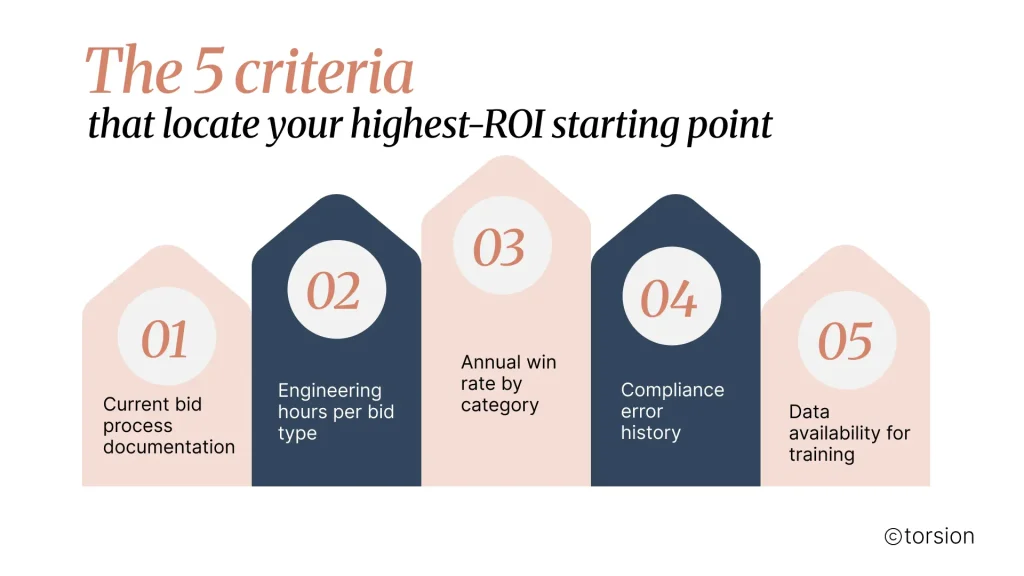
Current bid process documentation
Understanding the current process at a step level is a prerequisite for any AI evaluation. AI can only be assessed against a specific workflow, not a general aspiration to “be more efficient.” A good evaluation method here: ask a vendor to walk through how they would map your existing bid process before proposing a solution. If they skip this step or treat it as a formality, they are building on assumptions. A strong answer sounds like “we need to document every handoff between engineering, compliance, and sales before we scope anything.” A vague answer sounds like “our platform adapts to any workflow.”
Engineering hours per bid type
Bid types with the highest engineering hours per response represent the highest-cost bottleneck and the highest potential ROI for AI-driven document processing. A manufacturer responding to 200 transformer equipment RFPs per year at 12 engineering hours each has a very different cost profile than one responding to 50 custom fabrication RFPs at 3 hours each. The evaluation question: “Can you show me how you would calculate cost-per-bid for each of our bid categories before recommending a starting point?” Any vendor who proposes a starting category without this analysis is guessing.
Annual win rate by category
Deploying AI on bid categories with a documented win rate problem is more measurable than deploying on categories that are already performing well. If a company wins 45% of standard equipment bids but only 18% of engineered-to-order bids, the second category offers a clearer measurement baseline. The test: ask the vendor how they would use your win rate data to prioritize deployment. A good answer connects win rate to specific proposal quality issues like compliance gaps or inconsistent technical specifications, areas where AI-driven compliance checking can reduce error rates in measurable ways.
Compliance error history
Categories with documented compliance errors or post-award disputes represent a risk-reduction ROI that strengthens the business case beyond time savings alone. If a manufacturer has had two post-award disputes in the past 18 months tied to specification errors in proposals, that is a quantifiable cost that AI can directly address. The question to ask: “How do you factor compliance error history into your ROI model?” A vendor who does not ask about this data point is leaving the strongest part of the business case on the table.
Data availability for training
AI needs historical bid documents to train on. Bid categories with two or more years of archived historical bids in consistent formats are ready for immediate deployment. Categories where documents are scattered across email threads, personal drives, and outdated SharePoint sites require a data preparation phase that adds cost and time. The evaluation method is straightforward: before any vendor conversation, inventory your archived bids by category, format consistency, and volume. AI opportunity assessments that skip this data readiness step consistently underdeliver because the training foundation was never validated.
Three red flags during an opportunity assessment
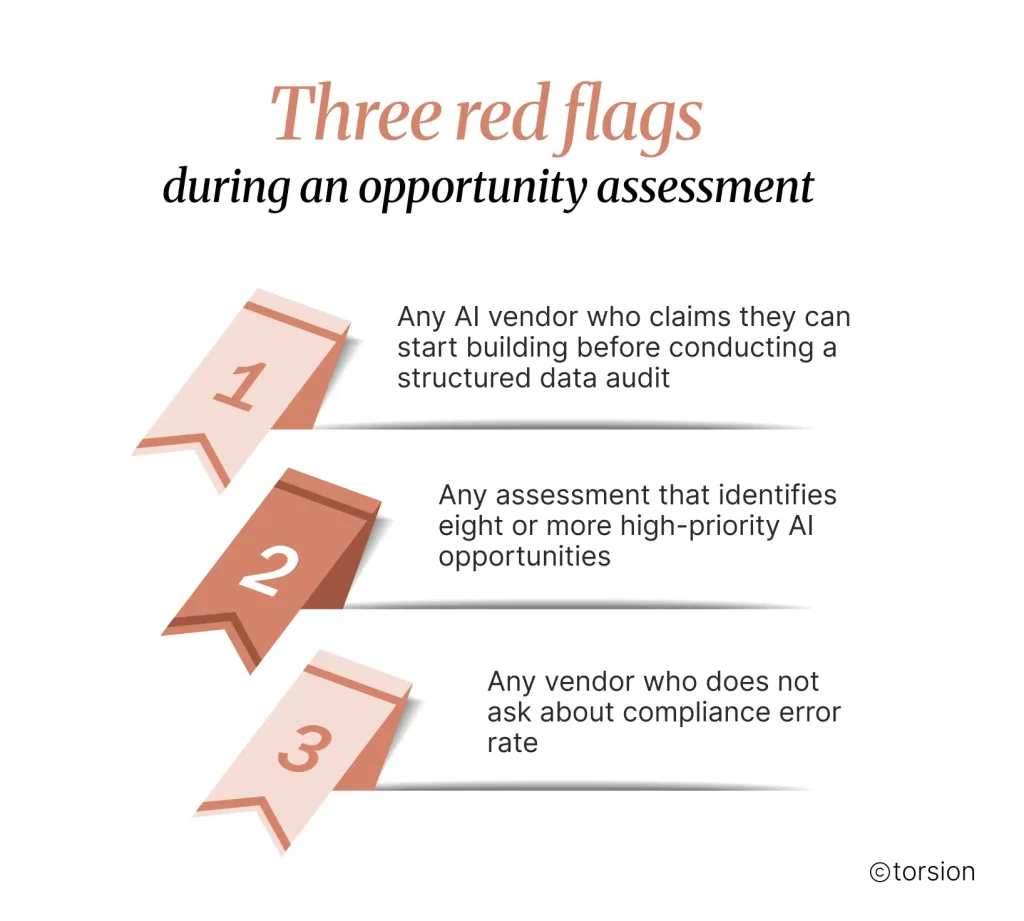
Any AI vendor who claims they can start building before conducting a structured data audit of the client’s historical bid archive is either overconfident or selling a generic product dressed up as custom AI. For manufacturing proposal teams, this matters because the quality and consistency of historical bid documents directly determines whether a trained model will produce accurate outputs or hallucinate specifications. The test: in your first conversation, ask the vendor what their data audit process looks like and how long it takes. If the answer is “we can start building in week one,” that vendor has not built enough custom AI systems to know what they do not know yet.
Any assessment that identifies eight or more high-priority AI opportunities in Phase 1 is a warning sign. A realistic Phase 1 targets one bid category with depth: enough training data, a clear cost baseline, and a measurable success metric. Manufacturing companies that try to automate across multiple bid categories simultaneously end up with shallow implementations that do not perform well in any category. Ask the vendor: “How many bid categories do you recommend we target in Phase 1, and why?” If the answer is more than two, push back hard on how they plan to achieve depth with that scope.
Any vendor who does not ask about compliance error rate or post-award dispute history is missing the highest-value data points in the assessment. For manufacturing companies responding to RFPs that involve ISO, ASTM, or client-specific compliance standards, the compliance accuracy of proposals is often the single largest risk factor in the bid process. The test is simple: track whether the vendor asks about compliance errors in the first or second meeting. If they focus only on speed and volume without addressing accuracy and risk, their solution is likely optimized for the wrong outcome.
Where AI fits in manufacturing proposal operations: an opportunity map
Not every part of the proposal process benefits from custom AI. Standard collaboration tools and proposal management platforms are the right choice for teams with straightforward coordination needs and relatively simple bid structures. The AI opportunity assessment for manufacturing sales and RFP automation becomes relevant when the scope includes the full technical bid process: engineering specifications, compliance documentation, pricing models, and quality assurance reviews. Teams at this level of complexity need to understand where AI can and cannot deliver measurable results before committing budget. The table below compares six dimensions that matter most for VP Sales and Sales Operations leaders at manufacturing companies beginning their AI evaluation.
| Dimension | Where AI typically cannot help yet | Where AI delivers measurable ROI in manufacturing proposals |
| Opportunity area | Novel bid categories with no historical training data | High-volume categories with 2+ years of archived documents |
| Document type | Highly variable formats with no consistent structure | Standardized or semi-standardized technical specification packages |
| Compliance complexity | First-time or novel client compliance requirements | Known standards sets (ISO, ASTM, client-specific) with historical precedent |
| Team impact | Bids where strategy and client relationship are the primary win factors | Bids where document volume and compliance accuracy are the primary constraints |
| ROI visibility | Low: baseline hard to establish for new bid types | High: engineering hours, compliance error rate, and bid volume are measurable |
| Training data readiness | No archived historical bids in the category | Minimum 20-30 completed bids of the same type available for training |
This map is not theoretical. RFP automation for manufacturers works best when the starting category sits firmly in the right column across most of these dimensions. If your highest-priority category falls into the left column on three or more dimensions, it is worth targeting a different category first and expanding later.
What a structured opportunity assessment looks like in practice
A well-structured engagement starts with a structured opportunity assessment conducted before Phase 1 scope is agreed. This assessment audits engineering hours per bid type, annual bid volume, compliance error history, and data availability across all relevant categories. The output is not a generic recommendations deck but a prioritized deployment roadmap that identifies the single highest-ROI starting point and maps an expansion sequence for subsequent phases. This approach ensures that the first deployment delivers measurable results, which builds internal credibility for subsequent phases and protects the budget holder from the political risk of a failed pilot.
A $500M industrial equipment manufacturer working with Torsion provides a concrete example. The assessment identified transformer equipment RFPs as the highest-priority starting point because that category had the highest document volume, the most consistent format, the largest engineering hour spend per bid, and the richest training data archive. The proposal team now uses a custom AI system that drafts technical specification sections and pre-populates compliance matrices, reducing engineering hours per bid by approximately 40%. The system flags specification inconsistencies before human review rather than after submission. The client owns all code, models, and training data: there is no ongoing vendor dependency, and the system runs on their infrastructure. This ownership model matters because it means the manufacturer can extend the system to additional bid categories without renegotiating licensing terms.
Your AI deployment roadmap: starting point and expansion sequence
The single most important decision in an AI deployment for manufacturing proposals is not which vendor to choose or which technology to use. It is which bid category to start with, because that choice determines whether the first deployment produces measurable ROI or becomes an expensive experiment that erodes internal confidence in AI. The criteria outlined above: process documentation, engineering hours, win rate, compliance error history, and data readiness: are the inputs that make this decision defensible rather than political.
The fastest way to locate your highest-impact opportunity is a structured 30-minute assessment. at Torsion to identify your highest-ROI starting point. The team maps your highest-impact RFP automation opportunity and tells you whether a custom system makes financial sense for your process.Book a structured AI opportunity assessment