
Key Takeaways
- The Billion-Dollar Paradox: A costly paradox is crippling enterprise AI. While 83% of executives label it a top priority, a staggering 70–85% of their projects fail to deliver value, with 42% showing zero ROI.
- The Cause of Failure Is Not Technology: The root cause of this widespread failure is not flawed algorithms but the absence of a coherent business strategy. Companies are engaging in “Random Acts of AI”: disconnected, bottom-up experiments that are destined to fail at scale.
- The Strategic Blueprint for Success: A successful AI strategy provides a framework built on four essential pillars: 1) Strategic Alignment that links AI to measurable business value, 2) Data & Technology Foundation to ensure readiness, 3) Organizational Readiness to manage people and skills, and 4) Governance & Risk for ethical, compliant deployment.
- The Path from Pilot to Profit: A phased implementation roadmap moving from Foundation to Pilot, Scale, and Transform is the proven path to de-risk AI investments. It turns AI from a series of expensive, failed experiments into a predictable engine for business impact and a durable competitive advantage.
Something is deeply wrong in the world of enterprise AI.
Right now, your competitors and perhaps you are pouring billions into what is hailed as the most powerful business tool ever created. A full 83% of enterprise leaders have staked their future on it. Yet, behind the closed doors of boardrooms and data labs, a frustrating reality is unfolding. The vast majority of these expensive ventures are quietly collapsing.
Consider the numbers: A staggering 70% to 85% of all corporate AI projects fail to meet their objectives. A stunning 42% of companies that have deployed AI admit to seeing zero return on their investment. Even more troubling, an estimated 88% of AI initiatives die in “pilot purgatory,” never making the leap from a promising experiment to a production-scale business solution.
This is the billion-dollar black hole at the center of the modern enterprise. But why is it there?
It’s a maddening question because, on the surface, everything seems right. You’ve hired the PhDs, bought the best-in-class platforms, and cleaned the data.
The technology itself works. Yet the transformational value remains stubbornly out of reach, and the dashboards are still red. It feels like trying to solve a puzzle with a missing piece you didn’t even know you were supposed to have.
The handful of organizations breaking this cycle and achieving exponential returns found a better puzzle piece. They understood that all the pieces connect according to a hidden architecture: an invisible but essential blueprint that most companies don’t even know exists. They are operating AI with a different system of logic.
What is this hidden architecture? What is the missing piece of the puzzle that separates the 85% who fail from the few who don’t? That is what we will now uncover.
What is an AI Strategy? (It’s Not What You Think)
The hidden architecture, the missing piece of the puzzle that separates success from failure, is deceptively simple. It’s not a revolutionary algorithm or a secret data source.
It’s a strategy.
But that word ‘strategy’ has been so overused it’s lost its meaning. When we talk about an AI strategy, we are not talking about a 50-page document that gathers dust. We are not talking about a vague mission statement to “leverage AI.” And we are definitely not talking about a shopping list of the latest generative AI tools.
Instead of falling into these traps, a structured AI Strategy Framework ensures your initiatives are aligned with business goals and built for measurable impact.
An AI strategy is a business blueprint for value creation. It’s a deliberate, top-down plan that answers a sequence of critical questions before a single line of code is written:
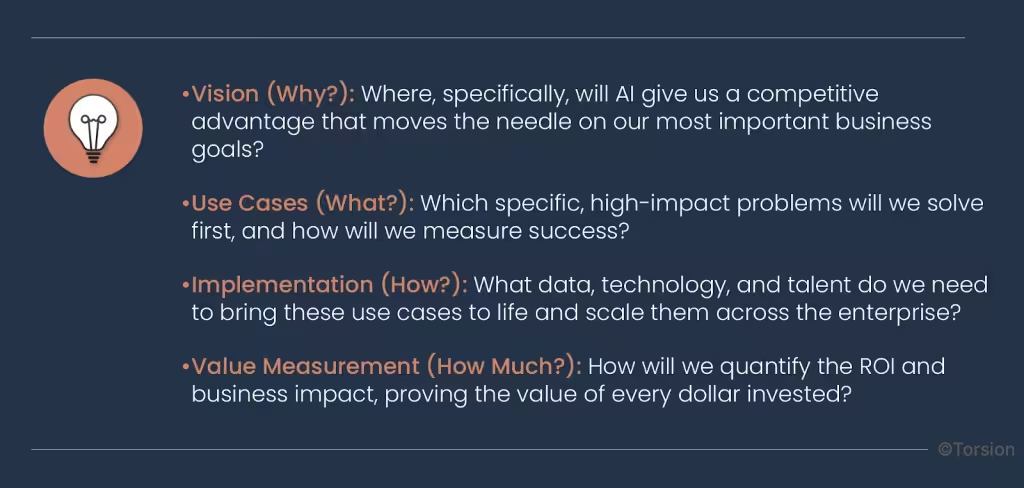
The 85% of companies that fail are skipping these questions. They are practicing what we call “Random Acts of AI.” A department head gets excited about a new tool. A data scientist builds a cool model in a silo. The company launches a dozen disconnected pilots, hoping one will magically transform the business.
This tactical, bottom-up approach is precisely why 88% of those pilots never see the light of day. They were solutions in search of a problem, disconnected from the core value drivers of the business.
Without a strategic blueprint, they are like building a beautiful, ornate window without knowing where the walls of the house will be. It’s a perfect component that is functionally useless.
An AI strategy flips the script. It starts with the house, the business outcome, and designs the AI components to fit that structure. And ensures every effort, investment, and pilot is a deliberate step toward a defined, measurable goal.
It’s the framework that turns technological potential into tangible business impact.
But what does a robust framework actually look like? What are the core pillars that prevent it from collapsing under the weight of real-world complexity?
The AI Strategy Framework: 4 Pillars That Matter
If “Random Acts of AI” are the cause of failure, a coherent framework is the foundation for success. A winning AI strategy isn’t a complex tapestry of theories; it’s a robust structure built on four essential pillars. Think of them as the load-bearing walls of your entire AI initiative. If one is weak, the whole structure is at risk of collapse.
This framework forces you to move from thinking about technology first to thinking about value first. It’s the blueprint that ensures every dollar you invest in AI is a direct, measurable step toward a critical business outcome.
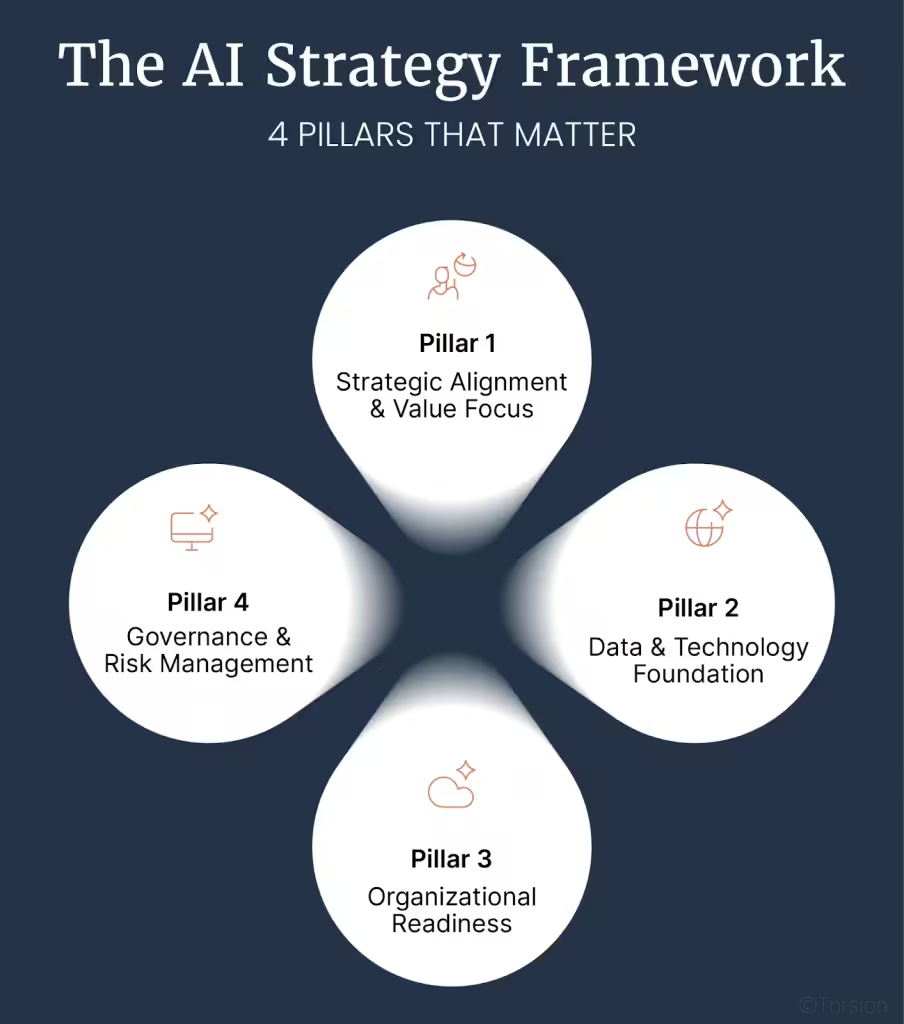
Pillar 1: Strategic Alignment & Value Focus
This is the “why” and the “how much.” It’s the most critical pillar, yet it’s the one most often ignored. It anchors your entire AI program to tangible business results, preventing it from drifting into a sea of interesting but ultimately useless science projects.
- Start with Business Outcomes: Instead of asking “What can we do with AI?”, ask “What are our most critical business challenges, and how can AI solve them?” This means identifying high-ROI opportunities first, like automating claims, detecting fraud, or optimizing your supply chain.
- Define Measurable KPIs: Every AI initiative must be tied to a specific, quantifiable key performance indicator (KPI). Are you aiming to reduce customer service costs by 30%? Increase sales conversion rates by 15%? Improve diagnostic accuracy by 50%? If you can’t measure it, you can’t manage it, and you certainly can’t prove its value.
- Secure Executive & Stakeholder Buy-In: An AI strategy is also a political document. It requires aligning stakeholders from the C-suite to the front lines, ensuring everyone from legal and compliance to IT and marketing understands the vision and their role in it. This alignment, secured through workshops and clear communication, is non-negotiable for success.
Pillar 2: Data & Technology Foundation
AI models are only as good as the data they eat and the infrastructure they run on. A brilliant algorithm fed with garbage data will produce garbage results. This pillar is about building a rock-solid technical foundation that is ready for the demands of enterprise-scale AI.
- Conduct a Brutally Honest Data Readiness Assessment: Most enterprise data is a mess. Torsion’s audits often reveal that critical data is siloed, inaccurate, or incomplete . Before you can run, you must walk. This means assessing the quality, integrity, and accessibility of your data and creating a plan to fix the gaps.
- Design a Future-Proof Architecture: Your current tech stack may not be ready for AI. A proper strategy involves evaluating your existing tools for compatibility, compute capacity, and integration flexibility. The goal is a modular, scalable architecture whether on-premise, in the cloud, or a hybrid, that can adapt as your AI needs and the technology itself evolve.
Pillar 3: Organizational Readiness
A shocking 64% of CEOs now believe that people, not technology, are the biggest determinant of AI success. You can have perfect data and a flawless algorithm, but if your team doesn’t know how to use it or actively resists it, your initiative is dead on arrival.
- Develop an AI Talent Strategy: Identify the skills you have and the skills you need. This isn’t just about hiring more data scientists. It’s about upskilling your entire workforce to create a culture of “AI literacy,” where people across the organization are empowered to work with and benefit from AI-driven insights.
- Implement a Change Management Program: AI changes workflows. It changes roles. It changes how people make decisions. A proactive change management plan is essential to address fear, communicate benefits, and guide employees through the transition, turning resistance into adoption.
Pillar 4: Governance & Risk Management
In the race to innovate, it’s easy to treat governance and ethics as an afterthought. This is a catastrophic mistake. A single data privacy incident or a biased algorithm that makes discriminatory decisions can destroy customer trust and erase years of brand equity overnight.
- Establish a Robust Governance Framework: This involves creating clear rules for data labeling, metadata management, and data lineage tracking . It defines who has access to what data and what they can do with it, ensuring consistency and control.
- Integrate Responsible AI from Day One: Your strategy must include proactive measures to ensure fairness, transparency, and accountability. This means conducting bias audits to evaluate model outputs across demographics and using explainability tools to make AI “black boxes” understandable to stakeholders.
- Ensure Continuous Compliance: Regulations like GDPR, HIPAA, and CCPA are not optional. An effective strategy includes continuous monitoring and automated alerts to ensure your AI systems remain compliant with all relevant laws, keeping you audit-ready at all times.
These four pillars form a comprehensive, interdependent system. Neglect one, and you create a critical point of failure that can bring your entire AI transformation to a grinding halt.
But when built together, they create a powerful foundation for turning AI from an expensive gamble into a predictable engine of business value.
Key Components of an AI Strategy
You have the four pillars to prevent your AI house from collapsing. But what are the five essential tools you need to actually build it?
While the pillars provide the structural blueprint, these tactical components are what separate a strategy on paper from a value-creating engine in practice.
- The North Star (Vision & Mission Alignment): Why do most AI projects wander aimlessly? They lack a defined destination. This component forges a specific AI vision statement that answers: “How will AI make us leaders in our market by 2030?” It ensures every project serves the company’s core mission, preventing costly detours.
- The Investment Portfolio (Resource Allocation): How do AI leaders avoid betting the farm on a single high-risk project? They don’t. They use a disciplined portfolio approach, like the 70-20-10 rule, to balance core optimizations (70%), emerging opportunities (20%), and experimental bets (10%). This framework turns your AI budget from a cost center into a strategic investment engine.
- The Periscope (Competitive Intelligence): What’s worse than a failed AI project? A successful one that just copies what your competitor did last year. This component involves systematically benchmarking your AI maturity against rivals to find the “white space”: the unique AI-driven capabilities that create an uncopyable market advantage.
- The Accelerator (Partnership & Ecosystem Strategy): Why are 61% of the most successful AI adopters partnering with specialists instead of building everything in-house? They understand that speed and expertise are a currency. This component defines a clear “build vs. buy vs. partner” matrix, turning the complex vendor landscape into a source of strategic acceleration, not confusion.
- The Amplifier (Communication & Change Management): A brilliant AI tool that no one uses is just expensive shelfware. With 64% of CEOs citing “people” as the biggest factor in AI success, how do you turn resistance into adoption? This component creates a multi-tiered communication plan that translates technical wins into business value, amplifying success and building unstoppable momentum.
The Benefits of a Strong AI Strategy
Everyone talks about AI saving money. But what if the real, transformative benefits are the ones that don’t show up on a simple cost-benefit analysis?
A strong AI strategy moves beyond incremental efficiency gains to unlock exponential, market-defining advantages.
- Speed Becomes a Weapon: It’s not just about being faster; it’s about fundamentally changing the clock speed of your business. How? Strategic AI adopters compress pilot-to-production cycles from a typical 18 months to just six, allowing them to capture market opportunities before competitors have even finalized their project plans.
- Your Brand Gets Bulletproofed: A single biased algorithm can destroy years of brand equity overnight. A strategic approach doesn’t just hope for ethical outcomes; it engineers them. The result? A 70% reduction in compliance-related incidents and a 90% decrease in bias-related model failures, turning a massive liability into a source of customer trust.
- You Build an Uncopyable Moat: While your competitors are busy launching one-off AI tools, a cohesive strategy builds an interconnected capability. This is what leads to a sustainable 20% revenue premium over peers. The advantage isn’t the AI model itself, it’s the integrated system of data, talent, and processes that your rivals cannot easily replicate.
- Your Company’s DNA Gets an Upgrade: What is the ultimate outcome of a great AI strategy? It isn’t just better software; it’s a smarter organization. It’s a 200% increase in data literacy across your workforce and an 85% improvement in decision-making accuracy. You’re deploying AI to create a resilient, adaptive organization ready for the next decade of disruption.
The Strategic Implementation Roadmap: From Blueprint to Business Impact
Knowing the four pillars is one thing. Building them is another. So, how do you translate a strategic document into a living, value-creating engine inside your organization?
The answer is you don’t do it all at once. The journey from “Random Acts of AI” to full-scale transformation is not a single, terrifying leap. It’s a deliberate, phased process designed to build momentum, minimize risk, and prove value at every step.
This is the roadmap that successful organizations use to turn ambition into achievement.
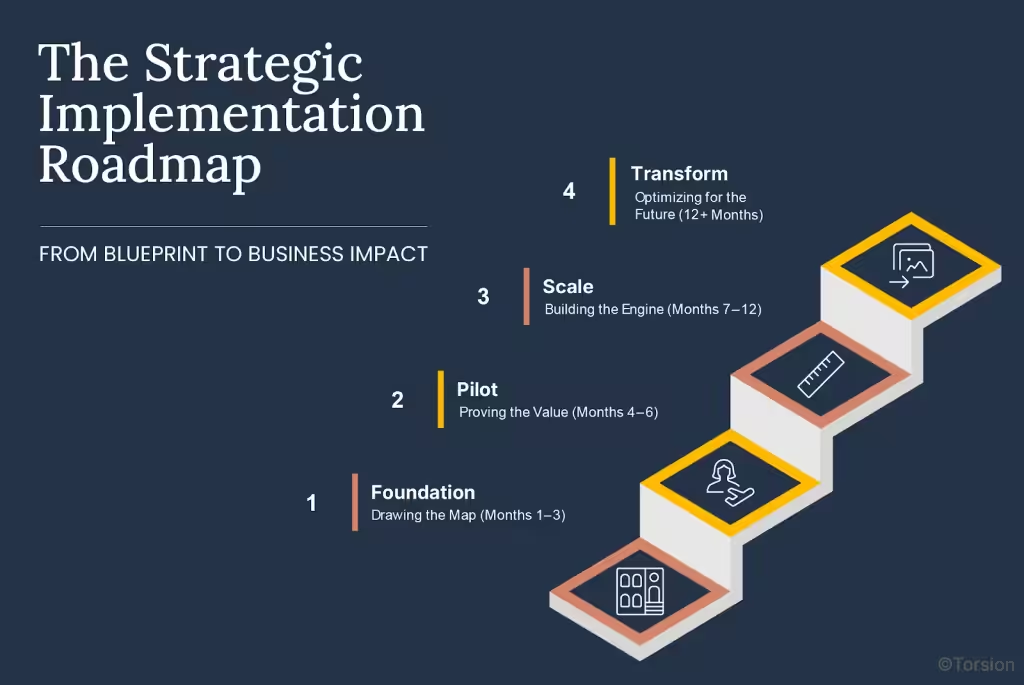
Phase 1: Foundation — Drawing the Map (Months 1–3)
Before you can build, you must have a blueprint. This initial phase is the most critical, as it sets the direction for everything that follows. It’s where you trade ambiguity for absolute clarity.
- What happens here? This phase is dominated by intense discovery and alignment. It involves strategic workshops with all key stakeholders from IT and data science to legal, finance, and operations. The goal is to conduct a brutally honest assessment of your organization’s AI readiness, evaluate your data and tech infrastructure, and, most importantly, identify and prioritize a handful of high-impact, high-feasibility use cases. It’s about finding the one or two places where a single drop of AI can create the biggest ripple effect, such as in claims automation or supply chain optimization.
- The Outcome: You don’t exit this phase with a vague mission statement. You exit with an actionable data strategy roadmap: a prioritized list of pilot projects, clear success metrics (KPIs) for each, a timeline, and unified stakeholder buy-in.
Phase 2: Pilot — Proving the Value (Months 4–6)
This is where the rubber meets the road. Instead of attempting a massive, high-risk launch, you start with a controlled, high-impact pilot project. This is your first battlefield, chosen to secure a quick, decisive win.
- What happens here? You execute on the top-priority use case identified in Phase 1. The key is to select a project with a high chance of success that delivers measurable value in a short time frame, often in areas like marketing or billing where backend complexity is lower. A Proof of Concept (PoC) is developed to validate the use case’s feasibility, test its performance against the predefined KPIs, and gather feedback from real users. It’s a real-world test designed to prove ROI and de-risk the initiative before further investment.
- The Outcome: You end this phase with indisputable proof. You have a working prototype, hard data on its performance and financial impact, and a success story that builds crucial momentum and silences organizational skeptics.
Phase 3: Scale — Building the Engine (Months 7–12)
With a successful pilot in hand, you now have the political and financial capital to scale. This phase is about taking what worked in the pilot and embedding it into the core operational fabric of the enterprise.
- What happens here? The validated AI model is moved from the pilot environment and integrated seamlessly into core business systems like your CRM, ERP, or proprietary platforms. This requires building robust, scalable infrastructure and creating standardized processes to manage the AI solution across the organization. The goal is to make the AI-driven insight or automation a natural part of your team’s daily workflow, with minimal disruption.
- The Outcome: AI is no longer a special project; it’s part of the plumbing. You have a streamlined, scalable AI solution driving efficiency and value across one or more departments, setting the stage for broader enterprise-wide deployment.
Phase 4: Transform — Optimizing for the Future (12+ Months)
AI is not a “set it and forget it” technology. The final phase is a continuous cycle of optimization and innovation. This is what separates companies that merely use AI from those that are transformed by it.
- What happens here? You implement systems for the long haul. This includes real-time performance monitoring to detect “model drift” and ensure sustained accuracy. A strong governance framework is embedded to manage compliance with regulations like GDPR and HIPAA automatically. Most importantly, you establish a feedback loop where the insights from your live AI systems are used to identify new opportunities, refine existing processes, and inform the next wave of strategic initiatives.
- The Outcome: Your AI program becomes a future-proof, living system. It’s an engine of continuous improvement that not only delivers sustained ROI but also becomes a core driver of your company’s competitive advantage and long-term innovation.
Common Roadblocks: 3 Traps That Derail AI Strategy
The path from a strategic plan to tangible value is littered with predictable, yet often fatal, traps. These are the subtle mistakes and flawed mindsets that cause even the most promising AI initiatives to collapse. They are the practical reasons behind the 85% failure rate. Recognizing them is the first step to avoiding them.
Trap 1: The “Random Acts of AI” Fallacy
This is the single most common reason AI strategies fail. It begins not with a bang, but with a scattered series of enthusiastic experiments. A team in marketing builds a chatbot. A data scientist in finance creates a predictive model. An operations manager buys a new automation tool. Each of these is a “Random Act of AI”: a disconnected, bottom-up project born from technological curiosity rather than strategic necessity.
- The Symptom: Your organization has a dozen exciting AI pilots but no clear path to scale any of them. They exist in silos, unable to integrate with core systems or share data, ultimately becoming “innovation shelfware”. This is precisely why 88% of AI proofs-of-concept never make it to production.
- The Cure: Enforce strategic discipline. Every single AI project must be born from the central strategy and justified by a clear business case and measurable KPIs. Instead of letting a thousand flowers bloom randomly, you cultivate a few, specific plants chosen for their high-yield potential.
Trap 2: The Technology-First Mindset
This trap happens when the tool becomes more important than the job. A new, powerful large language model is released, and the immediate question becomes “What can we do with this?” This is a solution looking for a problem. It leads to beautifully engineered tools that solve no one’s actual problem, resulting in low user adoption and zero ROI.
- The Symptom: Your development teams are focused on algorithmic novelty, but your business users are still struggling with the same old inefficient workflows. The architecture can’t support the new tech, leading to fragile, “sidecar” implementations that break under real-world pressure.
- The Cure: Flip the question. Start with a specific, high-value business pain point and ask, “Is AI the best way to solve this?”. This ensures the business need, not the technology’s capability, drives the project. The goal isn’t to use AI; it’s to reduce costs, improve efficiency, or drive revenue.
Trap 3: The Data Quality Blind Spot
AI models are not magic; they are powerful pattern-recognition engines that are entirely dependent on the data they are fed. The “garbage in, garbage out” principle is unforgiving. Many leaders tragically underestimate how un-ready their data is for AI.
- The Symptom: Your AI project stalls for months because the data is siloed, incomplete, or riddled with inconsistencies. In healthcare, for example, a staggering 80% of data is unstructured and locked in disconnected systems, making it nearly useless for advanced AI without significant upfront work. This isn’t a minor hiccup; poor data quality is the root cause of failure in over 70% of AI projects.
- The Cure: Treat data readiness as a non-negotiable prerequisite, not an afterthought. A rigorous data readiness assessment, a robust governance framework, and a plan for data harmonization must be central to your AI strategy from day one. Fixing the data foundation is often the least glamorous part of an AI initiative, but it is always the most important.
Avoiding these traps isn’t just about awareness—it’s about execution. Identifying roadblocks is one thing, but building the governance, processes, and technical foundations to overcome them requires deep expertise.
For most organizations, trying to do this in-house leads to wasted time, stalled initiatives, and costly missteps. What seems like savings upfront often turns into expensive delays later.
The smarter choice? Delegate the heavy lifting to a team of experts with proven knowledge and tested experience in designing and executing AI strategies.
With the right partners, you don’t just avoid failure—you accelerate impact, reduce risk, and turn AI into a true driver of business value.
Real Examples of AI Strategies in Action
The framework and roadmap provide the blueprint, but what does success actually look like? The difference between a company stuck in “pilot purgatory” and one achieving transformative results lies in execution.
The following examples show what happens when a clear AI strategy built on the four pillars is put into practice.
Case Study 1: Transforming Healthcare with Sharecare+
The Vision: Healthcare advocacy firm Sharecare had a bold strategic vision: to create a “five-star hotel” experience for every member. This meant moving beyond a reactive, fragmented support model to a proactive, unified digital platform that could anticipate member needs and guide them seamlessly through their healthcare journey.
The Strategy in Action:
- Strategic Alignment: Instead of building isolated tools, the entire initiative was anchored to the core business goal of redefining member advocacy. The AI wasn’t the goal; the “five-star” experience was.
- Phased Implementation: Torsion partnered with Sharecare to translate this vision into a scalable execution plan. They didn’t try to build everything at once. They started by launching Sharecare+, an AI-powered advocacy layer, and then systematically scaled it.
- Technology Foundation: Key technical solutions were chosen to directly support the strategy, including an NLP engine for member communication (WeCare GPT), an ETL pipeline for data processing, and a care gap analysis tool to operationalize clinical logic.
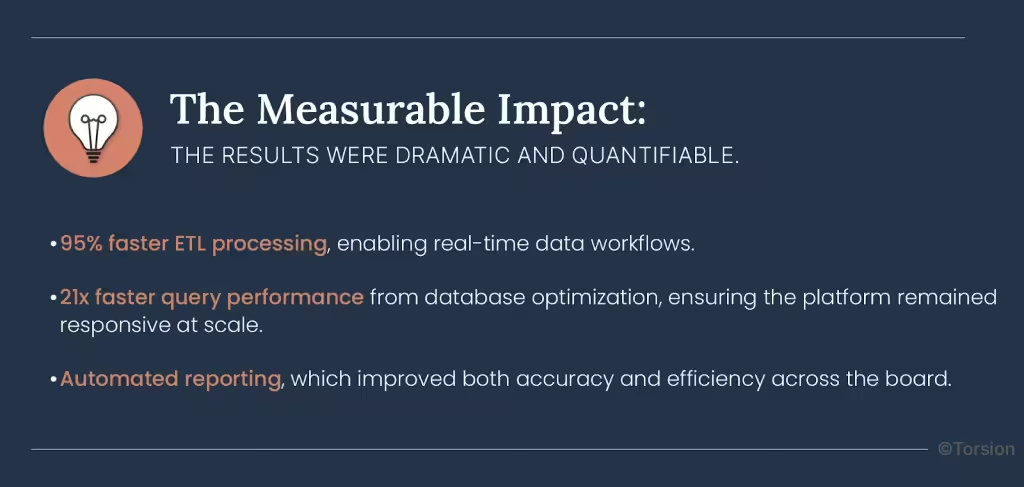
Sharecare executed an AI strategy that transformed its core service delivery model.
Case Study 2: Driving Manufacturing Excellence with Prolec GE
The Vision: Prolec GE, a major transformer manufacturer, faced a critical business bottleneck. Manual, error-prone testing and certification processes were capping their on-time delivery rate at a suboptimal 82%, constraining growth despite a booming market. Their strategic vision was to create a unified digital platform that would automate testing workflows and ensure compliance at scale.
The Strategy in Action:
- Strategic Alignment: The project was laser-focused on solving a specific, high-value business problem: the delivery bottleneck caused by testing delays.
- Data & Technology Foundation: Torsion helped implement a solution designed for the harsh realities of a factory floor, including an agent-based offline architecture to handle inconsistent network reliability and a centralized data management system to unify production intelligence.
- Phased Implementation: The solution was built with modular components, such as a template-driven reporting framework and an automated calculation engine, to systematically eliminate manual errors and accelerate certification.
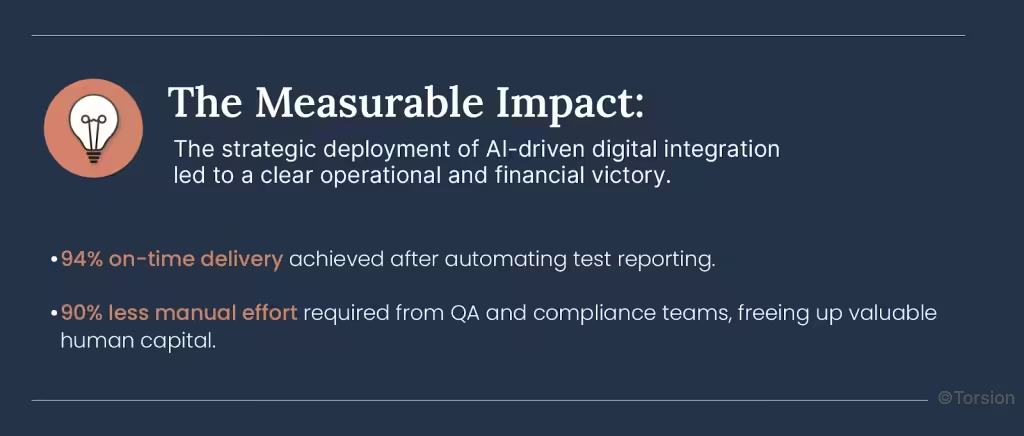
The Vision: Prolec GE executed an AI strategy that would automate testing workflows and ensure compliance at scale.
Beyond Healthcare and Manufacturing
This strategic approach is industry-agnostic. In finance, leading firms are moving beyond random pilots to execute cohesive AI strategies that deliver concrete returns:
- Real-Time Fraud Protection: Instead of just flagging suspicious transactions, a strategic approach uses AI to analyze vast datasets and identify complex fraud patterns, reducing losses while minimizing false positives for legitimate customers. PayPal, for instance, leveraged deep learning models to achieve an 11% reduction in fraud-related losses.
- Automated Compliance: Financial institutions are building AI systems to automate compliance with strict regulations like AML and KYC, reducing audit times and minimizing regulatory risk.
- Hyper-Personalized Services: Banks are using AI not just for chatbots, but to analyze customer data and offer personalized financial advice, loan products, and investment opportunities, significantly increasing customer satisfaction and lifetime value.
In every successful case, the story is the same: the victory was not in buying technology, but in deploying a strategy.
Turning AI Strategy into Business Impact
We began with a mystery: why are so many companies, armed with massive budgets and brilliant minds, failing at AI?
We’ve journeyed from the “billion-dollar black hole” of stalled projects to a clear understanding of the hidden architecture that separates the 85% who fail from the few who achieve transformative results.
The answer, as we’ve seen, is not more technology. It’s more strategy.
The difference lies in moving from “Random Acts of AI” that are scattered, bottom-up experiments to a disciplined, top-down AI strategy. This is the framework that anchors every initiative to a measurable business outcome, ensuring that every dollar invested is a step toward tangible value.
It’s the blueprint that considers not just the algorithm, but the four pillars of success: Strategic Alignment, Data Foundation, Organizational Readiness, and Governance.
The journey, from foundation and pilot to scaling and transformation, is not easy, but it is a proven path. We’ve seen it in action with companies like Sharecare and Prolec GE who executed a deliberate strategy to solve core business challenges, yielding dramatic, quantifiable returns.
The age of AI experimentation is over. The competitive landscape will now be defined by those who can execute.
Your organization has a choice: continue to gamble on disconnected projects and risk becoming another statistic. Or commit to building a robust AI strategy that turns technological potential into a durable competitive advantage.
The future belongs to those who think strategically with AI.