
TL;DR:
- The decision is whether to build a financially credible internal business case for AI investment in the manufacturing proposal process, not whether AI is worth exploring in general.
- The most common mistake is presenting AI as a cost-reduction initiative rather than a revenue-acceleration investment: manufacturing CFOs respond more strongly to win rate improvement and bid capacity increases than to headcount savings.
- Evaluate based on baseline measurement before deployment, quantified win rate impact, bid capacity improvement, compliance risk reduction, and payback period calculation.
- Avoid any business case that relies exclusively on headcount reduction: manufacturing CFOs know that winning more bids requires more delivery capacity, so headcount savings in proposals rarely translate cleanly to the bottom line.
- A strong engagement looks like a 6-week Phase 1 with a fixed build cost where the investment is bounded, ROI is measurable from the first bid processed, and the client owns the system outright at the end.
If you are working on how to build an AI business case your CFO will approve for a manufacturing proposal process, you are past the “should we use AI?” conversation. You already know the opportunity exists. The real challenge is getting the investment signed off by a finance leader who has seen vague technology pitches before and rejected most of them. The mistake most teams make when presenting AI ROI to a manufacturing CFO is framing it as a cost-reduction play: fewer people writing proposals, lower overhead per bid. CFOs who run manufacturing companies understand that winning more contracts means delivering more contracts, so headcount savings in proposal teams do not map neatly to bottom-line improvement. This article gives you the criteria that matter, the red flags that kill credibility, and a framework for building the kind of business case that gets budget approval on the first pass.
What most teams get wrong when evaluating building a financially credible internal business case for AI investment
The most common error is pitching AI to the CFO as a way to reduce headcount on the proposal team. In a manufacturing environment, proposal engineers are not just writing documents: they are translating technical specifications, pricing complex assemblies, and ensuring compliance with customer requirements. When a team frames AI as “we can do the same work with fewer people,” the CFO immediately asks what happens when bid volume goes up after deployment. The answer is usually silence, because the business case was built on the wrong premise. A headcount-reduction argument creates a ceiling on the projected value of the investment, and manufacturing CFOs spot that instantly.
The right question is not “how many proposal writers can we eliminate?” but “how many more bids can we win with the same team?” This reframe changes the entire financial model. Off-the-shelf RFP software handles proposal libraries, collaboration workflows, and template generation. Custom AI trained on a company’s own bid history, product specifications, and compliance records does something fundamentally different: it reduces the engineering hours per bid while increasing the quality and consistency of technical responses. The AI investment payback period for a manufacturing proposal process becomes measurable in additional won contracts, not in salary savings. That distinction is what separates a business case that gets approved from one that gets tabled.
The five numbers your CFO will actually weigh
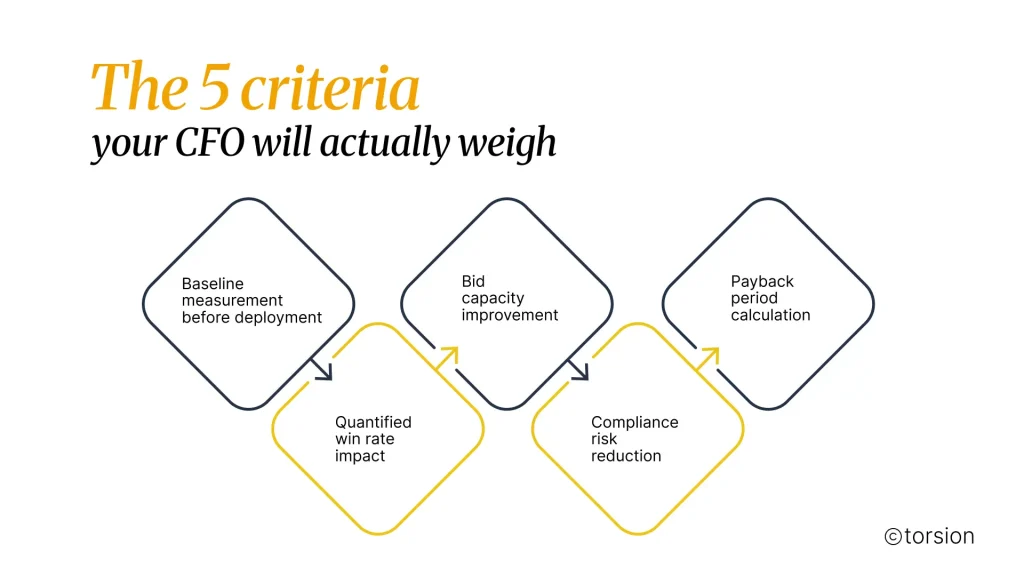
Baseline measurement before deployment
No CFO will approve a technology investment without knowing the starting point. Before any AI deployment, the proposal team needs documented metrics for engineering hours per bid, current win rate, and the number of bids declined each month due to capacity constraints. The evaluation method is simple: ask your vendor whether their onboarding process includes a structured baseline assessment. A good answer describes a specific measurement protocol with defined KPIs. A vague answer sounds like “we will track improvements over time,” which gives the CFO nothing to anchor ROI calculations against.
Quantified win rate impact
A 1-2 percentage point improvement in win rate in competitive manufacturing markets translates to material contract value. If a company bids on $2M average contracts and submits 100 bids per year at a 25% win rate, moving to 27% means an additional $4M in annual revenue. CFOs understand bid-to-revenue relationships intuitively, so this framing resonates. Ask any vendor for reference data from comparable manufacturing deployments showing actual win rate changes, not projected ones. Comparable deployments show 3-5 point win rate improvements when AI is trained on a company’s own historical bid data rather than generic models.
Bid capacity improvement
Every bid declined because the proposal team is at capacity is a quantifiable revenue opportunity lost. Most manufacturing proposal teams operate at a fixed ceiling determined by headcount and available engineering hours. AI converts declined bids into accepted ones by reducing the hours required per response, and this frames the investment as revenue capture rather than cost control. Ask the vendor: “What bid capacity increase have your manufacturing clients measured in the first 90 days?” A credible answer cites a specific percentage range with context about team size and bid complexity.
Compliance risk reduction
Compliance failures in bid submissions create post-award disputes, rework costs, and reputational damage with procurement teams that control repeat business. In regulated manufacturing sectors, a missed specification or an outdated certification reference can disqualify a bid entirely or trigger costly corrections after contract award. Quantifying this exposure strengthens the risk-reduction component of the business case. The evaluation question: “How does your system handle compliance matrix generation, and can you show me an example where it flagged a requirement that a manual review missed?” Torsion’s compliance-first approach, which embeds regulatory alignment from the start rather than adding it after deployment, addresses this directly by building compliance checking into the AI framework’s core logic.
Payback period calculation
A 6-week Phase 1 with a fixed build cost makes payback period calculation straightforward for the CFO. The investment is bounded, ROI is measurable from the first bid processed, and the client owns the system outright at the end. This is what good looks like: the CFO can model exactly how many additional won contracts are needed to recover the investment, rather than projecting savings over an ambiguous multi-year timeline. Ask vendors: “What is the fixed cost of Phase 1, and at what bid volume does the investment pay for itself?” Any answer that requires a 12-month commitment before ROI measurement is a warning sign. CFOs in 2026 prioritize technology investments with clear, bounded payback periods, and your business case needs to reflect that expectation.
Three red flags in a vendor’s ROI claims
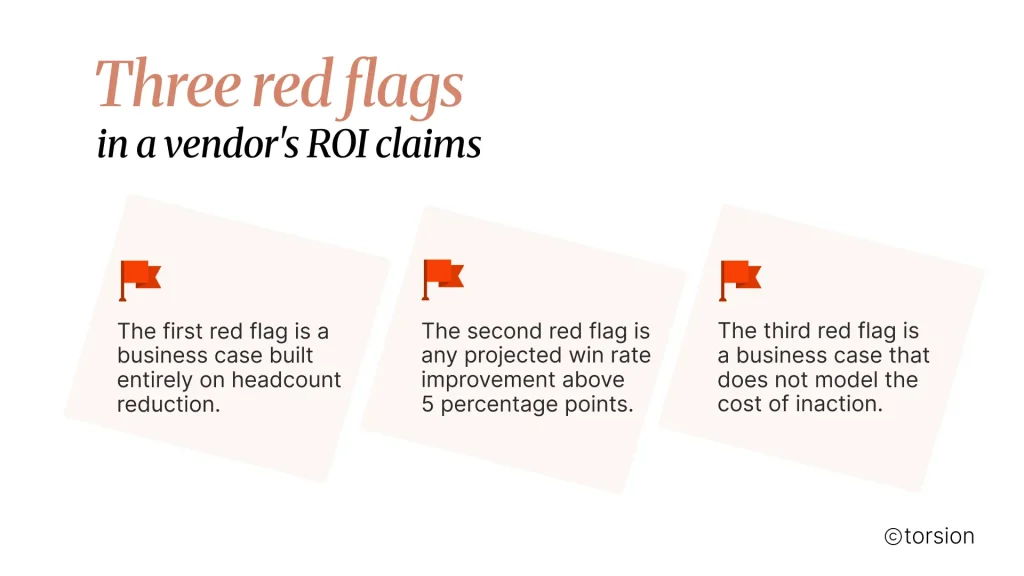
The first red flag is a business case built entirely on headcount reduction. Manufacturing CFOs know that winning more bids means delivering more projects, which requires people. If a vendor’s ROI model shows that the AI system pays for itself by eliminating two proposal engineers, the CFO will ask who handles the increased delivery workload when bid volume rises. This is not a theoretical concern: it is the exact objection that kills AI business cases in manufacturing boardrooms. Test for it by asking the vendor: “If we win 15% more contracts after deployment, how does your business case model the delivery capacity needed to fulfill them?” If the answer does not address this, the model is incomplete.
The second red flag is any projected win rate improvement above 5 percentage points without reference to comparable industry deployment data. Overstated projections undermine the credibility of the entire case, and CFOs who have seen technology vendors promise outsized returns will discount the whole proposal. Only 28% of AI projects deliver measurable ROI within the first year, which means your CFO has good reason to be skeptical of aggressive claims. The test: ask the vendor for anonymized case data from a manufacturing client with similar bid volume and contract complexity. If they cannot produce it, the projection is speculative.
The third red flag is a business case that does not model the cost of inaction. The CFO needs to see what staying with the manual process costs in declined bids and compliance risk over the next 12 months. If a manufacturing company declines 3-5 bids per month due to capacity constraints, and the average contract value is $1.5M, the annual cost of inaction is between $54M and $90M in foregone revenue opportunity (adjusted for win probability). Test for this by asking: “Does your business case template include a cost-of-inaction scenario?” If the vendor has not built this into their standard financial model, they do not understand what CFOs need to see.
The manufacturing AI proposal business case: how to present the numbers
Manual proposal tools are the right choice for teams with straightforward collaboration needs where the bid process involves assembling existing content rather than generating custom technical responses. This comparison is for teams whose scope includes the full technical bid process: complex specifications, compliance requirements, and engineered pricing. Building an AI business case that your CFO will approve for manufacturing requires showing a direct side-by-side comparison of the current state versus the post-deployment state across dimensions the finance team actually cares about. Enterprise CFOs show sharply rising confidence in AI investments when presented with bounded costs and measurable outcomes. The table below compares six dimensions that matter most for VP Sales and Directors of Business Development at manufacturing companies seeking AI budget approval teams.
| Dimension | Manual proposal process (current state) | AI-assisted proposal process (post-deployment) |
| Engineering hours per bid | 35-40 hours for complex technical bids (APMP 2023) | 6-8 hours of human judgment work per bid |
| Monthly bid capacity | Fixed ceiling determined by team size and available hours | Increases by 25-40% without additional headcount |
| Win rate impact | Baseline win rate (measure before deployment) | Comparable deployments show 3-5 point win rate improvement |
| Compliance error rate | Manual review misses requirements in 15-20% of regulated bids (Shipley Associates) | AI compliance matrix flags all requirements before submission |
| Cost per bid response | Fully-loaded engineering time at market rate for 35-40 hours | 6-8 hours of engineering time plus build cost amortised over bid volume |
| Payback period | Ongoing manual cost with no fixed investment | Recoverable in 3-6 additional won contracts depending on average contract value |
What a CFO-ready engagement looks like in practice
A well-structured engagement starts with a fixed-scope Phase 1 that runs 6 weeks, costs a defined amount, and produces a working system trained on the client’s own bid history. The investment is bounded from day one, which means the CFO can approve it without open-ended financial exposure. ROI measurement begins with the first bid processed through the system, not after a 6-month “optimization period.” The client owns the system, the trained models, and all underlying data outright at the end of Phase 1, which eliminates ongoing vendor dependency and gives the finance team a clean asset on the balance sheet. This structure reflects how Torsion approaches AI deployment across complex, compliance-heavy industries: structured execution with measurable outcomes at each stage.
A $500M industrial equipment manufacturer provides a useful reference point. The CFO approved the Phase 1 investment after reviewing a 3-scenario model (conservative, base, and upside) built entirely on the client’s own historical win rate and average contract value. The proposal team now processes 30% more bids per month with the same headcount, and compliance checking that previously required a dedicated reviewer happens automatically before each submission. The company has seen measurable reductions in processing time consistent with broader industry benchmarks for AI-assisted proposal workflows. The client owns all code, models, and training data with no ongoing vendor dependency, which was a non-negotiable requirement from the CFO before approval.
The three numbers every manufacturing CFO needs before approving an AI proposal investment
The business case that gets approved is the one that gives the CFO three specific numbers: the cost of the bounded Phase 1 investment, the revenue value of the additional contracts the team can win with increased capacity and improved win rate, and the 12-month cost of maintaining the current manual process while competitors accelerate. VP Sales and Directors of Business Development who present these three numbers, backed by their own baseline data rather than vendor projections, report significantly higher approval rates for AI investments.
The most direct way to pressure-test these numbers is to model them against your own bid volume. at Torsion, where the team will build the business case numbers using your own bid volume and contract value. They map your highest-impact RFP automation opportunity and tell you whether a custom system makes financial sense for your process.Book a financial modelling session