
TL;DR:
- The problem: missed compliance requirements in technical RFP submissions cost manufacturing proposal teams and bid compliance managers dearly.
- Compliance failures are among the top three reasons competitive manufacturing bids are disqualified, accounting for 15-20% of bid losses in regulated industries (Shipley Associates Proposal Best Practices Guide).
- Why it matters: in a typical 300-page industrial RFP package, applicable compliance requirements are distributed non-linearly across 12-18 separate specification documents (APMP Technical Proposal Research).
- Why workarounds fail: bid compliance checklists built from previous similar RFPs and assigning a dedicated compliance reviewer to read the full package before the proposal team begins writing address symptoms, not the structural cause.
- What changes with AI: AI generated a full pass/fail/review compliance matrix from 40-60 bid documents, surfacing requirements that had been missed in manual review. Engineers resolved flagged items rather than discovering them post-submission.
- The root cause: compliance requirements in technical manufacturing RFPs are not consolidated. They are embedded in appendices, referenced conditionally across spec documents, and triggered by scope decisions that have not yet been made when the review begins.
Compliance gaps in manufacturing RFP submissions that cause bid disqualification remain one of the most expensive and preventable problems in industrial bidding: compliance failures are among the top three reasons competitive manufacturing bids are disqualified, accounting for 15-20% of bid losses in regulated industries (Shipley Associates Proposal Best Practices Guide). For manufacturing proposal teams and bid compliance managers, every missed requirement translates directly into lost revenue, wasted engineering hours, and eroded credibility with buyers who may not offer a second chance, which is why the push toward an AI compliance check for RFP manufacturing bid documents has become a priority rather than an experiment. By the end of this article, you will understand exactly where compliance requirements hide inside complex RFP packages, why the most common workarounds fail to catch them, and how AI-driven extraction and cross-referencing changes the math for teams submitting technical manufacturing bids.
The real scope of missed compliance requirements in technical RFP submissions
Compliance failures are among the top three reasons competitive manufacturing bids are disqualified, accounting for 15-20% of bid losses in regulated industries (Shipley Associates Proposal Best Practices Guide). In a typical 300-page industrial RFP package, applicable compliance requirements are distributed non-linearly across 12-18 separate specification documents (APMP Technical Proposal Research). These are not neatly summarized in a single appendix or checklist; they are scattered across mechanical specifications, environmental standards, quality management clauses, and referenced third-party codes. The idea of running an AI compliance check across RFP manufacturing bid documents exists precisely because human reviewers cannot hold all of these threads simultaneously while also meeting proposal deadlines.
A typical week for a proposal manager at a mid-to-large manufacturer looks something like this: two to three active bids in various stages, each with its own document set ranging from 150 to 600 pages. The manager cross-references technical specs against internal product data sheets, checks environmental and safety clauses against certifications, and flags items that need engineering input. Meanwhile, new RFP notifications arrive, and the team must decide which opportunities to pursue and which to decline purely because there is not enough capacity to review them thoroughly. Research shows that organizations responding to RFPs spend an average of 23 hours per response, and that figure climbs significantly for complex industrial packages with multiple specification layers.
The true cost extends well beyond time. When compliance gaps slip through, win rates drop, and the damage compounds. A team that loses 15-20% of bids to compliance errors is not just losing those individual contracts; it is losing the downstream revenue, the reference accounts, and the internal confidence that comes from a healthy pipeline. Engineering teams pulled into post-submission scrambles to address compliance deficiencies cannot spend that time on product improvement or new bid development. The financial impact on a manufacturer bidding on $5M-$50M contracts is measured in millions of dollars annually, not thousands.
Why bid compliance checklists built from previous similar RFPs are not the answer
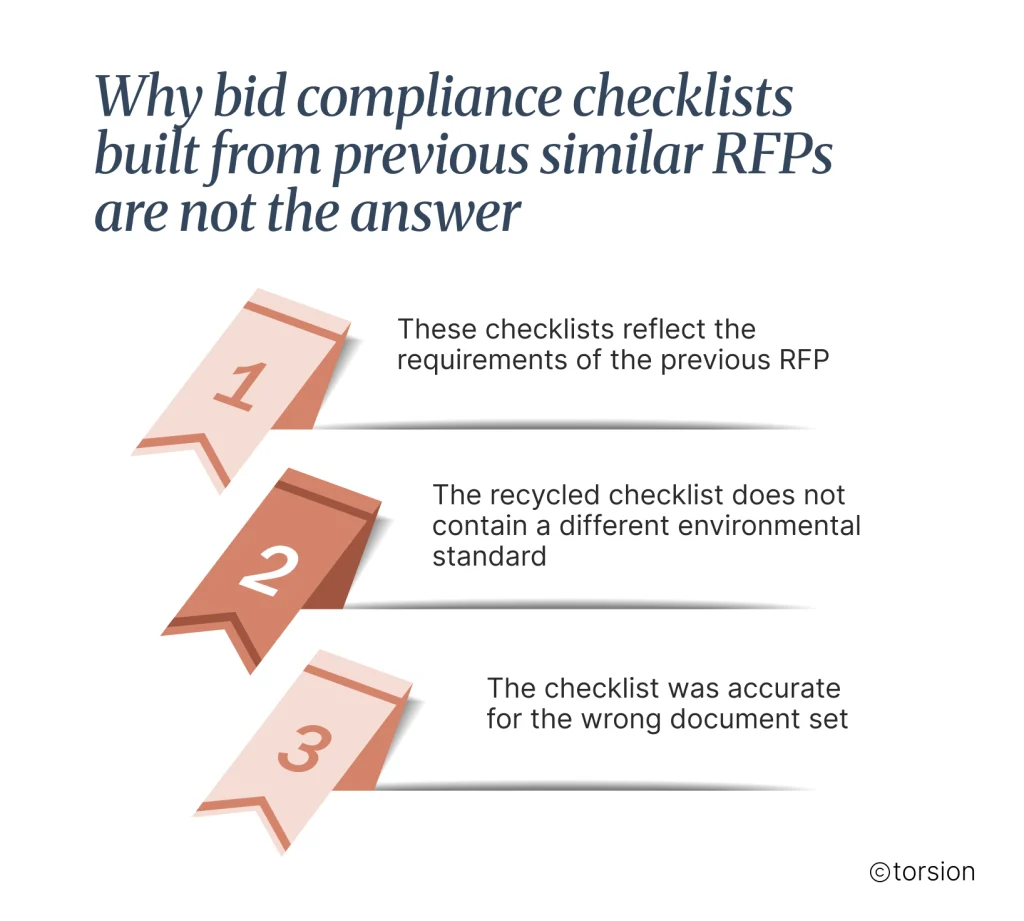
Bid compliance checklists built from previous similar RFPs are the most common first response to this problem. Teams take a checklist from a won bid in the same sector, update it with the new RFP number and client name, and use it as their compliance backbone. The failure mode is specific: these checklists reflect the requirements of the previous RFP, not the current one. When a new package introduces a different environmental standard, references an updated revision of an industry code, or buries a conditional requirement inside a piping specification appendix, the recycled checklist simply does not contain it. Missed requirements in technical bid submissions leading to disqualification often trace back to exactly this gap: the checklist was accurate for the wrong document set.
Assigning a dedicated compliance reviewer to read the full package before the proposal team begins writing is the second common approach. This person, usually a senior engineer or quality manager, reads every document front to back and flags compliance items. The specific failure mode here is timing and cognitive load. A 300-page package with 12-18 spec documents takes 30-40 hours to read with the level of attention compliance review demands. By the time the reviewer finishes, the proposal team has already begun writing sections based on incomplete information, and the reviewer’s flags arrive as change orders rather than inputs. On packages with a 3-4 week turnaround, this approach consumes nearly half the available calendar time before writing even starts.
This lives in the document structure. More reviewers will not catch it. A $500M industrial equipment manufacturer Torsion works with described it plainly: adding a second compliance reviewer did not reduce errors, it added coordination overhead.
The structural cause behind missed compliance requirements in technical RFP submissions
Compliance requirements in technical manufacturing RFPs are not consolidated. They are embedded in appendices, referenced conditionally across spec documents, and triggered by scope decisions that have not yet been made when the review begins.
A mechanical specification might state that all welding shall comply with a referenced code, but that code only applies if the scope includes pressure-rated assemblies, a determination that depends on the client’s process conditions document, which itself references a separate data sheet. This chain of conditional references is structural. No amount of additional headcount or process discipline can resolve it because the requirements are architecturally distributed, not accidentally hidden. Missed requirements leading to technical bid submission disqualification are a symptom of this architecture, and manufacturers are increasingly recognizing that AI is not a technology problem but a process problem that requires rethinking how document intelligence works.
When this root cause goes unaddressed, the consequences follow a predictable pattern. Compliance errors surface after bid submission, sometimes during client evaluation and sometimes during post-award audits. Qualified bids get declined not because the manufacturer cannot meet the requirement, but because the response did not address it. Proposal quality drops under time pressure as teams rush to cover more documents with fewer hours, and the most experienced engineers, the ones who can spot subtle compliance triggers, burn out from repetitive document review instead of contributing their technical judgment where it matters most. For manufacturing proposal teams and bid compliance managers, this cycle erodes both output quality and team retention.
A structural cause requires a structural solution, not another layer of manual review.
How the compliance picture changes once AI reads every document
When AI handles the rule-based components of compliance review in technical RFP submissions, the workflow shifts fundamentally. Instead of a human reading every page sequentially, AI systems perform document graphing: mapping the relationships between specifications, appendices, data sheets, and referenced codes. From that graph, the system extracts individual compliance requirements, identifies conditional triggers, and checks each requirement against the bidder’s product specifications and certifications. The output is a structured compliance matrix, not a summary or a highlight reel, but a line-by-line pass/fail/review assessment. Torsion’s AI builds a compliance matrix that cross-references every extracted requirement against the client’s product specs, so the engineer resolves flags rather than discovering them post-submission. This is consistent with broader trends in procurement AI that show automated compliance workflows reducing processing time by up to 95% on document-heavy tasks.
A mid-cap industrial manufacturer Torsion partnered with ran this across its bid process. The AI produced a full pass, fail, and review compliance matrix from 40 to 60 bid documents and surfaced requirements that manual review had been missing, so engineers resolved flagged items instead of finding gaps after submission. A compliance review that had taken 30 to 40 hours of senior engineering time became a focused 4 to 6 hour pass over flagged exceptions.AI adoption in manufacturing is moving from uncertainty to execution in 2026
The shift is not about replacing engineers. It is about redirecting engineering judgment from document scanning to technical decision-making. A senior mechanical engineer reviewing a flagged welding code applicability question brings genuine expertise to that decision. That same engineer spending four hours reading a civil specification looking for buried compliance clauses does not. AI handles the extraction and cross-referencing; the engineer handles the judgment calls. This division of labor reflects how enterprise AI predictions for 2026 emphasize augmentation of skilled workers rather than replacement, particularly in compliance-heavy industries where domain expertise remains essential.
The compliance matrix itself becomes a living document throughout the bid process. As scope decisions are made and clarifications received from the client, the AI system can re-evaluate conditional requirements and update the matrix. This is something a static checklist cannot do and a human reviewer can only do by re-reading the entire package. For teams managing multiple concurrent bids, this dynamic updating capability is the difference between confident submissions and anxious ones.
From compliance risk to compliance confidence in your bid process
The compliance gap in manufacturing RFPs is structural, not behavioral, and closing it means changing how requirements are extracted and cross-referenced rather than asking already-stretched teams to read more carefully. For proposal managers and bid compliance managers, the most important shift is recognizing that AI-generated compliance matrices do not remove engineering judgment from the process; they ensure that judgment is applied to the right questions at the right time, before submission rather than after.
If you are mapping where compliance risk enters your bids, Torsion’s team can provide tailored insights specific to your bid volume, document complexity, and compliance requirements, so to start that conversation.