
TL;DR:
- The problem: hidden costs of manual RFP document processing are costing manufacturing sales leaders and proposal managers dearly.
- Manual RFP responses in complex technical industries average 35 hours of team time per bid, with large-scale packages exceeding 80 hours across reviewers, engineers, and writers (APMP Proposal Industry Survey 2023)
- Why it matters: compliance failures caused by missed requirements during manual review account for an estimated 15-20% of bid disqualifications in regulated manufacturing industries (Shipley Associates Proposal Best Practices Guide)
- Why workarounds fail: manual spec-tracking spreadsheets and requirement checklists built from previous similar bids or assigning multiple engineers to review the same document package in parallel to reduce total calendar time address symptoms, not the structural cause
- What changes with AI: AI reduced document review from 40-60 files reviewed manually over 3 days to a structured reference graph and extracted standards list produced in under 4 hours
- The root cause: manual RFP processing is a latency problem disguised as a labour problem – the bottleneck is the sequential nature of human document review, not the skill or effort of the team
The true cost of manual RFP processing in manufacturing is rarely captured on a balance sheet, yet it shapes every bid a company wins or loses. Manual RFP responses in complex technical industries average 35 hours of team time per bid, with large-scale packages exceeding 80 hours across reviewers, engineers, and writers (APMP Proposal Industry Survey 2023). For manufacturing sales leaders and proposal managers, the accumulated RFP document review hours cost manufacturing organizations not just in labor spend but in strategic capacity: every hour spent cross-referencing specs is an hour not spent on pricing strategy, client engagement, or pursuing additional opportunities. By the end of this article, you will have a clear picture of where those hours go, why common workarounds fail to fix the problem, and what a structural fix actually looks like in practice.
The real scope of hidden costs of manual RFP document processing
Manual RFP responses in complex technical industries average 35 hours of team time per bid, with large-scale packages exceeding 80 hours across reviewers, engineers, and writers (APMP Proposal Industry Survey 2023). Compliance failures caused by missed requirements during manual review account for an estimated 15-20% of bid disqualifications in regulated manufacturing industries (Shipley Associates Proposal Best Practices Guide). When you add up the RFP document review hours cost manufacturing firms absorb each quarter, the figure often exceeds the salary of a full-time proposal coordinator, yet the work is spread invisibly across engineers, product managers, and sales staff who have other responsibilities.
A typical week for a proposal manager at a mid-to-large manufacturing company involves juggling two to four active bids simultaneously. Each bid package might include 40 to 60 documents: technical specifications, compliance questionnaires, scope-of-work narratives, insurance and safety certifications, and referenced industry standards like ASME or API codes. The proposal manager must cross-reference requirements across these documents, route specific sections to subject-matter engineers, track responses, and reconcile conflicting information before assembling a final submission. Most teams report declining at least one qualified bid per month simply because they lack the bandwidth to start another review cycle. A recent analysis of manual workflow costs found that organizations running fully manual proposal processes spend 30-50% more per bid than those with even partial automation in place.
The true cost extends well beyond labor hours. Every declined bid is a revenue opportunity that disappears permanently. Every compliance miss that leads to disqualification erodes the team’s win rate over time, making future pipeline forecasts less reliable. And when experienced engineers spend their weeks buried in document review instead of technical problem-solving, the organization pays an opportunity cost that never shows up in a project budget but absolutely shows up in competitive positioning.
Why manual spec-tracking spreadsheets and requirement checklists are not the answer
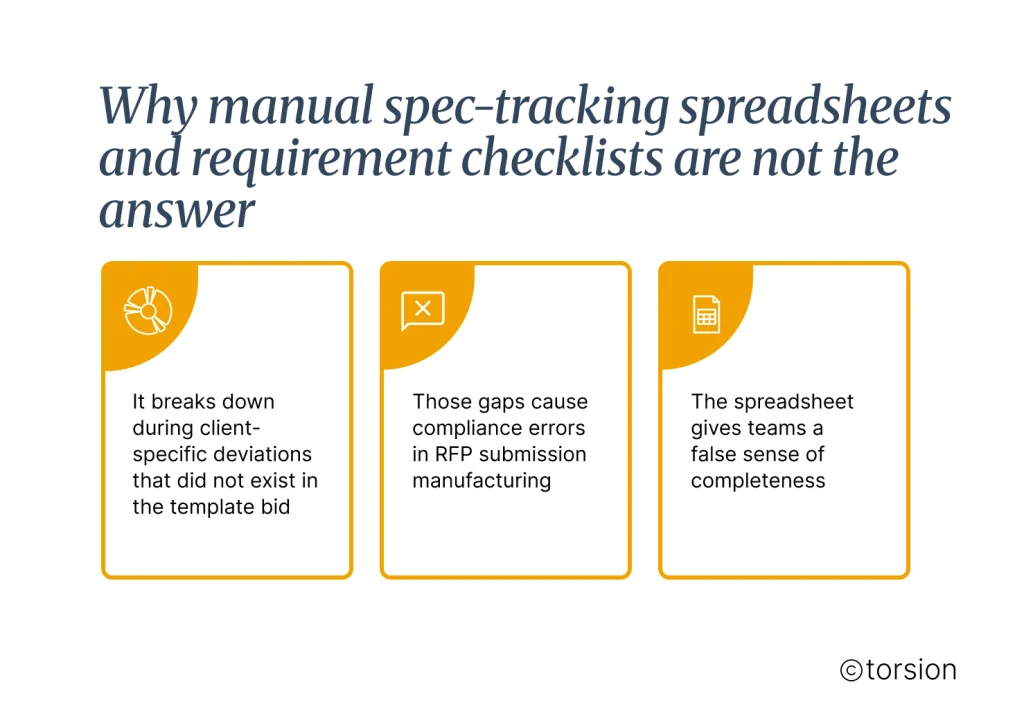
Manual spec-tracking spreadsheets and requirement checklists built from previous similar bids are the most common first response to document overload. Teams create a master spreadsheet listing every requirement from a prior, similar RFP, then map incoming requirements against it. The approach works reasonably well when a new bid closely mirrors a previous one, but it breaks down at the exact point where it matters most: novel requirements, updated standards, or client-specific deviations that did not exist in the template bid. Those gaps are where compliance errors in RFP submission manufacturing consequences become real. A single missed clause referencing an updated welding standard or a changed testing protocol can disqualify an otherwise strong bid. The spreadsheet gives teams a false sense of completeness because it only captures what was known before, not what is new. Research into what the RFP process really costs confirms that hidden rework from these gaps often doubles the effective cost per proposal.
Assigning multiple engineers to review the same document package in parallel to reduce total calendar time is the second most common workaround. The logic is straightforward: if one person takes three days to review 50 documents, three people should take one day. In practice, parallel review introduces coordination overhead that partially offsets the time savings. Engineers working independently will flag the same requirements differently, use inconsistent terminology in their notes, and occasionally miss requirements that each assumed the other would catch. The handoff and reconciliation step, where someone must merge three separate review outputs into a single coherent requirements matrix, often takes nearly as long as a single sequential review would have. Worse, it consumes three engineers’ time instead of one.
The cause is structural. More bodies change nothing. A $500M industrial equipment manufacturer that Torsion works with tried both approaches over 18 months before concluding that neither reduced their compliance error rate or meaningfully shortened their bid cycle.
The structural cause behind hidden costs of manual RFP document processing
Manual RFP processing is a latency problem disguised as a labour problem – the bottleneck is the sequential nature of human document review, not the skill or effort of the team. A human reviewer must read a document, understand its context, identify requirements, cross-reference those requirements against other documents in the package, and record findings before moving to the next file. Each step depends on the one before it. Adding more reviewers does not eliminate this dependency; it just distributes it across more people who then need to synchronize their outputs. No amount of process improvement or headcount expansion changes the fundamental constraint that a human can only hold so many cross-references in working memory at once. The compliance errors in RFP submission manufacturing consequences that result from this constraint are not mistakes born of carelessness. They are predictable outcomes of asking people to do work that exceeds the bandwidth of sequential human cognition when applied to 200-400 page technical packages.
Left in place, the cost compounds with every package the team touches. Compliance errors surface after bid submission, sometimes weeks later when a client’s evaluation committee flags a missing certification or an incomplete response to a mandatory section. By then, the opportunity to correct the submission has passed. Qualified bids get declined during intake because the team knows they cannot complete a thorough review within the submission window. Proposal quality degrades under time pressure: executive summaries become generic, technical responses become copy-paste from prior bids without proper tailoring, and deviation narratives get skipped entirely. For manufacturing sales leaders and proposal managers, the result is a slow erosion of win rate that is difficult to diagnose because no single bid failure looks systemic. The pattern only becomes visible in aggregate, across a full year of submissions.
A structural cause requires a structural solution, one that changes the sequence of work itself rather than asking people to move through the same sequence faster.
Where the cost goes when AI absorbs the document work
The shift happens when AI handles the rule-based, sequential portions of RFP document processing: document graphing, requirements extraction, compliance checking, and output generation. Instead of a human reviewer reading files one at a time and building a mental map of cross-references, an AI system processes all documents simultaneously. Torsion’s AI approach processes the full document package as a connected graph rather than a linear queue, eliminating the latency that is the true source of the time cost. Requirements are extracted and mapped against applicable standards, compliance gaps are flagged with specific document and page references, and the output is a structured matrix that a proposal team can act on immediately. This is not about replacing engineering judgment. It is about removing the hours of mechanical reading and cross-referencing that precede the point where engineering judgment actually adds value. Organizations that have moved toward AI-assisted RFP response report that the cost per bid drops significantly even in the first quarter of deployment.
One $500M industrial equipment maker Torsion works with cut document review from 40 to 60 files read by hand over three days down to a structured reference graph and extracted standards list produced in under four hours. Engineers who had lost 15 to 20 hours a week to document review during peak periods reclaimed that time for technical work. The cost that vanished was one nobody had been tracking, which is why it sat unaddressed for years.impact on government contracting workflows
What you are actually paying for every manual RFP response
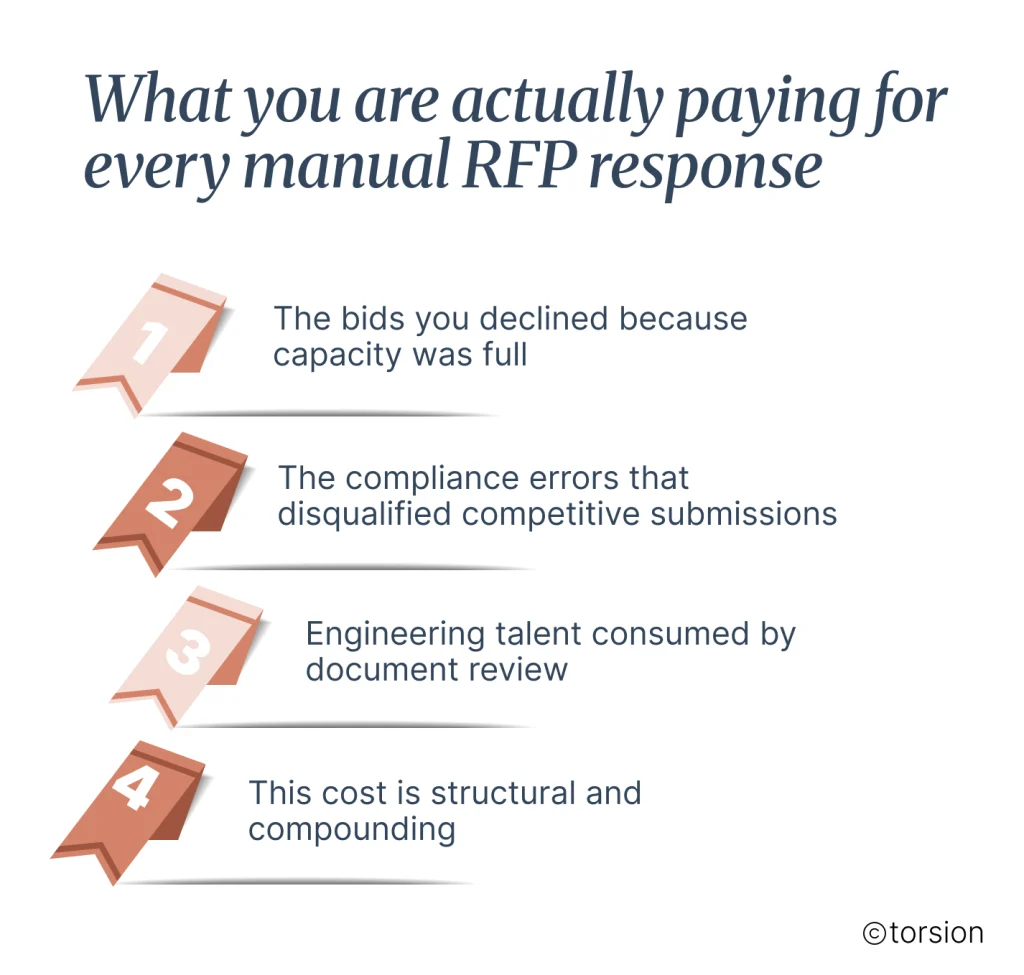
Every manual RFP response carries a price tag that goes far beyond the visible labor hours: it includes the bids you declined because capacity was full, the compliance errors that disqualified otherwise competitive submissions, and the engineering talent consumed by document review instead of technical problem-solving. For proposal managers in manufacturing, the most important realization is that this cost is structural and compounding, meaning each quarter of manual processing makes the next quarter’s pipeline harder to sustain.
If you are tallying what your manual process actually costs, the complete guide to AI for manufacturing RFP response covers the full picture. For organizations ready to quantify the specific impact on their own bid operations, Torsion’s team can provide a based on your current volume, document complexity, and compliance requirements. A can also help frame the internal business case. The playbook from offers additional perspective on how structured AI integration changes bid economics across regulated industries.tailored assessmentpractical breakdown of manual proposal costsgovernment contracting insights