
TL;DR:
- The problem: AI pilots that never move from proof-of-concept to production cost CTOs and VP Engineering at manufacturing and industrial companies dearly: 70% of enterprise AI initiatives fail to move from pilot to full production deployment (McKinsey State of AI 2024)
- Why it matters: Only 11% of organizations that complete an AI proof-of-concept report achieving measurable business value from it within 12 months (Gartner AI Adoption Survey 2024)
- Why workarounds fail: Running multiple simultaneous pilots in parallel to find one that performs well in a demo and extending the pilot timeline indefinitely to gather more data before committing to a production decision address symptoms, not the structural cause
- What changes with AI: Phase 1 was built entirely on 3 years of the client’s actual historical bid documents, not synthetic data, with accuracy benchmarks established and signed off before any production cutover
- The root cause: Most AI pilots fail not because the technology does not work, but because they are evaluated on demo performance against curated data rather than production-grade accuracy on the client’s real, messy documents
The question of why enterprise AI pilots fail to reach production has a stark answer backed by data: 70% of enterprise AI initiatives fail to move from pilot to full production deployment (McKinsey State of AI 2024). For CTOs and VP Engineering at manufacturing and industrial companies, this failure rate represents more than a technology problem: it means stalled AI proof-of-concept to production manufacturing workflows, wasted budgets, and eroded confidence in AI as a viable operational tool. By the end of this article, you will understand the structural reasons behind this failure rate, why common workarounds make things worse, and what the small percentage of successful deployments actually do differently.
The gap between a promising demo and a production system that runs reliably on real data is where most enterprise AI projects go to die. That gap is not closing on its own, and the standard playbook for managing it is broken. Understanding why is the first step toward fixing it.
The real scope of AI pilots that never move from proof-of-concept to production
Seventy percent of enterprise AI initiatives fail to move from pilot to full production deployment (McKinsey State of AI 2024). Only 11% of organizations that complete an AI proof-of-concept report achieving measurable business value from it within 12 months (Gartner AI Adoption Survey 2024). These numbers are not abstractions. For manufacturing and industrial companies attempting AI proof-of-concept to production manufacturing transitions, they represent millions in sunk costs and months of engineering time that produced nothing usable.
Consider what a typical week looks like for a proposal manager at a mid-size industrial manufacturer. They are processing 8 to 12 active bid requests simultaneously, each requiring cross-referencing of 40 to 100 pages of technical specifications against internal product catalogs, compliance matrices, and pricing sheets. Two or three qualified bids get declined every month purely because the team lacks capacity to respond within the submission window. The documents pile up. The cross-referencing is manual. The deadlines are fixed.
The true cost extends well beyond hours spent. Every declined bid is lost revenue. Every rushed submission with incomplete compliance checks carries risk of disqualification or, worse, a contract awarded on terms the company cannot actually meet. Win rates drop not because the company’s products are inferior but because the proposal team is operating at 120% capacity with no structural relief in sight. Team turnover in these roles runs high, and institutional knowledge walks out the door with every departure.
Why running multiple simultaneous pilots in parallel is not the answer
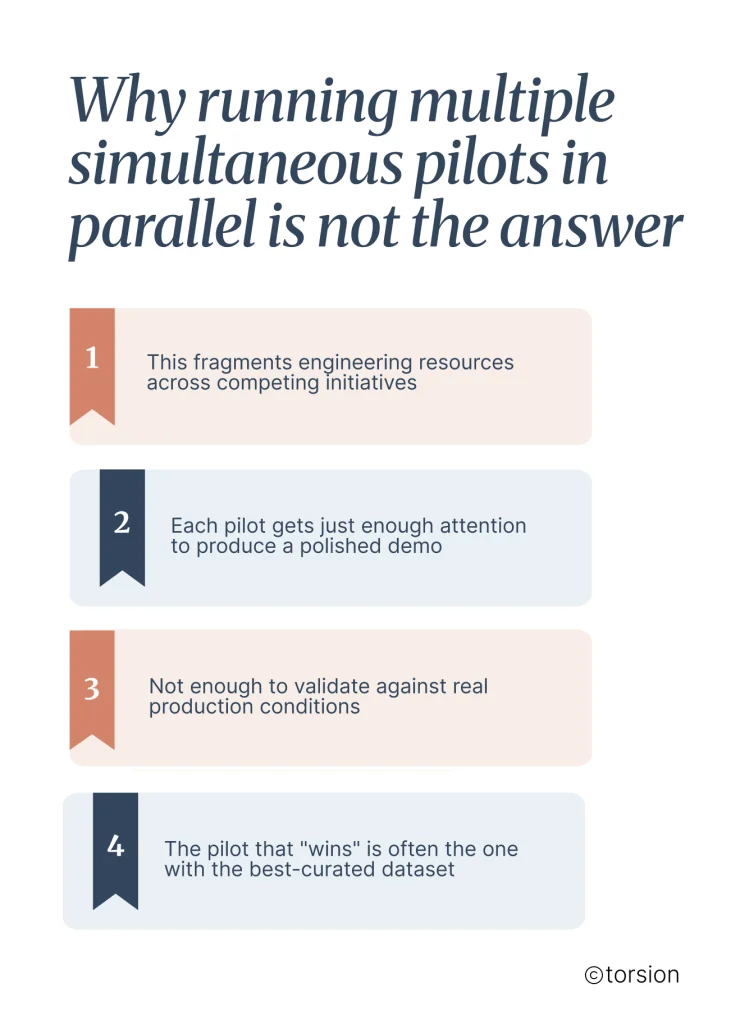
The first workaround most enterprise teams try is running multiple simultaneous pilots in parallel to find one that performs well in a demo. The logic seems sound: test three or four vendors or approaches, pick the winner. In practice, this fragments engineering resources across competing initiatives, and each pilot gets just enough attention to produce a polished demo but not enough to validate against real production conditions. The enterprise AI implementation failure rate causes are visible right here: 42% of AI projects show zero ROI precisely because the selection criteria reward demo performance over production readiness. The pilot that “wins” is often the one with the best-curated dataset, not the one most likely to survive contact with real documents.
The second workaround is extending the pilot timeline indefinitely to gather more data before committing to a production decision. This feels responsible. More data, more confidence, right? But indefinite timelines kill momentum. Stakeholders lose interest. Budget windows close. The pilot team gets reassigned. And the fundamental problem remains untested: whether the system can perform on uncurated, messy, real-world data at production volume. Research consistently shows that extended pilots without fixed benchmarks simply delay the same failure that would have surfaced in week six.
The bottleneck is structural. More staff will not clear it. A $500M industrial equipment manufacturer Torsion works with had run three consecutive pilot programs over 18 months before recognizing that the evaluation framework itself was the bottleneck.
The structural cause behind AI pilots that never move from proof-of-concept to production
Most AI pilots fail not because the technology does not work, but because they are evaluated on demo performance against curated data rather than production-grade accuracy on the client’s real, messy documents. This is the root cause, and it explains why the enterprise AI implementation failure rate causes remain stubbornly consistent year over year. The problem is structural because it is embedded in how pilots are scoped, evaluated, and approved. No amount of additional headcount or process refinement changes the fact that a system validated on clean, hand-picked examples will behave differently when it encounters the full spectrum of a company’s actual document corpus. MIT research confirms that this evaluation gap is the single largest predictor of pilot failure.
Unaddressed, this is what turns a promising pilot into a stalled one. Compliance errors surface after bid submission because the AI was never tested against the specific regulatory language the company’s clients use. Qualified bids get declined because the proposal team does not trust the system’s output enough to rely on it under deadline pressure. Proposal quality degrades as teams toggle between manual processes and a half-trusted AI tool, introducing inconsistency rather than reducing it. For CTOs and VP Engineering at manufacturing and industrial companies, this creates a credibility problem: the AI initiative that was supposed to increase capacity instead becomes a source of friction and rework.
A structural cause requires a structural solution, one that changes what gets measured and when.
What the successful 5% do once AI owns the document work
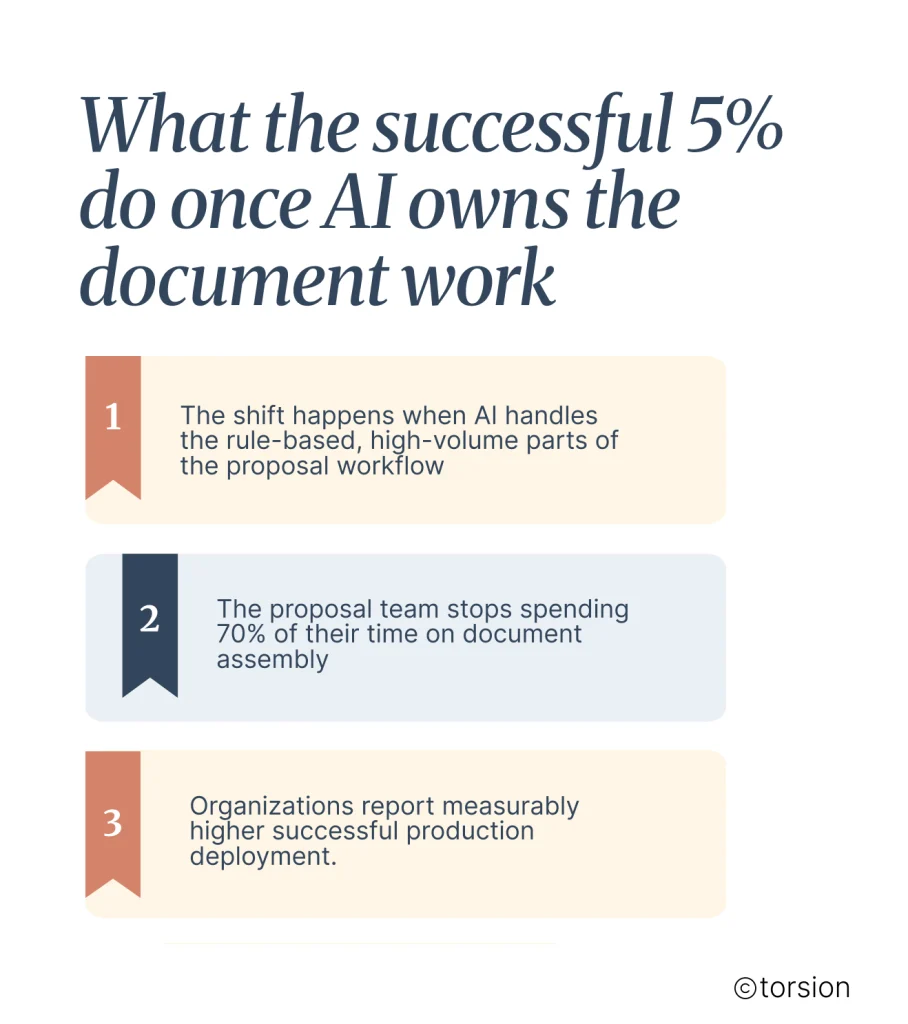
The shift happens when AI handles the rule-based, high-volume parts of the proposal workflow: document graphing, requirements extraction, compliance checking, and output generation. These are the steps where human time is most expensive and least differentiated. When an AI system takes over these tasks, the proposal team stops spending 70% of their time on document assembly and starts spending it on the work that actually wins bids. Torsion’s Phase 1 engagement is deliberately scoped to 6 weeks with fixed accuracy benchmarks. The client approves performance on their own data before any commitment to Phase 2. This structure exists specifically to close the gap between pilot and production: there is no indefinite evaluation period, no demo on synthetic data, and no ambiguity about what “good enough” means. Organizations that adopt this kind of structured approach report measurably higher rates of successful production deployment.
At that manufacturer, Phase 1 ran entirely on three years of the company’s own historical bid documents rather than synthetic data, with accuracy benchmarks signed off before any production cutover. That sequence, real data first and a benchmark gate before go-live, separates the pilots that ship from the ones that stall. The system learned the exact document formats, compliance language, and product specifications the company meets in live bids.
This approach reflects a broader principle in enterprise AI adoption. Torsion’s methodology covers the full AI lifecycle, from initial roadmap through deployment, monitoring, and regulatory compliance, with ethics and governance frameworks built into every stage rather than added after the fact. For manufacturing companies operating in compliance-heavy environments, this matters. A system that performs well on clean data but has no governance structure is a liability, not an asset.
The difference between an AI pilot and an AI deployment
The difference comes down to one thing: what data the system was validated on and who signed off on the accuracy. If your AI pilot was evaluated on curated examples selected to make it look good, you have a demo. If it was evaluated on your actual historical documents with fixed accuracy thresholds agreed upon before testing began, you have the foundation for a production system. For proposal managers at manufacturing and industrial companies, the practical test is simple: can you trust this system’s output enough to submit it to a client without manual review of every line?
If you are weighing an AI pilot for your proposal process, the complete guide to AI for manufacturing RFP response covers the full picture. For teams ready to move past the pilot stage and into structured deployment, is a practical next step: they will assess your current workflow and come back with specific, tailored recommendations for your business.reaching out to Torsion’s team