
TL;DR:
- The real decision is choosing between off-the-shelf RFP software and a custom AI system built specifically for manufacturing proposal automation
- Most teams evaluate on feature count or demo polish rather than how each option handles their specific document types and compliance requirements
- Evaluate on training data source, large document handling, compliance checking, pricing model, and data ownership
- Avoid any vendor who cannot tell you exactly what training data their system uses and how accuracy was measured before you sign
- A well-structured engagement looks like a 6-week Phase 1 scoped build on the client’s own historical bid documents, product specs, and compliance records, where the client owns all code and data at the end with no ongoing dependency
If you are reading this, you are probably not wondering whether AI can help your proposal team. You already know it can. The question is whether to buy an off-the-shelf RFP software subscription or invest in a custom AI system for manufacturing proposal automation, and most of the comparison content online does not help you answer that honestly. The mistake most teams make when comparing AI and RFP software for manufacturing proposals is evaluating on feature count or demo performance rather than on how each tool actually handles their specific document types, product nomenclature, and compliance requirements. This article gives you the specific criteria, red flags, and a decision framework to make the right call for your bid volume and document complexity. It is built for VP Sales and Proposal Directors at manufacturing companies who are past the “should we use AI?” stage and into the “which approach actually works for our process?” stage. The distinction matters because generic advice about proposal automation ignores the reality that manufacturing bids involve 200-to-400-page technical packages, industry-specific compliance standards, and product specifications that no general-purpose tool was trained to understand. What follows is a structured comparison designed to save your team from a six-figure mistake.
What most teams get wrong when choosing between off-the-shelf RFP software and a custom AI system
The most common error is treating this as a feature comparison. Teams sit through demos of Loopio, Responsive, and RFPIO, then compare those against AI-powered alternatives based on how many integrations each tool supports or how polished the interface looks. That approach fails manufacturing proposal teams specifically because the demo environment never reflects the complexity of a real bid. A vendor can show you a clean, 20-page sample RFP and make the output look impressive. But your team is dealing with multi-section technical packages that reference proprietary product lines, customer-specific compliance clauses, and engineering tolerances that vary by contract. The demo tells you nothing about how the system performs on those documents.
The better question is not “which tool has more features?” but “which approach can be trained on our actual bid history, product specifications, and compliance records?” RFP software does three things well: it provides a proposal content library, enables team collaboration, and generates responses from templates. A custom AI system built on a manufacturing company’s own bid data does something fundamentally different: it learns the company’s specific nomenclature, understands how compliance requirements vary across contracts, and generates responses calibrated to how that company actually wins bids. The gap between a custom AI RFP system and a SaaS tool for manufacturing bids is not about features. It is about whether the system knows your business or just knows how to format a response.
The five criteria that separate custom AI from RFP software
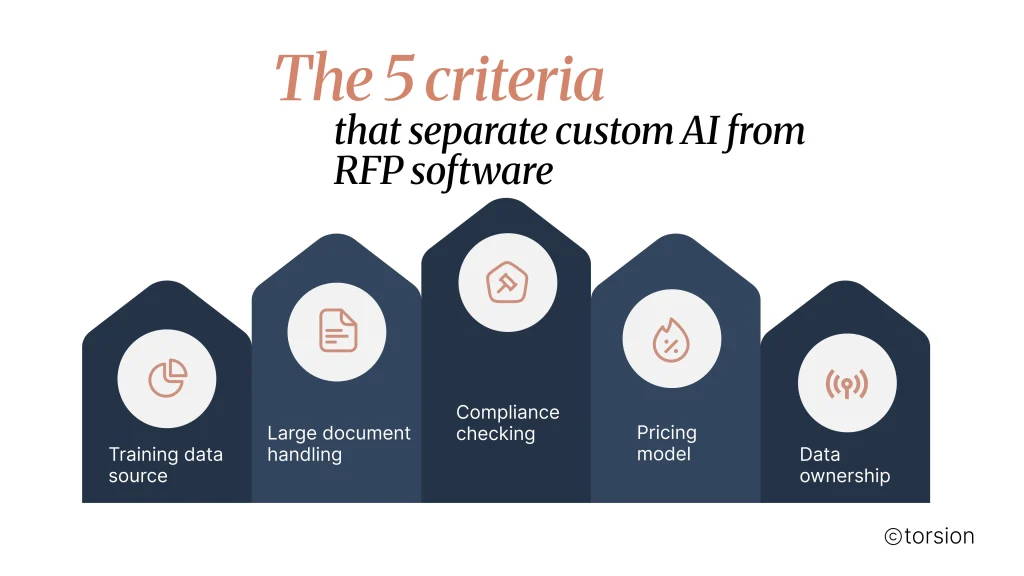
Training data source
A system trained on generic proposal data will not know your product nomenclature, your compliance standards, or the bid structures your customers expect. Accuracy depends entirely on the training data source. When evaluating a vendor, ask: “What specific data was this system trained on, and can you show me accuracy benchmarks on documents similar to ours?” A good answer names the data sources and provides measured accuracy figures. A vague answer like “we trained on thousands of RFPs across industries” means the system knows a little about everything and not enough about your products.
Large document handling
Not all tools process 300-page multi-document bid packages the same way. Many RFP platforms require manual upload and section tagging before the system can generate anything useful, which means your proposal team spends hours on prep work before the tool even starts helping. Ask the vendor to demonstrate processing a full, unstructured bid package. A strong system ingests the full package autonomously, builds a reference graph across documents, and extracts requirements without manual setup. If the answer involves “your team will need to tag sections first,” factor that labor cost into your evaluation.
Compliance checking
Generic compliance checking uses standard clause libraries that may not match your industry’s specific requirements. For manufacturing teams working across defense, energy, or regulated industrial sectors, this is where mistakes become expensive. A custom AI system is trained on the specific standards, client specifications, and compliance obligations from your own bid history. The evaluation question here is: “Can you show me how your system handles a compliance requirement that is specific to our industry and not covered by a standard clause library?” The answer reveals whether the tool checks boxes or actually understands your regulatory environment.
Pricing model
SaaS tools charge per seat or per RFP, which means costs scale directly with team size and bid volume. A custom AI system involves a one-time build cost with no ongoing per-use fees. For teams processing 30 or more RFPs per year, the math often favors a custom build within the first 12 to 18 months. Ask both types of vendors to project total cost of ownership over three years at your current bid volume, then at 150% of that volume. The pricing model that scales better for your growth trajectory is the one worth choosing.
Data ownership
With SaaS RFP tools, your bid responses and documents are stored on vendor infrastructure, and data usage is governed by vendor terms you may not have read carefully. With a custom AI system, the client owns all code, models, and data. This matters for manufacturing companies whose bids contain proprietary engineering data, pricing strategies, and customer-specific configurations. A well-structured engagement ends with the client holding full ownership: custom-built systems are becoming the standard for exactly this reason.
Three red flags when a vendor pitches RFP automation
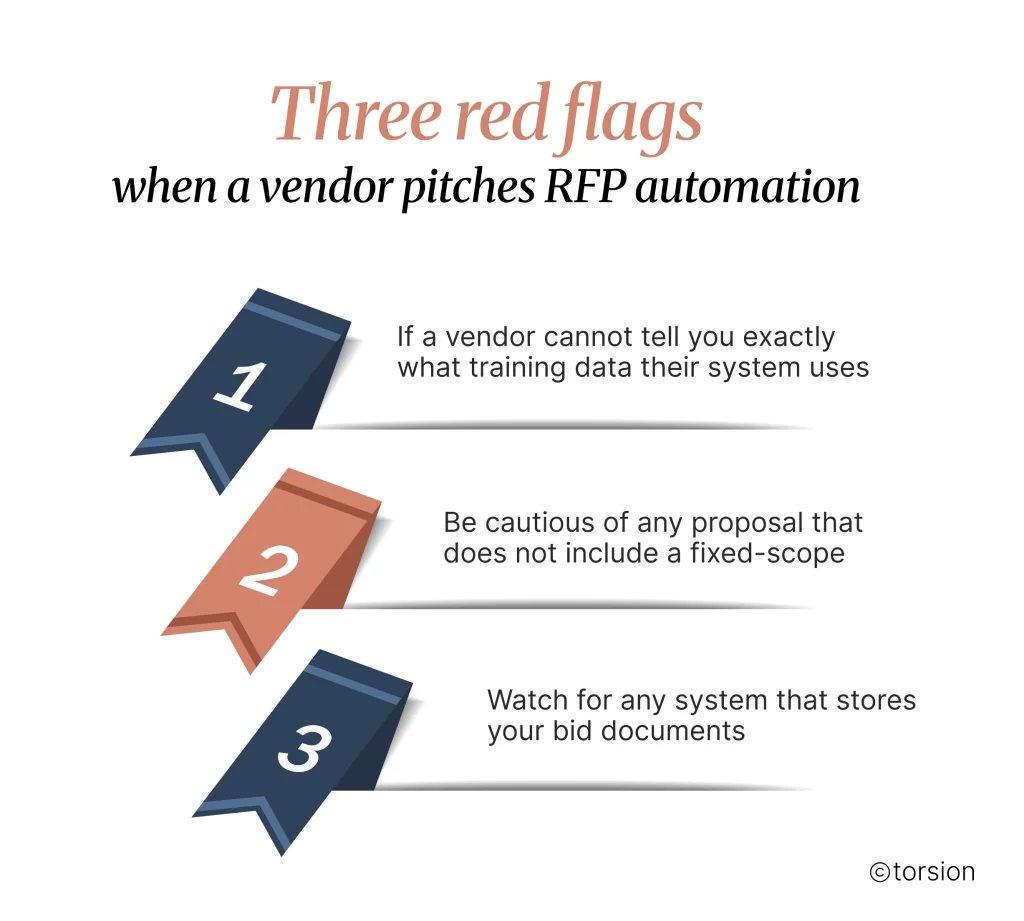
If a vendor cannot tell you exactly what training data their system uses and how accuracy was measured before you sign, walk away. This is not a minor omission. For manufacturing proposal teams, accuracy on your specific document types is the entire value proposition. Ask: “What was your accuracy rate on technical manufacturing bid packages during testing, and how did you measure it?” If the answer references general benchmarks or pivots to a discussion about the platform’s other capabilities, the vendor either has not tested on documents like yours or does not want to share the results.
Be cautious of any proposal that does not include a fixed-scope Phase 1 with defined accuracy benchmarks before full deployment begins. Some vendors push for a 12-month contract with a long onboarding period and no clear accuracy targets until months into the engagement. The test here is simple: ask for a scoped pilot on one real historical bid, with a defined accuracy threshold that determines whether the engagement proceeds. If the vendor resists this structure, they are not confident in their system’s performance on your data.
Watch for any system that stores your bid documents on shared infrastructure or uses them to improve a model that other clients benefit from. SaaS platforms often aggregate user data to improve their models across the entire customer base. For manufacturing companies, this means your proprietary product specifications, pricing strategies, and compliance approaches could be informing responses generated for competitors. Ask directly: “Does our data remain isolated, or does it contribute to a shared model?” If the vendor hedges, your bid intelligence is not as private as you think.
RFP software vs custom AI for manufacturing proposal teams: six dimensions that matter
RFP software tools like Loopio, Responsive, and RFPIO are genuinely good products for teams whose primary need is collaboration and content library management. This comparison is not about dismissing those tools. It is about recognizing that for manufacturing proposal teams dealing with complex technical bids, the requirements extend well beyond what a collaboration platform was designed to handle. The question of AI vs. RFP software for manufacturing proposal teams comes down to whether you need a better way to organize responses or a system that can actually generate accurate, compliant technical content from your own data. The table below compares six dimensions that matter most for VP Sales and Proposal Directors at manufacturing companies evaluating proposal automation options teams.
| Dimension | RFP software (Loopio / Responsive / RFPIO) | Custom AI system (Torsion) |
| Training data | Uses generic proposal libraries and publicly available bid data | Trained exclusively on the client’s own historical bids, product specs, and compliance records |
| Large document handling | Requires manual upload, section tagging, and template mapping by the proposal team | Ingests the full package autonomously, builds a reference graph, and extracts requirements without manual setup |
| Compliance checking | Checks against generic clause libraries that may not match your industry standards | Checks against the specific standards, client specifications, and compliance obligations from your own bid history |
| Pricing model | Per-seat or per-RFP subscription; costs scale with team size and volume | One-time Phase 1 build fee; no ongoing per-use or per-seat charges |
| Data ownership | Bid responses and documents stored on vendor infrastructure; data usage governed by vendor terms | Client owns all code, models, and data; no ongoing vendor access to bid documents after deployment |
| Time to accurate output | Generic templates usable from day one; accuracy on your specific documents requires extensive manual configuration | 6-week Phase 1 build produces output calibrated to your specific products and document types from first use |
What a well-scoped custom AI engagement looks like
A well-structured engagement starts with a fixed-scope Phase 1 that typically runs six weeks. During that period, the system is built on the client’s own historical bid documents, product specifications, and compliance records. The scope is defined before work begins: which document types, which compliance standards, and what accuracy benchmarks determine success. At the end of Phase 1, the client owns all code, models, and training data. There is no ongoing dependency, no subscription that locks you in, and no vendor retaining access to your bid intelligence. This structure exists because AI-powered manufacturing platforms work best when they are purpose-built for the specific environment they serve, not configured from a generic template.
A $500M industrial equipment manufacturer Torsion works with chose a custom AI system over a subscription RFP tool after comparing both approaches on a real historical bid: the RFP tool required 2 days of manual configuration per bid while the custom system processed the same package in under 4 hours. The proposal team now spends its time reviewing and refining AI-generated responses rather than manually assembling them from a content library. Compliance checking that previously took a senior engineer half a day per bid now happens automatically against the company’s own compliance database. The result was 40% faster compliance processing on technical bids. The client owns all code, models, and training data with no ongoing vendor dependency.
How to choose the right approach for your proposal volume and document complexity
The decision between off-the-shelf RFP software and a custom AI system comes down to two factors: how complex your bid documents are and whether your competitive advantage depends on proposal quality, not just proposal speed. If your bids are short, standardized, and low-compliance, a SaaS RFP tool will serve you well. If your bids involve multi-hundred-page technical packages with industry-specific compliance requirements and proprietary product data, a custom system built on your own data will outperform a generic tool on accuracy, speed, and total cost of ownership within the first year.
The cleanest way to settle the build-versus-buy question is to see both approaches run on one of your real bids: at Torsion, where the team will show you both approaches applied to a real bid document from your archive. We run both options on one of your historical packages and show you the difference.