
TL;DR:
- The decision: identifying which RFP categories to target first when deploying AI for proposal automation in manufacturing
- Common mistake: attempting to automate all RFP types simultaneously rather than isolating the highest-ROI bid category for the first deployment
- What to evaluate: document complexity per bid type, historical win rate by category, annual bid volume by type, engineering hours per response, and compliance standardisation level
- Red flag to avoid: any vendor who recommends starting with your lowest-volume bid type because it is “simpler” – this prioritises vendor convenience over client ROI
- What good looks like: a six-week Phase 1 scoped to the single highest-ROI bid category, identified through a baseline audit of engineering hours, win rate, and annual volume per bid type before the build begins
If you are reading this, you have likely already accepted that AI can improve your manufacturing proposal process and are now working through a harder question: how to prioritize which RFP types to automate first in your manufacturing business. This is the decision that separates teams who see measurable ROI in eight weeks from those still running pilots twelve months later. The most common mistake teams make at this stage is attempting to automate all RFP types simultaneously rather than identifying the single highest-ROI bid category for the first deployment – a failure in prioritizing AI deployment across manufacturing RFP types that burns budget and dilutes results. This article provides the evaluation criteria, the red flags that signal a bad vendor engagement, and a concrete framework for making a better decision about where to start.
What most teams get wrong when deciding which RFP categories to target first when deploying AI
The single most damaging error manufacturing proposal teams make is trying to automate everything at once. A VP of Sales approves a budget, the team selects an AI vendor, and the project scope immediately balloons to cover transformer equipment RFPs, service contract renewals, spare parts bids, and aftermarket support proposals in a single deployment. What happens next is predictable: the AI system gets trained on a thin layer of data spread across five or six bid types, accuracy stays low across all of them, and the proposal team quietly reverts to manual processes within four months. In manufacturing specifically, where a single RFP package can include hundreds of pages of technical drawings, compliance certifications, and product specifications, this scattered approach means the system never gets deep enough in any one category to actually reduce engineering hours.
The right question is not “can we automate our RFPs?” but rather “which single bid category will produce the highest ROI from AI automation first?” Answering this requires distinguishing between what off-the-shelf RFP software does – proposal libraries, collaboration tools, template generation – and what custom AI trained on your specific bid history, product specifications, and compliance records can do. Identifying the highest-ROI RFP category for manufacturing AI automation first means looking at your own data, not accepting a vendor’s generic recommendation. The categories where your team spends the most engineering hours, submits the most bids per year, and already wins at a reasonable rate are almost always the right starting point.
The five criteria for choosing your first bid category
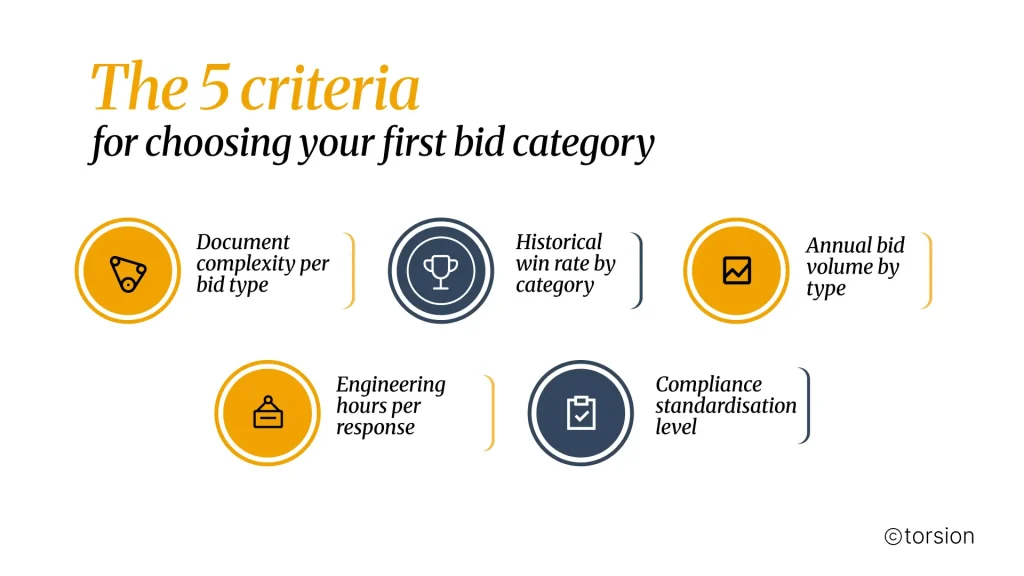
Document complexity per bid type
Bid types with higher document complexity benefit more from AI processing. A 300-page transformer equipment RFP that requires cross-referencing technical specifications, compliance certificates, and engineering drawings saves dramatically more time per response than a 40-page service contract renewal that an experienced proposal writer can handle in a day. Manufacturing companies that automate complex, document-heavy workflows first consistently see faster payback periods. The evaluation question to ask: “For each bid category, how many distinct document types does a single response require?” If a vendor cannot explain how their system handles multi-document cross-referencing for your most complex bid type, the answer you are getting is vague for a reason.
Historical win rate by category
Deploying AI on bid categories where your team already wins at a reasonable rate maximises measurable ROI. If your win rate on transformer equipment bids is 35% and your win rate on aftermarket support proposals is 8%, improving the transformer category by even a few percentage points translates to real revenue. Improvements are more visible and more defensible to leadership where the baseline is strong. Ask any prospective vendor: “How do you use our historical win rate data to select the deployment category?” A good answer references your specific numbers. A vague answer talks about “improving outcomes across the board.”
Annual bid volume by type
Higher-volume categories produce more training data faster, which means the AI system improves more quickly. A category where your team submits 40 bids per year generates enough feedback loops for the model to learn patterns, refine outputs, and increase accuracy within weeks. A category with five bids per year across four sub-types simply does not produce enough data for meaningful model improvement in any reasonable timeframe. Procurement-focused automation in manufacturing follows the same principle: concentrate effort where volume justifies the investment. What good looks like here is a Phase 1 scoped to the single highest-volume category, with a baseline audit confirming at least 20-30 historical bids available for initial training.
Engineering hours per response
Categories with the highest engineering hours per response represent the largest labour cost reduction opportunity. In many manufacturing businesses, the proposal team pulls in two to four engineers per bid for technical review, specification validation, and compliance sign-off. If one bid category consistently requires 80 engineering hours per response and another requires 15, the math on where to start is straightforward. Ask your vendor: “How do you quantify engineering time savings per bid category, and what is your measurement methodology?” If the answer does not include a pre-deployment baseline measurement of hours per response, the vendor has no way to prove the system is working.
Compliance standardisation level
Bid types with a stable, well-defined compliance standard set are better initial candidates than categories with highly variable client-specific requirements. A bid category governed by consistent ISO, IEC, or ASME standards gives the AI system a predictable framework to learn against. Categories where every client invents their own compliance checklist require more manual intervention and more ongoing model adjustment. This does not mean variable-compliance categories cannot be automated – they can, in Phase 2 or Phase 3 – but they are poor choices for a first deployment where the goal is proving ROI quickly.
Three red flags in how a vendor scopes your first category
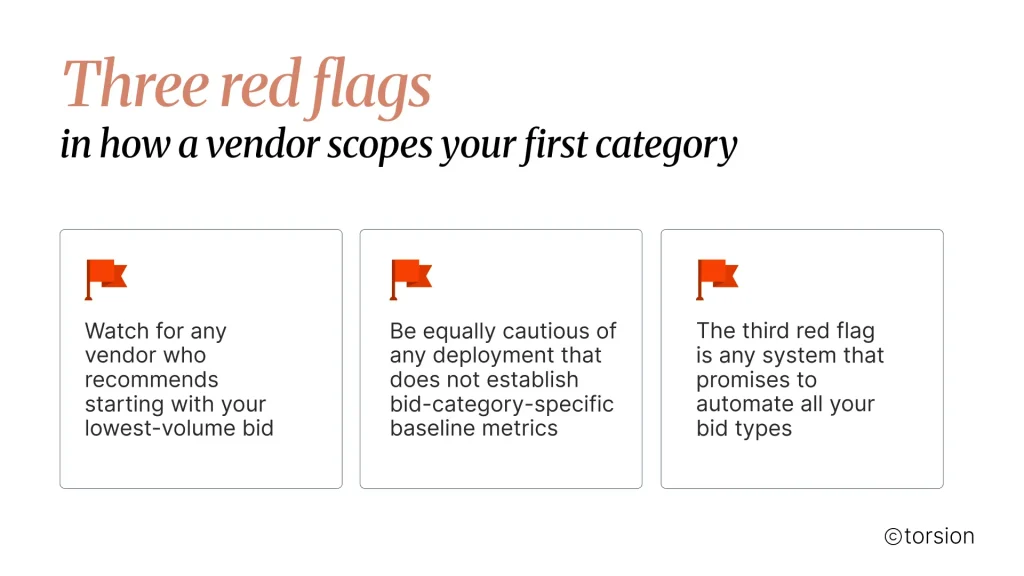
Watch for any vendor who recommends starting with your lowest-volume bid type on the grounds that it is simpler. This is a tell. Simpler for the vendor means less complex training data to manage, fewer edge cases to handle, and a faster “success” story they can reference – but it produces almost no measurable ROI for the manufacturing company paying for the engagement. The test is direct: ask “why are you recommending we start with this category instead of our highest-volume, highest-complexity type?” If the answer centres on the vendor’s delivery timeline rather than your financial return, that is a vendor optimising for their own convenience. RFP automation for manufacturers should always start where the business impact is greatest, not where the technical lift is smallest.
Be equally cautious of any deployment that does not establish bid-category-specific baseline metrics before starting. Without a baseline measurement of engineering hours per response, win rate, and bid cycle time for the target category, there is no way to measure whether the AI system is actually improving anything. Some vendors skip this step because measuring a baseline takes two to three weeks and delays the start of billable work. The question to ask: “What specific metrics will you measure before the build begins, and how will we compare them to post-deployment performance?” If the vendor’s answer is “we will track overall time savings,” that is not category-specific and will not tell you whether the investment is paying off.
The third red flag is any system that promises to automate all your bid types in Phase 1. Production-quality AI requires training data from the specific bid type it is targeting, and accumulating enough data for reliable outputs takes time. A vendor promising to cover five bid categories in an initial deployment is either planning to deliver shallow automation across all of them – essentially a template library with AI branding – or underestimating the technical requirements. Ask: “How many bid categories have you deployed in a single Phase 1 for a manufacturing client, and what were the accuracy benchmarks for each?” One category with 90%+ accuracy beats five categories at 60%.
RFP automation prioritisation for manufacturing: which bid categories to start with
Generalist prioritisation tools work well for teams whose needs are limited to collaboration and document management. This comparison is for teams whose scope includes the full technical bid process: engineering review, compliance validation, specification matching, and response generation. When determining how to prioritize which RFP types to automate first in a manufacturing business, the distinction between a generalist approach and a category-specific AI deployment matters enormously. The table below compares six dimensions that matter most for VP Sales and proposal operations leaders at manufacturing companies beginning an AI deployment teams.
| Dimension | Generalist prioritisation approach | Category-specific AI deployment (Torsion approach) |
| Starting point | Automates the simplest or newest bid type first regardless of ROI | Starts with the highest-volume, highest-complexity category where training data is richest |
| ROI measurement | Measures overall team time saved, not category-specific improvement | Measures win rate, engineering hours, and bid acceptance rate for the specific category |
| Training data quality | Uses available data across all categories, reducing accuracy per category | Concentrates training data on one category, producing higher accuracy sooner |
| Expansion plan | Undefined: no structured approach to adding new bid categories | Category-by-category expansion with accuracy benchmarks per type before proceeding |
| Timeline to measurable result | 6-12 months before enough cross-category data exists to measure impact | 4-8 weeks for the first category in Phase 1; clear before/after comparison available |
| Compliance handling | Generic compliance framework applied across all categories | Compliance rules trained per bid category matching the specific standards for each type |
What a category-first deployment looks like in practice
A well-structured engagement starts with a baseline audit, not a build. Before any model training begins, the engagement team maps every active bid category, documents the engineering hours per response, pulls historical win rates, and calculates annual volume per type. This audit typically takes two to three weeks and produces a clear ranking of categories by expected ROI. The highest-ranked category becomes the scope for a six-week Phase 1 – a focused deployment on a single bid type where the data is richest and the financial impact is most measurable. This is how structured execution bridges the gap between AI ambition and real-world enterprise outcomes.
A $500M industrial equipment manufacturer working with Torsion scoped Phase 1 to transformer equipment RFPs – the highest-volume, highest-complexity category – and produced measurable results in six weeks before expanding to additional product lines. The proposal team now spends roughly 60% less engineering time per transformer bid, with compliance validation handled automatically against IEC and IEEE standards rather than manually cross-checked by two engineers per submission. The model accuracy on technical specification matching reached 92% within the first Phase 1 cycle. The client owns all code, models, and training data outright, with no ongoing vendor dependency or licensing fees tying them to a single provider.
Which bid category to automate first and how to measure whether it worked
The single most important decision in manufacturing RFP automation is not which AI tool to buy – it is which bid category to deploy it on first. Get that right, and the ROI data from Phase 1 funds and justifies every subsequent phase; get it wrong, and the entire initiative stalls before it proves anything.
The quickest way to find your highest-ROI starting category is a 30-minute audit of your bid history – at Torsion, where the team will identify your highest-ROI automation starting point before you commit to a build. They map your highest-impact RFP automation opportunity and tell you whether a custom system makes financial sense for your specific process.book an RFP audit