
TL;DR:
- The problem: proposal team capacity forcing bid declines is costing VP of Sales and Directors of Business Development at US manufacturing companies.
- 42% of proposal teams regularly decline RFP opportunities due to insufficient bandwidth (APMP Proposal Industry Salary and Compensation Survey)
- Why it matters: the average value of a declined industrial manufacturing contract ranges from $250K to $2M per bid depending on scope and product category (Shipley Associates win-loss analysis benchmarks)
- Why workarounds fail: hiring contract proposal writers to cover peak RFP periods and applying bid/no-bid scoring to triage RFPs by relationship quality rather than systematic capacity planning address symptoms, not the structural cause
- What changes with AI: the proposal team went from declining 3 to 4 qualified bids per month to responding to all incoming qualified opportunities after AI took over document processing
- The root cause: proposal teams are spending 60-70% of their working hours on rule-based document tasks – reading, extracting, cross-referencing – that prevent bid volume from scaling even when the sales pipeline justifies it
Understanding why manufacturing proposal teams decline qualified RFP opportunities starts with a number that should unsettle every sales leader: 42% of proposal teams regularly decline RFP opportunities due to insufficient bandwidth (APMP Proposal Industry Salary and Compensation Survey). For VP of Sales and Directors of Business Development at US manufacturing companies, the reality of a manufacturing sales team declining qualified RFP bids due to capacity constraints means revenue is disappearing before a single page of a proposal is written. By the end of this article, you will understand the structural cause behind these declines, why common fixes fail, what the actual cost looks like in dollar terms, and how AI-driven document processing is enabling manufacturing proposal teams to respond to every qualified bid without adding headcount.
The pipeline looks healthy. The CRM is full. Sales has done the relationship work. And yet, bids are being turned away. That disconnect between pipeline strength and proposal output is one of the most expensive, least-discussed problems in industrial manufacturing sales today. Most leadership teams assume it is a staffing issue. It is not. The bottleneck sits deeper than headcount, and the cost of ignoring it compounds every quarter.
Every declined RFP is a decision made under pressure, not a strategic choice. The proposal manager is not saying “this opportunity is a bad fit.” They are saying “we physically cannot produce another compliant response this week.” That distinction matters enormously, because the revenue lost to capacity constraints is revenue that was already qualified, already in the pipeline, and already worth pursuing.
The real scope of proposal team capacity forcing bid declines
Roughly 42% of proposal teams regularly decline RFP opportunities due to insufficient bandwidth (APMP Proposal Industry Salary and Compensation Survey). The average value of a declined industrial manufacturing contract ranges from $250K to $2M per bid depending on scope and product category (Shipley Associates win-loss analysis benchmarks). When a manufacturing sales team is declining qualified RFP bids due to capacity rather than strategic fit, the math gets uncomfortable fast: even three declined bids per month at the low end of that range represents $750K in unrealized pipeline, or $9M annually.
Consider what a typical week looks like for a proposal manager at a mid-market industrial manufacturer. Monday opens with two new RFP packages, each running 80 to 150 pages of technical specifications, compliance requirements, and commercial terms. By Tuesday, the team is cross-referencing product data sheets against customer-specific requirements, pulling deviation logs from prior bids, and formatting responses to match the buyer’s submission template. A third RFP arrives Wednesday. The team looks at the calendar, looks at the two bids already in progress, and declines the third. That third bid might be a $1.2M contract with an existing customer. It does not matter. There is no capacity to respond.
The true cost extends well beyond the immediate revenue loss. Teams operating at maximum capacity consistently produce lower-quality proposals. Win rates drop. Compliance errors increase. The average RFP response win rate across industries hovers around 45%, but teams stretched thin on capacity often fall well below that benchmark. When proposal quality degrades, even the bids that do get submitted carry a lower probability of winning, creating a compounding loss that most organizations never quantify.
Why hiring contract proposal writers to cover peak RFP periods is not the answer
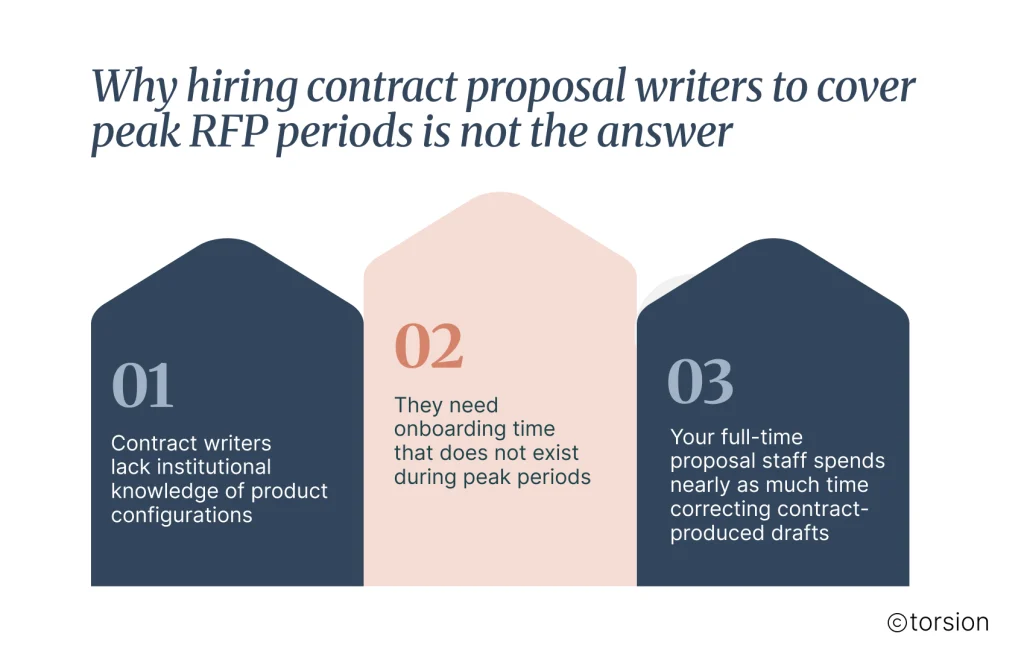
Hiring contract proposal writers to cover peak RFP periods is the most common response to RFP bid capacity constraints in manufacturing proposal teams. The logic seems sound: demand spikes, so you bring in temporary help. The failure mode is specific and predictable. Contract writers lack institutional knowledge of product configurations, deviation history, and customer-specific compliance requirements. They need onboarding time that does not exist during peak periods. The result is that your full-time proposal staff spends nearly as much time reviewing and correcting contract-produced drafts as they would have spent writing the responses themselves. The cost to prepare a single competitive proposal can run from $5,000 to $50,000 depending on complexity, and rework from poorly onboarded contractors pushes those numbers higher.
Applying bid/no-bid scoring to triage RFPs by relationship quality rather than systematic capacity planning is the second most common approach. This method ranks incoming RFPs by factors like existing customer relationship, estimated deal value, and competitive positioning. The specific failure mode here is that the scoring framework becomes a rationalization tool for declining bids the team simply cannot handle, rather than a genuine strategic filter. When capacity is the binding constraint, even high-scoring opportunities get declined. The framework gives leadership the impression that declines are strategic when they are actually forced by bandwidth.
This is built into the process. Hiring does not solve it. A $500M industrial equipment manufacturer that Torsion works with tried both approaches over 18 months before recognizing that the constraint was not people or process but the nature of the itself.document work
The structural cause behind proposal team capacity forcing bid declines
Proposal teams are spending 60-70% of their working hours on rule-based document tasks – reading, extracting, cross-referencing – that prevent bid volume from scaling even when the sales pipeline justifies it. This is not a process inefficiency that a better template or a new project management tool can fix. The work itself is the constraint. Every RFP requires reading hundreds of pages, extracting specific requirements, mapping those requirements against product capabilities, checking compliance against regulatory and customer-specific standards, and formatting outputs to match submission templates. These tasks are rule-based and repetitive, but they demand enough domain context that general-purpose administrative staff cannot perform them. The RFP bid capacity constraint facing manufacturing proposal teams is structural because the volume of document work scales linearly with bid volume while human capacity does not.
When this root cause goes unaddressed, the consequences cascade. Compliance errors surface after bid submission because reviewers were rushing through cross-referencing steps. Qualified bids get declined because the team is buried in document processing for the bids already in progress. Proposal quality drops under time pressure, which lowers win rates on the bids that do get submitted. For VP of Sales and Directors of Business Development at US manufacturing companies, this creates a situation where the sales team is generating qualified pipeline that the proposal team physically cannot convert. Recent research shows that RFP completion rates have been falling across industries, and manufacturing is no exception. The growing complexity of RFP documents only accelerates this trend.
A structural cause requires a structural solution, not another incremental staffing adjustment.
What your bid capacity looks like once AI takes the document load
When AI handles the rule-based portions of proposal work, the constraint shifts from document processing capacity to strategic decision-making capacity, which is a fundamentally different bottleneck. The specific steps that change are document graphing (mapping the structure and relationships within an RFP package), requirements extraction (pulling individual compliance and technical requirements from unstructured text), compliance checking (cross-referencing extracted requirements against product specifications and regulatory standards), and output generation (producing formatted response drafts). Torsion’s system offloads the document intake, graphing, and extraction stages – the work that consumes proposal team bandwidth – while the team retains full control of strategic content and product selection. This is not about replacing proposal professionals. It is about removing the document processing burden that prevents them from doing the work that actually wins bids.
The manufacturer cited above went from turning away three to four qualified bids a month to answering every incoming qualified opportunity, with no change in headcount. The declined-bid problem had never been about sales effort. It cleared the moment the document-processing load came off the team.role of AI in creating competitive advantage
One detail worth highlighting: the time and effort required to respond to a typical manufacturing RFP drops significantly when the document intake and extraction stages are automated. Teams that previously spent four to five days on document processing before any strategic work began now reach the strategic phase within hours.
Turning declined bids into accepted ones without adding headcount
The revenue cost of declining qualified bids is real, measurable, and in most manufacturing organizations, completely untracked. If your proposal team is spending the majority of its time on document processing rather than strategic proposal work, the fix is not more people or better triage frameworks: it is removing the document burden that makes every additional bid feel impossible.
If you are looking at where AI could lift your bid capacity, covers the full picture. For a conversation specific to your team’s capacity constraints and bid volume, Torsion’s team can provide tailored insights based on your current workflow and RFP pipeline: to start that conversation.how AI handles the document-heavy steps in the manufacturing RFP processreach out here