TL;DR:
- The typical AI deployment for a manufacturing proposal team takes 3-6 months of failed POC-to-production attempts before anything sticks
- Phase 1 delivered a working prototype in 6 weeks, trained on the client’s actual historical bid documents, with accuracy benchmarks established and signed off before production deployment
- The steps: real data scoping and baseline measurement, system build on historical documents, accuracy benchmarking, production integration, handoff and monitoring setup
- AI cannot match the accuracy of a fully trained system on the first bid type it processes: performance improves as more bids from that product category are processed and feedback is incorporated
- The result: proposal teams focus on judgment work, not document processing
Most CTOs and engineering leaders have seen the same story play out. An engineering team builds or procures an AI proof-of-concept that performs well in a demo against curated data but stalls when tested against the real, messy document structures in the company’s actual bid archive. The question of how to deploy AI for a manufacturing proposal team from POC to production is one that typically burns 3-6 months of failed attempts before anyone admits the approach itself is broken. This article walks through exactly what happens at each stage of AI deployment for manufacturing proposal teams when the goal is a production system, not another demo. If you’re a CTO or VP Engineering overseeing AI deployment at a manufacturing company, you’ll walk away knowing precisely where most deployments fail, what a structured alternative looks like, and how to evaluate whether your current approach is on track or headed for the same dead end.
The gap between a compelling POC demo and a system that actually runs in production is where most AI investments die. Roughly 75% of enterprise AI initiatives fail to deliver on ROI expectations, and the proposal function at manufacturing companies is a perfect case study in why. The bid documents are dense, the compliance requirements are layered, and the product nomenclature is specific enough that generic AI training data is nearly useless.
The AI deployment for manufacturing proposal teams from POC to production process before AI
The first two stages of a typical POC attempt are where the foundation cracks. During real data scoping and baseline measurement, the team runs AI against synthetic or curated data: performance looks strong, but it does not reflect real bid document complexity. A curated dataset might include 50 clean RFP responses, but the actual archive contains thousands of documents with inconsistent formatting, legacy product codes, and compliance clauses that vary by region. During the system build, the AI is not trained on the company’s actual historical bids, product specs, or compliance records. It uses generic training data, which means the system has never seen the specific product nomenclature, standards sets, or deviation histories that define how that company actually bids. These are the ai deployment manufacturing proposal team poc to production steps where most projects quietly lose 4-8 weeks without producing anything usable.
The next three stages compound the problem. Accuracy benchmarking is measured against the demo dataset, not the production environment, so compliance edge cases that appear in real bids are never tested. This means the first time the system encounters a non-standard environmental certification requirement or a customer-specific quality clause, it either hallucinates an answer or skips it entirely. Production integration happens without a structured handoff period: the system is connected to the live bid workflow, and errors are discovered in production rather than during validation. Each production error costs the proposal team 2-4 hours to identify and correct. No monitoring or retraining process is established, so system accuracy does not improve with usage. The system is as wrong on bid number 50 as it was on bid number 1.
The cumulative toll is significant. This manufacturer reported 3 to 6 months of failed POC-to-production attempts on average before engaging a structured . During that period, the proposal team’s bid decline rate increased because engineers were spending time debugging AI outputs instead of writing technical responses. Compliance errors that made it into submitted bids triggered two formal customer complaints, each requiring senior leadership involvement to resolve. , and the manufacturing proposal function is one of the hardest places to get it right without a production-first methodology.deployment partnerOnly about 28% of AI projects generate meaningful ROI
What changes at each stage of the deployment
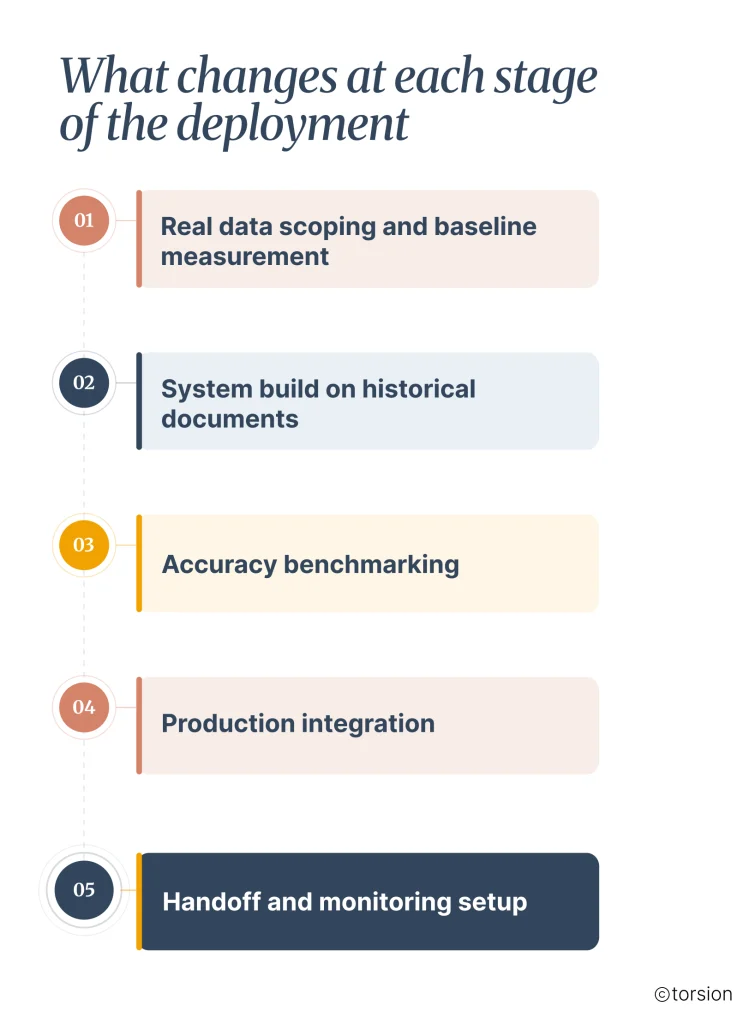
Real data scoping and baseline measurement
In the manual process, an engineering team collects a sample of past bids and cleans them into a format the AI vendor’s system can ingest, often losing metadata, revision history, and compliance annotations in the process. With a production-first approach, all Phase 1 work is performed on the client’s actual historical bid documents, product spec database, and compliance records from day one: the AI ingests documents in their native format, preserving the structural complexity that the system will face in production. The engineer’s role at this stage is to validate that the document set is representative, flagging any bid categories or product lines that are underrepresented in the training corpus.
System build on historical documents
A typical uses generic training data, which means the system has no understanding of the company’s product nomenclature, standards set, or compliance history. In a production-ready enterprise AI POC to production manufacturing proposal deployment, the system is trained specifically on the client’s document types, product nomenclature, standards set, and compliance history. At this manufacturer, this meant training on 12 years of bid documents covering four product families and three regulatory jurisdictions. The engineer validates that the system correctly maps product codes to current specifications and flags any retired products or superseded standards.POC build
Accuracy benchmarking
Manual accuracy testing typically compares AI output to the demo dataset, which was curated to be clean and consistent. A production-ready system benchmarks accuracy against a representative sample of real historical bids, including the edge cases: bids with non-standard compliance requirements, multi-product packages, and customer-specific quality clauses. The client signs off on performance thresholds before any production work begins. The engineer reviews the accuracy report, identifies any bid categories where performance falls below threshold, and decides whether those categories need additional training data or should remain in manual processing for now.
Production integration
Without structure, the system is connected to the live bid workflow and errors surface in production, often on active bids with hard deadlines. A production-ready system is integrated into the live bid workflow in a controlled parallel-run period: AI output is validated against manual review before full cutover. At this manufacturer, the parallel run lasted three weeks and . The engineer compares AI-generated compliance matrices and pre-filled response templates against their own work, documenting discrepancies for the retraining pipeline.covered 14 active bids across two product families
Handoff and monitoring setup
In a typical failed deployment, no monitoring or retraining process is established, so the system’s accuracy degrades as product lines change, new compliance requirements emerge, and customer expectations shift. A production-ready deployment includes monitoring dashboards, retraining triggers, and a structured feedback loop: accuracy improves as new bids are processed. The engineer reviews the monitoring dashboard weekly, approves retraining batches, and escalates any accuracy drops that correlate with new product introductions or regulatory changes.
AI deployment for proposal teams: the POC approach vs the production-ready approach
| Workflow stage | Before AI | With AI |
| Real data scoping and baseline measurement | Team runs AI against synthetic or curated data during the POC: performance looks strong but does not reflect real bid document complexity. | All Phase 1 work is performed on the client’s actual historical bid documents, product spec database, and compliance records from day one, producing a validated reference graph of document relationships. |
| System build on historical documents | System is not trained on the company’s actual historical bids, product specs, or compliance records: it uses generic training data. | System is trained specifically on the client’s document types, product nomenclature, standards set, and compliance history, generating a structured requirements register per bid category. |
| Accuracy benchmarking | Accuracy is measured against the demo dataset, not the production environment: compliance edge cases that appear in real bids are not tested. | Accuracy is benchmarked against a representative sample of real historical bids, producing a signed-off compliance matrix with per-category confidence scores. |
| Production integration | System is connected to live bid workflow without a structured handoff period: errors discovered in production rather than during validation. | System is integrated into the live bid workflow in a controlled parallel-run period: AI output generates pre-filled response templates validated against manual review before full cutover. |
| Handoff and monitoring setup | No monitoring or retraining process is established: system accuracy does not improve with usage. | Monitoring dashboards, retraining triggers, and a structured feedback loop are established: accuracy improves as new bids are processed, with weekly reporting on per-category performance. |
Total time from document intake to submission-ready output drops from 3-6 months of failed POC-to-production attempts on average to 6-week Phase 1 to working production prototype.
What the system cannot do in early deployment
AI cannot match the accuracy of a fully trained system on the first bid type it processes: performance improves as more bids from that product category are processed and feedback is incorporated. This is not a limitation to apologize for. It is a design boundary. AI handles patterns from its training data, and it gets better at recognizing compliance requirements, product specifications, and customer-specific clauses as it processes more examples. But novel requirements outside the training set still need expert judgment. A new environmental regulation that took effect last quarter, or a customer’s proprietary quality standard that has never appeared in a previous bid, will not be handled correctly by any AI system on first contact.
Two additional constraints are worth stating plainly. First, early in deployment the first bids in a new category return less until the system builds examples. If the system has been trained on industrial pumps but the team is now bidding on heat exchangers, the AI’s compliance mapping and product specification matching will be less accurate until it processes enough heat exchanger bids to build reliable patterns. Second, conflicting requirements are surfaced for a subject-matter expert rather than settled automatically. AI flags them: it can identify when a requirement conflicts with a stated specification or when a compliance clause is open to interpretation. But the engineer decides. , and any vendor claiming otherwise is overselling.AI-assisted proposal systems in 2026 still require human oversight for final judgment calls
How one manufacturer went from POC to production in six weeks
Before engaging Torsion, the manufacturer’s proposal team had been through three separate AI POC attempts over 14 months. Each POC performed well against curated demo data but stalled when tested against the real document structures in the company’s bid archive. The average time per bid package was increasing, not decreasing, because engineers were spending hours correcting AI outputs that had been generated from generic training data. Torsion’s Phase 1 build took 6 weeks. The system was trained on the client’s own historical bid documents and product spec database, covering four product families and three regulatory jurisdictions. Accuracy benchmarks were established against a sample of 40 real historical bids, and the client’s engineering lead signed off on performance thresholds before any production work began.
Phase 1 delivered a working prototype in 6 weeks, trained on the client’s actual historical bid documents, with accuracy benchmarks established and signed off before production deployment. The proposal team now operates differently. Engineers focus on product selection, deviation strategy, and client relationships: the work that actually wins bids. Document processing, compliance matrix generation, and initial response drafting are handled by the AI system, with engineers reviewing and approving outputs rather than creating them from scratch. The time comparison tells the story: from 3-6 months of failed POC-to-production attempts on average to a 6-week Phase 1 to working production prototype. Implementation costs for enterprise AI deployments vary widely, but the cost of a 6-week structured deployment is a fraction of what most companies spend on failed POC cycles that never reach production.
What separates a 6-week deployment from a 6-month pilot that never ships
The difference comes down to two things: training on real data from day one, and establishing accuracy benchmarks that the client signs off on before production begins. Every failed POC Torsion has analyzed shares the same root cause: the system was built on generic or curated data and then expected to perform against production-complexity documents it had never seen. CTOs and VP Engineering leaders who have been through this cycle know the pattern. The fix is not better AI. The fix is a structured deployment methodology that treats production readiness as the starting point, not the destination.
If you want to see what deploying AI for your manufacturing proposal team from POC to production looks like, see what a Phase 1 scoping engagement involves: book an assessment to get tailored insights and a realistic timeline for your specific bid environment.