
TL;DR:
- The process: AI training and continuous improvement on historical manufacturing bid data currently takes 3-5 days per complex bid; senior engineer time required for every bid manually
- What AI changes: bid-ready output in under 4 hours with accuracy improving over time for the same output, trained on 3 years of historical bid documents before deployment; knew the client’s product compliance history from day one and improved accuracy with each new bid processed
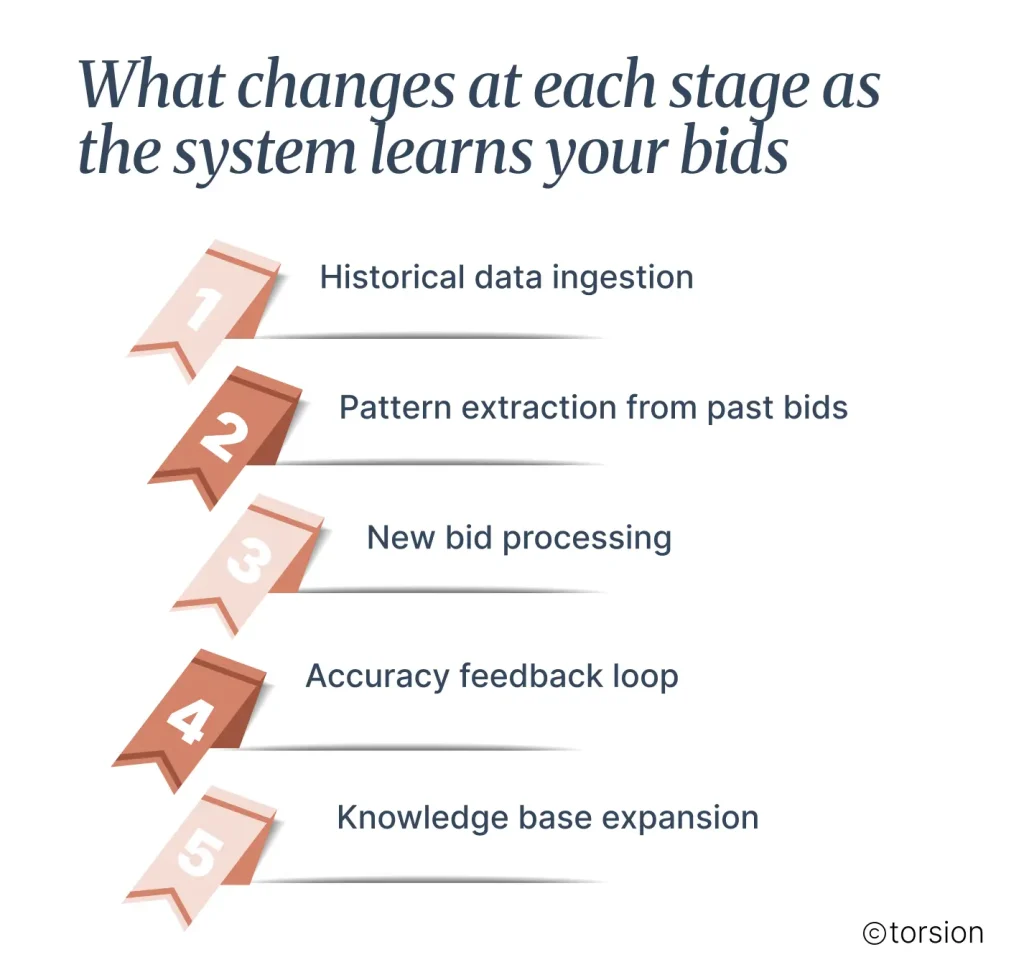
- The steps: Historical data ingestion, Pattern extraction from past bids, New bid processing, Accuracy feedback loop, Knowledge base expansion
- What AI cannot do: AI cannot generate novel compliance strategies or invent product configurations; it surfaces patterns from historical bids and flags unknowns; engineers apply judgment to genuinely new territory
- The result: the system carries more of each bid as it learns, freeing engineers for judgment calls
A proposal team draws on institutional knowledge held by senior engineers: product configurations that passed compliance, past client requirements, successful bid structures. But this knowledge is unstructured and not systematically retrievable, and each complex bid consumes 3-5 days of senior engineer time. Understanding how AI learns from past manufacturing bids to improve RFP responses starts with recognizing that most of this knowledge already exists inside an organization; it just sits in formats no system can query. This article walks through exactly what happens at each stage of AI training and continuous improvement when a custom system is built on a manufacturer’s historical bid data. Manufacturing VP Sales leaders and proposal managers evaluating custom AI will finish this piece knowing precisely which steps the AI handles, which steps still require human judgment, and what realistic improvement looks like over the first year of deployment.
The AI training and continuous improvement on historical manufacturing bid data process before AI
Senior engineers hold institutional bid knowledge in memory, accessible only when they are available and engaged on that specific bid. Patterns from past successful bids are distributed across individual engineers’ experience with no systematic capture or retrieval. The time cost is real: pulling the right engineer into a bid review adds 4-8 hours of scheduling delay alone, and compliance errors from incomplete recall of prior product configurations account for a significant share of revision cycles. Understanding how AI uses historical bid data to improve manufacturing proposals requires first seeing how fragile the manual version of this process actually is.
Each new bid starts from scratch. Engineers re-examine the same product compliance questions answered on similar bids before, often spending a full day verifying standards that were confirmed six months ago on a nearly identical package. When a senior engineer leaves, their bid knowledge goes with them, and no structured knowledge transfer process exists. Win/loss patterns from past bids are never fed back into the proposal process to improve future responses. The accuracy feedback loop, in practice, does not exist: a lost bid generates a debrief email, not a systematic update to how the next bid gets built.
The cumulative toll across a mid-to-large manufacturer runs to 3-5 days per complex bid, with senior engineer time required for every bid regardless of similarity to past work. This manufacturer reported that their proposal team was declining roughly 15% of viable RFP opportunities simply because they lacked the to respond within the submission window. That is not a . That is because institutional knowledge was locked inside a handful of people’s heads.engineering bandwidthprocess inefficiencyrevenue left on the table
What changes at each stage as the system learns your bids
Historical data ingestion
In the manual process, senior engineers hold institutional bid knowledge in memory, accessible only when they are available and engaged on that specific bid. AI ingests historical bid documents, spec files, compliance records, and win/loss data, then builds a structured knowledge base indexed by product, standard, and bid type, producing a searchable reference graph that maps every past compliance decision to its source document. The engineer still validates that ingested documents are current and flags any legacy specs that should be excluded from the training set.
Pattern extraction from past bids
Patterns from past successful bids are distributed across individual engineers’ experience with no systematic capture or retrieval. AI identifies patterns from past successful bids: which product configurations passed compliance for which standards, which response structures won for which client types, outputting a compliance matrix that ranks historical response accuracy by product category and regulatory standard. A custom AI RFP system improves over time in manufacturing precisely because this pattern extraction step gets sharper with each new data point. The engineer reviews the extracted patterns for edge cases where a past compliance decision was context-dependent and should not be generalized. At this manufacturer, this step alone surfaced 23 recurring compliance patterns that had never been formally documented.
New bid processing
Each new bid starts from scratch in the manual process, with engineers re-examining the same product compliance questions answered on similar bids before. AI applies learned patterns to each new bid, pre-answering known compliance questions using verified historical responses and generating a pre-filled response template that flags only genuinely new requirements for engineer attention. The engineer focuses exclusively on product selection decisions, deviation strategy for novel requirements, and client-specific customization. Research shows that manual RFP processes consume 20-30 hours per response on average, and the bulk of that time goes to re-answering questions the organization has already answered before.
Accuracy feedback loop
When a senior engineer leaves in the manual process, their bid knowledge goes with them, and no structured knowledge transfer process exists. Each completed bid is fed back into the system: the AI updates its knowledge base with new compliance outcomes, producing an updated requirements register that extends its accuracy for that bid category over time. The engineer confirms whether the bid outcome (win, loss, or revision request) should modify the system’s confidence scores for specific response patterns. This feedback mechanism is what separates a static document search tool from a system that genuinely improves, and organizations using structured feedback loops in their RFP process report measurable accuracy gains within the first quarter of deployment.
Knowledge base expansion
Win/loss patterns from past bids are never fed back into the proposal process to improve future responses in the manual workflow. As the knowledge base grows, AI covers a larger share of each new bid automatically, producing expanded compliance matrices and pre-filled templates for product categories that previously required full manual effort. New product categories or client types still require engineer input until sufficient training history accumulates. At this manufacturer, the system’s coverage of standard bid questions grew from 62% at initial deployment to 84% within six months, purely through the accumulation of new bid outcomes.
How AI builds and applies institutional bid knowledge over time
| Workflow stage | Before AI | With AI |
| Historical data ingestion | Senior engineers hold institutional bid knowledge in memory, accessible only when they are available and engaged on that specific bid. | AI ingests historical bid documents, spec files, compliance records, and win/loss data and builds a structured reference graph indexed by product, standard, and bid type. |
| Pattern extraction from past bids | Patterns from past successful bids are distributed across individual engineers’ experience with no systematic capture or retrieval. | AI identifies patterns from past successful bids and outputs a compliance matrix ranking which product configurations passed compliance for which standards and which response structures won for which client types. |
| New bid processing | Each new bid starts from scratch as engineers re-examine the same product compliance questions answered on similar bids before. | AI applies learned patterns to each new bid and generates a pre-filled response template that pre-answers known compliance questions using verified historical responses, flagging only genuinely new requirements for engineer attention. |
| Accuracy feedback loop | When a senior engineer leaves, their bid knowledge goes with them and no structured knowledge transfer process exists. | Each completed bid is fed back into the system as the AI updates its requirements register with new compliance outcomes, extending its accuracy for that bid category over time. |
| Knowledge base expansion | Win/loss patterns from past bids are never fed back into the proposal process to improve future responses. | As the knowledge base grows, AI covers a larger share of each new bid automatically with expanded compliance matrices, though new product categories or client types still require engineer input until sufficient training history accumulates. |
Total time from document intake to submission-ready output drops from 3-5 days per complex bid with senior engineer time required for every bid to bid-ready output in under 4 hours with accuracy improving over time.
The limits of what the system can learn from past bids
AI cannot generate novel compliance strategies or invent product configurations: it surfaces patterns from historical bids and flags unknowns, and engineers apply judgment to genuinely new territory. That is how the system is scoped. The system handles patterns from its training data with high confidence. Novel requirements outside that training set, such as a new regulatory standard the organization has never bid against or a product configuration that has no historical precedent, still need . The AI’s role in these cases is to clearly flag the gap so the engineer knows exactly where to focus, rather than burying the unknown inside a wall of auto-generated text. On complex bids, firms that treat AI as a replacement for expert judgment rather than a complement to it consistently underperform.
How the system learned one manufacturer’s bid history
At this manufacturer, the knowledge that won bids, which product configurations had passed which standards and which response structures had worked for which clients, lived in a few senior engineers’ heads. Torsion trained the Phase 1 system over six weeks on the company’s own historical bids and product spec database, validating it against 50 completed bids before cutover. The part that matters for a learning system came next: coverage of standard bid questions grew from 62% at launch to 84% within six months, purely from new bid outcomes accumulating.construction and industrial sectors have seen similar AI adoption timelines
The system was trained on 3 years of historical bid documents before deployment; it knew the client’s product compliance history from day one and improved accuracy with each new bid processed. Engineers now focus on product selection, deviation strategy, and client relationships rather than re-verifying compliance answers the organization confirmed months ago. The time comparison tells the story: from 3-5 days per complex bid with senior engineer time required for every bid to bid-ready output in under 4 hours with accuracy improving over time. The proposal team has not added headcount. They respond to more bids, and the invisible cost of not automating repetitive RFP work no longer compounds with every opportunity they used to decline.
Why institutional bid knowledge is an asset, not a locked-up resource
Every manufacturer already owns the data needed to make AI learn from past bids and get smarter with every RFP: the bid documents, compliance records, and win/loss history sitting in shared drives and email archives. The question is whether that data stays locked inside individual engineers’ memories or becomes a structured, queryable asset that improves with every bid the organization completes.
If you want to see what AI training and continuous improvement on historical manufacturing bid data looks like for your team, see what training a custom AI on your bid history involves: book an assessment at Torsion.