
TL;DR:
- Selecting an AI implementation partner for manufacturing proposal automation requires evaluation criteria that go far beyond a polished demo presentation.
- Most teams make the mistake of judging AI vendors on demo performance against curated datasets rather than testing against their own real bid documents.
- Focus your evaluation on performance against your actual data, engagement structure with fixed scope, data ownership and security terms, comparable manufacturing references, and a post-deployment support model that eliminates permanent vendor dependency.
- Decline any vendor who refuses to run their system against a sample of your actual historical bid documents before presenting a commercial proposal: claiming IP protection is not a valid reason to avoid this test.
- A strong engagement looks like a fixed-scope six-week Phase 1, built on your own data, with accuracy benchmarks defined before work begins
If you are actively evaluating how to select an AI partner for your manufacturing proposal team, you have likely already sat through several impressive demos and walked away unsure which vendor can actually deliver on your specific bid documents. The most common mistake teams make in this evaluation is judging AI partners on the strength of their demo against a prepared dataset, rather than demanding performance proof against real historical bids from their own archive. This article provides the criteria, red flags, and a structured framework for making a better decision: one that protects your data, defines success before work begins, and gives your proposal team a system that works on day one with your actual documents.
What most teams get wrong when selecting an AI implementation partner for manufacturing proposal automation
The single most damaging error manufacturing proposal teams make is treating the vendor demo as a reliable predictor of production performance. Demos are built on curated datasets: clean formatting, predictable compliance structures, and bid types the vendor has already optimized for. A manufacturing proposal team dealing with multi-section technical bids, cross-referenced compliance annexes, and product specification tables that vary across divisions will encounter entirely different accuracy results when the system meets their actual documents. The demo tells you what the vendor’s system can do under ideal conditions. It tells you almost nothing about what it will do with your messy, real-world bid archive.
The right question is not “how accurate is your system?” but rather “how accurate is your system on our data?” This distinction separates RFP software tools from custom AI built for your specific bid process. Off-the-shelf proposal platforms handle collaboration, template generation, and content libraries well. Custom AI trained on your historical bids, product specifications, and compliance records solves a fundamentally different problem: generating technically accurate proposal content that reflects your company’s actual capabilities and past performance. Questions to ask any AI vendor for manufacturing proposal automation should center on this distinction: where did you train your model, what data did you use, and will you prove accuracy on our documents before we sign anything?
The five criteria that separate a real AI partner from a demo
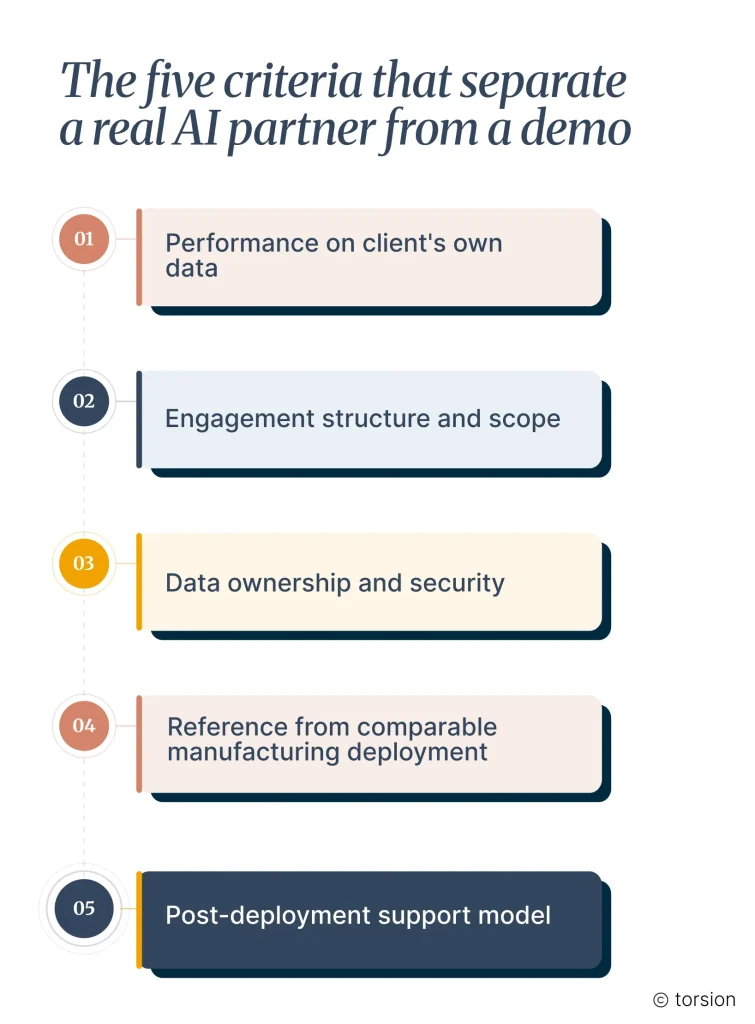
Performance on client’s own data
Any system can produce impressive accuracy numbers on a curated demo dataset. The only meaningful performance test is running the vendor’s system against a sample from your actual historical bid archive before you commit to an engagement. Ask the vendor: “Will you process five of our past bids and show us the output before we discuss pricing?” A good answer is an immediate yes with a clear timeline. A vague answer about needing to “scope the effort first” or concerns about protecting their IP should end the conversation. Manufacturing bids contain product-specific technical language, nested compliance requirements, and formatting conventions that generic training data simply does not cover. Only 28 percent of AI projects deliver measurable ROI, and a primary reason is deploying systems validated on the wrong data.
Engagement structure and scope
A defined Phase 1 scope with a fixed timeline, fixed deliverables, and accuracy benchmarks agreed before work begins protects your team from open-ended consulting engagements that consume budget without producing a usable system. Ask: “What exactly will we have at the end of Phase 1, and how will we measure whether it succeeded?” What good looks like is a fixed six-week Phase 1 scoped to a single bid category, with accuracy thresholds documented in the statement of work. What should concern you is any proposal that describes Phase 1 as “discovery” without specifying what gets delivered or when.
Data ownership and security
Your company should own all code, models, and training data at the end of the engagement. Any vendor who retains rights to your trained model or uses your bid data to improve a shared system serving other clients is creating a risk you should not accept. This matters especially in manufacturing, where bid documents contain proprietary pricing structures, product specifications, and compliance records that represent competitive intelligence. Ask: “Who owns the trained model at handoff, and will any of our data be used to train models for other clients?” The only acceptable answer is full ownership transfer to you, documented in the contract.
Reference from comparable manufacturing deployment
A reference from a manufacturer with comparable bid document types is significantly more valuable than a reference from a generic enterprise AI deployment. A vendor who has deployed successfully for a financial services firm has proven they can build AI systems, but they have not proven they can handle the specific challenges of manufacturing proposals: multi-part technical specifications, compliance cross-references, and product configuration tables. Ask for a reference you can speak with directly, and ask that reference specifically about document complexity and accuracy on technical content. The future of proposal management increasingly depends on AI that understands industry-specific document structures, not just general language patterns.
Post-deployment support model
A monitoring and retraining plan should be part of the Phase 1 deliverable, not sold as an ongoing managed service that creates permanent vendor dependency. Your proposal team needs to maintain and retrain the system as bid requirements evolve, new product lines launch, or compliance standards change. Ask: “At day 90 post-deployment, what does our team need from you to keep this system running?” A strong answer describes a handoff process: documentation, monitoring dashboards, and a retraining protocol your internal team can execute. A weak answer describes a monthly retainer for ongoing model management. The goal is independence, not a subscription.
Three red flags to catch before you sign with an AI partner
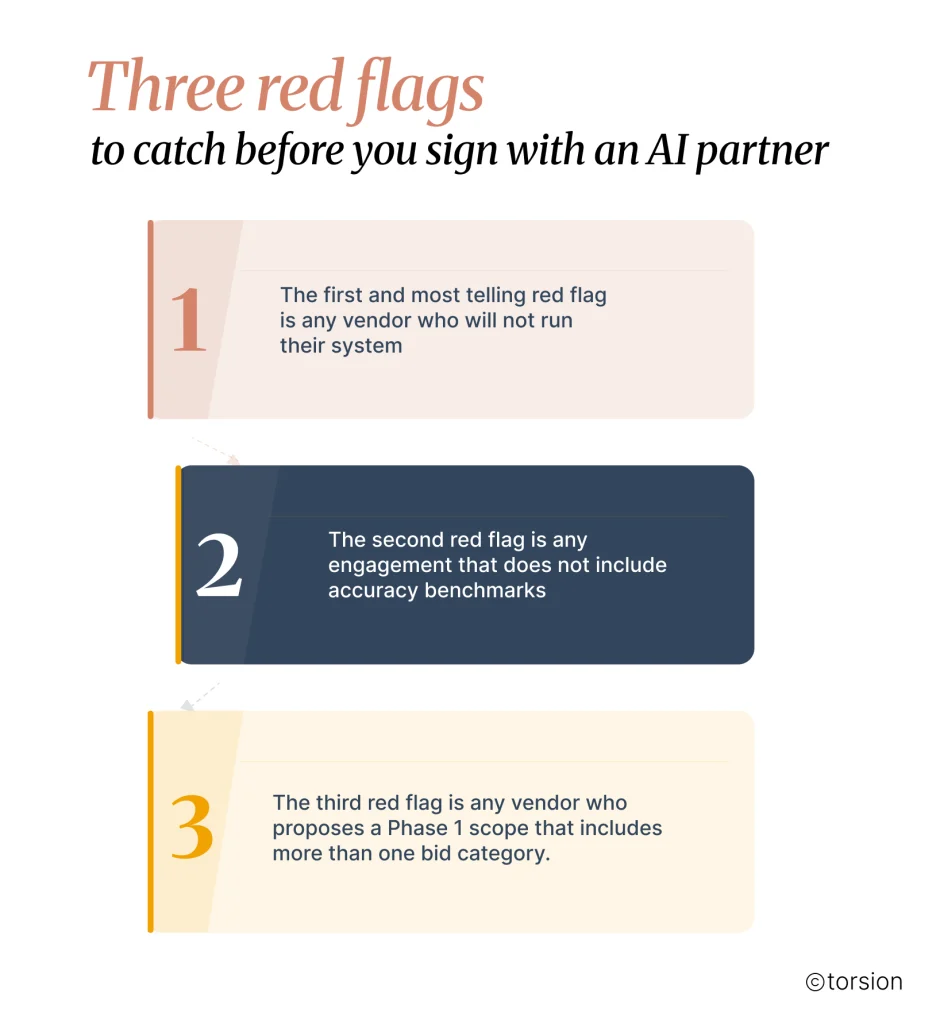
The first and most telling red flag is any vendor who will not run their system against a sample of your actual historical bid documents before presenting a commercial proposal. Some vendors claim that running on client data before contract signature would expose their proprietary models or IP. This is not a valid reason. A vendor confident in their system’s performance on real manufacturing documents will welcome the opportunity to prove it. The test is simple: during your second conversation, say “We would like you to process three of our past bids and walk us through the output.” If the response is anything other than agreement with a timeline, you have your answer. Manufacturing proposal teams deal with documents that contain nested compliance tables, cross-referenced annexes, and product-specific technical language. A system that has not been tested on these structures before you sign is a system you are buying on faith.
The second red flag is any engagement that does not include accuracy benchmarks defined before Phase 1 begins. Without defined thresholds, there is no objective standard against which to measure whether the vendor delivered what they promised. This is particularly dangerous for manufacturing proposal teams because “accuracy” in this context is not a single number: it includes correct product specifications, proper compliance cross-referencing, accurate pricing table formatting, and adherence to customer-specific submission requirements. Before signing, ask: “What accuracy metric will we use, and what threshold constitutes a successful Phase 1?” If the vendor cannot answer this question with specific numbers tied to your document types, the engagement has no accountability structure. As federal agencies increasingly use AI to evaluate proposals, accuracy on your specific documents is not optional.
The third red flag is any vendor who proposes a Phase 1 scope that includes more than one bid category. Production-quality AI for a specific bid type requires focused training data, not coverage breadth. A vendor proposing to automate your capital equipment bids, service contract proposals, and spare parts quotations all in Phase 1 is either underestimating the complexity of each category or planning to deliver shallow automation across all three. Ask: “Which single bid category will Phase 1 focus on, and why?” The right answer identifies your highest-volume or highest-value bid type and explains why focused training on that category will produce the best accuracy results.
How AI partners for manufacturing proposals compare on the dimensions that matter
Most generic AI implementation firms are perfectly capable partners for teams with straightforward collaboration and template needs. This comparison is for teams whose scope includes the full technical bid process: generating compliant, technically accurate proposal content from historical data and product specifications. Understanding how to evaluate an AI partner for your manufacturing proposal team means looking beyond the demo and into the structural details of the engagement itself. The table below compares six dimensions that matter most for VP Sales, Proposal Directors, and CTOs at manufacturing companies evaluating AI consulting firms.
| Dimension | Generic AI implementation firms | Specialist manufacturing proposal AI partner |
| Demo approach | Demo against curated or synthetic datasets | Demo run against a sample from the client’s actual bid archive |
| Phase 1 scope | Open-ended discovery and build; timeline and deliverables flexible | Fixed 6-week build with defined deliverables and accuracy benchmarks before start |
| Training data | Generic enterprise data supplemented by client documents | Trained exclusively on client’s historical bids, product specs, and compliance records |
| Data ownership | Vendor retains rights or uses client data to improve shared models | Client owns all code, models, and training data at handoff |
| Reference quality | References from general enterprise AI deployments | Reference from comparable manufacturing proposal deployment available |
| Post-deployment model | Ongoing managed service with monthly retainer | Monitoring process handed to client at day 90; no ongoing vendor dependency required |
What a partner worth signing looks like in practice
A well-structured engagement starts with a fixed-scope Phase 1 lasting six weeks, built entirely on the client’s own data. Accuracy benchmarks are defined and agreed before any work begins, not retrospectively adjusted after delivery. The system runs in parallel with the existing proposal process for two weeks before full cutover, giving the proposal team time to validate outputs against their own quality standards. At handoff, the client receives complete ownership of all code, models, and training data, with no ongoing vendor dependency required to operate or retrain the system. Leaders evaluating AI vendors should ask five critical questions before committing to ensure this kind of structure is in place.
A $500M industrial equipment manufacturer working with Torsion chose this engagement model after running three vendors’ systems against a sample of their historical transformer equipment bids: Torsion’s output correctly handled the cross-referenced compliance annexes without manual configuration. The proposal team now generates first-draft technical sections in hours rather than days, with compliance cross-references pre-populated from the client’s own historical records. Proposal managers spend their time reviewing and refining content rather than assembling it from scratch. The client owns all code, models, and training data with no ongoing vendor dependency, and their internal team manages retraining as new product lines are added. This outcome reflects what AI-driven competitive advantage looks like in practice: not a vendor relationship, but an internal capability.
The five questions to ask before signing with any AI partner for your proposal team
The decision to select an AI implementation partner for manufacturing proposal automation comes down to whether the vendor will prove performance on your data, define success before work begins, and hand you full ownership at the end. Every other consideration: brand reputation, slide deck quality, sales team responsiveness: is secondary to these structural commitments.
The surest way to judge a partner is to watch their system run on a sample of your real bids. at Torsion, where the team will run their system on a sample of your actual bid documents before any commercial discussion. We process a sample of your real bids and show you the output before any commercial discussion.Book an evaluation call