TL;DR:
- The process: AI-assisted transformation of the end-to-end technical RFP workflow currently takes 4-6 days end-to-end for a complex technical bid manually
- What AI changes: 1-2 days of human review and strategic work for the same output; the full workflow from document intake to submission-ready output dropped from 4-6 days to under 2 days, with improved compliance catch rate and the team submitting on all qualified bids
- The steps: Specification capture from RFP documents, requirements mapping to product capabilities, compliance gap identification, bid document drafting, final review and submission
- What AI cannot do: AI cannot capture verbal or informal specification changes communicated outside the written RFP package; scope changes discussed in client calls must be manually added to the AI’s working requirements set
- The result: the team spends its time on deviation strategy instead of spec capture
A manufacturing proposal team manually reads and captures specifications from a multi-document RFP package, maps them to product compliance requirements, and builds bid documents from scratch before submission, and this process takes 4-6 days end-to-end for a complex technical bid: it is precisely this workflow where AI transforms the technical RFP process from spec capture to bid submission. This article walks through exactly what happens at each stage of the end-to-end technical RFP workflow when AI is involved, from initial document intake through requirements mapping, compliance analysis, bid drafting, and final review. Manufacturing sales teams and proposal managers handling complex technical bids will find a stage-by-stage breakdown they can use to evaluate where AI fits into their own process, what it actually produces at each step, and where human judgment remains non-negotiable.
The AI-assisted transformation of the end-to-end technical RFP workflow process before AI
Engineers start by reading the full RFP document package and manually capturing applicable specifications into a requirements spreadsheet. For a large package with drawings, annexes, and referenced standards, this takes 1-2 days and is prone to missed specifications buried in appendices or cross-referenced documents. Once the requirements spreadsheet is complete, engineers compare each captured specification against the product catalogue and manually map requirements to available product configurations. This mapping step introduces its own errors: mismatched part numbers, outdated catalogue entries, and specifications that could be satisfied by multiple configurations but get mapped to only one. Understanding how AI transforms the technical RFP workflow from spec capture through to submission starts with seeing how much time and risk accumulates in these first two steps alone.
Engineers then identify compliance gaps between requirements and available configurations and propose deviations or alternatives. This is a judgment-heavy process done under time pressure, and gaps discovered late in the cycle often force last-minute redesign of the bid approach. Writers build bid documents from scratch using the requirements map and compliance gap analysis as input, a 1-2 day drafting process that depends entirely on the accuracy of the upstream work. A senior engineer reviews the full assembled bid for technical accuracy and compliance completeness before the submission deadline, but at this point, catching a fundamental error means either a rush rewrite or a non-compliant submission.
The cumulative toll is real. A complex technical bid takes 4-6 days end-to-end, and many teams simply cannot process enough bids to respond to every qualified opportunity. This manufacturer estimated that their team was declining roughly 30% of qualified RFPs because the manual process could not absorb the volume. Each declined bid represented potential revenue left on the table, not because the team lacked capability, but because the workflow consumed too many hours per package. Compliance errors in submitted bids carried their own cost: a single missed specification in a government or regulated-industry RFP can disqualify the entire submission.
What changes from spec capture through to submission
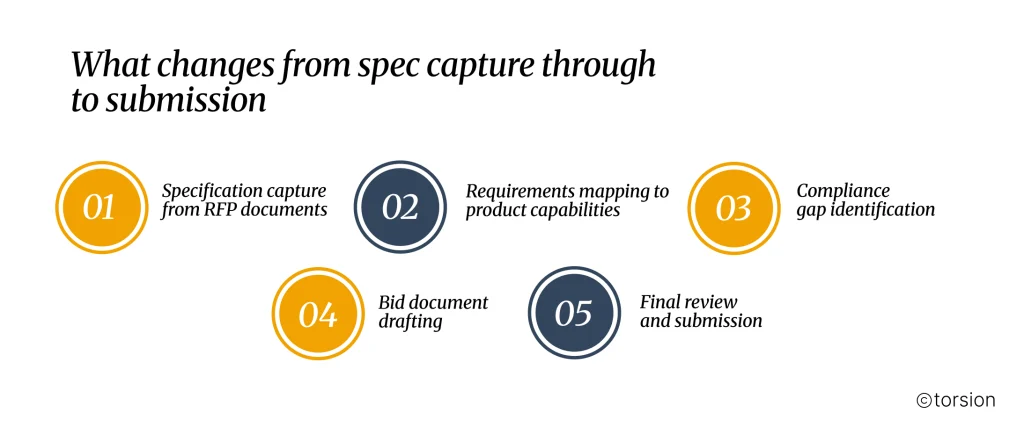
Specification capture from RFP documents
Engineers manually read every document in the RFP package, including drawings, annexes, and referenced standards, and transcribe applicable specifications into a requirements spreadsheet, a process that takes 1-2 days for a large package. AI reads the full document package simultaneously, extracts all specifications, and produces a structured requirements register with source document references in under 4 hours. The engineer reviews the AI-generated register for completeness, verifying that no informal or verbal scope changes (communicated outside the written package) need to be added. On this engagement, this step alone freed up a full day of engineering time per bid, which the team redirected toward product selection and client strategy.
Requirements mapping to product capabilities
Engineers compare each captured specification against the product catalogue and manually map requirements to available product configurations, a process that depends on individual product knowledge and is inconsistent across team members. AI maps extracted specifications to the product database and identifies gaps between requirements and available configurations, producing a structured requirements-to-product mapping that flags where multiple configurations could satisfy a single requirement. The engineer reviews the mapping, selects the preferred configuration where options exist, and confirms that the product database reflects current availability. This step is where manufacturing bid workflow automation from spec to submission delivers its clearest time savings, because the AI handles the high-volume comparison work that previously consumed hours of catalog cross-referencing.
Compliance gap identification
Engineers identify compliance gaps between requirements and available configurations and propose deviations or alternatives, a judgment-heavy process done under time pressure where gaps discovered late often force last-minute bid restructuring. AI generates a compliance gap report flagging each unresolved requirement, so engineers review flagged items and make deviation or alternative recommendations rather than discovering gaps from scratch. The engineer’s role shifts from gap discovery to gap resolution: deciding whether to propose a deviation, suggest an alternative product, or flag the requirement as non-compliant. On this engagement, compliance catch rate improved measurably after AI took over the gap identification step, because the system flagged requirements that had been .historically overlooked in manual reviews
Bid document drafting
Writers build bid documents from scratch using the requirements map and compliance gap analysis as input, a 1-2 day drafting process that depends on the accuracy and completeness of upstream work. AI pre-populates bid document templates using the requirements mapping and historical bid responses, so engineers and writers review and customize rather than drafting from scratch. The writer focuses on client-specific messaging, deviation rationale, and strategic positioning rather than structural assembly. This shift from drafting to editing is consistent with broader trends in proposal automation: AI-generated first drafts now serve as the starting point for the majority of enterprise bid teams that have adopted AI tooling in 2026.
Final review and submission
A senior engineer reviews the full assembled bid for technical accuracy and compliance completeness before the submission deadline, a process that previously required checking every specification against the bid document line by line. Final review now focuses on strategic content (deviation rationale, client-specific messaging) rather than structural completeness, because the AI has already verified that every requirement in the register has a corresponding response in the bid document. The senior engineer spends review time on the decisions that affect win probability: whether the proposed deviations are defensible, whether the pricing strategy aligns with the technical approach, and whether the bid tells a compelling story. The shift from compliance checking to strategic review is one of the most significant changes in how experienced engineers spend their time during bid cycles.
The technical RFP workflow from spec capture to submission: before and after AI
| Workflow stage | Before AI | With AI |
| Specification capture from RFP documents | Engineers read the full document package and manually capture applicable specifications into a requirements spreadsheet, taking 1-2 days for a large package. | AI reads the full document package simultaneously, extracts all specifications, and produces a structured requirements register with source document references in under 4 hours. |
| Requirements mapping to product capabilities | Engineers compare each captured specification against the product catalogue and manually map requirements to available product configurations. | AI maps extracted specifications to the product database and identifies gaps between requirements and available configurations, producing a structured requirements-to-product mapping. |
| Compliance gap identification | Engineers identify compliance gaps between requirements and available configurations and propose deviations or alternatives, a judgment-heavy process done under time pressure. | AI generates a compliance gap report flagging each unresolved requirement; engineers review flagged items and make deviation or alternative recommendations rather than discovering gaps from scratch. |
| Bid document drafting | Writers build bid documents from scratch using the requirements map and compliance gap analysis as input, a 1-2 day drafting process. | AI pre-populates bid document templates using the requirements mapping and historical bid responses; engineers and writers review and customize rather than drafting from scratch. |
| Final review and submission | Senior engineer reviews the full assembled bid for technical accuracy and compliance completeness before submission deadline. | Final review focuses on strategic content (deviation rationale, client-specific messaging) rather than structural completeness. |
Total time from document intake to submission-ready output drops from 4-6 days end-to-end for a complex technical bid to 1-2 days of human review and strategic work.
Where the workflow still needs human judgment
AI cannot capture verbal or informal specification changes communicated outside the written RFP package. Scope changes discussed in client calls, pre-bid meetings, or informal emails must be manually added to the AI’s working requirements set. This is not a temporary limitation that will be fixed in the next software update: it is a design boundary. AI processes patterns from structured data it has been trained on and given access to. Novel requirements that exist only in conversation, or specifications that contradict the written package based on verbal clarification, still need an engineer to capture, interpret, and input them.
On a first-of-its-kind specification, the system has no precedent to match against, so early output is limited. The system improves as it processes more bids in that category, building a richer mapping between specifications and product configurations over time. Early bids require more human review and correction, which trains the system for subsequent rounds. Where a specification is ambiguous, the system marks it for a subject-matter expert rather than guessing. AI flags them clearly, identifying where two documents specify conflicting tolerances or where a requirement could be interpreted multiple ways, but the engineer makes the call. A found that teams who understood these boundaries from the start reported higher satisfaction with AI-assisted workflows than teams who expected full automation.2026 study on AI adoption in procurement
How one manufacturer ran spec-to-submission with AI
The manufacturer’s proposal team manually read and captured specifications from multi-document RFP packages, mapped them to product compliance requirements, and built bid documents from scratch before every submission. Each complex technical bid took 4-6 days end-to-end, and the team was declining roughly 30% of qualified RFPs because the manual process could not absorb the volume. Torsion stood up the Phase 1 system in six weeks on the client’s historical bids and product specifications. Accuracy benchmarks were established before production cutover: the AI’s specification extraction was validated against 50 previously completed bids, and the requirements mapping was tested against known product configurations to establish a baseline accuracy rate before the team relied on it for live bids.
The full workflow from document intake to submission-ready output dropped from 4-6 days to under 2 days, with improved compliance catch rate and the team submitting on all qualified bids. Engineers now focus on product selection, deviation strategy, and client relationships rather than document processing. Writers spend their time on strategic messaging and competitive positioning rather than assembling bid structures from templates. The time comparison tells the story clearly: from 4-6 days end-to-end for a complex technical bid to 1-2 days of human review and strategic work. The team has not added headcount, but their bid volume capacity has more than doubled, and compliance errors in submitted bids have dropped to near zero.
What the end-to-end AI-assisted workflow looks like in production
The practical difference for a manufacturing proposal team is not that AI removes human work: it removes the wrong kind of human work. Engineers and writers spend their hours on judgment, strategy, and client relationships instead of document processing, specification transcription, and structural assembly, and the bid quality improves because the humans are doing what humans are best at.
If you want to see what AI-assisted transformation of the end-to-end technical RFP workflow looks like for your team, book a 30-minute walkthrough with Torsion to see the full workflow in action.