TL;DR:
- The process: AI-assisted RFP response for manufacturing sales teams currently takes 30-40 hours (60-80+ for large packages) manually
- What AI changes: 6-8 hours of human judgment work for the same output: document review dropped from 3-4 days to under 4 hours; compliance catch rate improved; team accepted 30% more bid opportunities
- The steps: Document intake and graphing, Requirements extraction, Compliance checking, Output generation, Engineer review and submission
- What AI cannot do: AI cannot make final product selection decisions or resolve ambiguous client requirements: it surfaces relevant specifications, but engineers confirm deviations and strategic choices
- The result: engineers spend their time on product decisions instead of document triage
A proposal team manually reads 40-60 files per RFP, cross-references requirements across spec documents, builds compliance matrices by hand, and produces bid output from scratch, burning 30-40 hours per package (60-80+ for large packages). If you have been searching for an AI for manufacturing RFP response complete guide that explains what actually happens at each stage, this is it. This article walks through exactly what changes at every step of the RFP workflow when AI is involved: from document intake and graphing through compliance checking and final submission. It is written for manufacturing proposal managers, VP Sales leaders, and CTOs at industrial companies who want to understand the real mechanics, honest limitations, and measurable outcomes of AI-assisted RFP response so they can make an informed build-or-buy decision for their own teams.
The AI-assisted RFP response for manufacturing sales teams process before AI
The manual RFP process starts with document intake: an engineer downloads 40-60 files from a client portal, opens each one individually, determines whether it is relevant to the bid, and tracks cross-references in a spreadsheet. This step alone takes 1-2 days and is where the first errors creep in: missed addenda, overlooked referenced standards, and mislabeled documents that surface weeks later during review. From there, the engineer reads applicable spec documents line by line to identify standards, compliance clauses, and scope requirements. Understanding how AI improves the manufacturing RFP response process end to end starts with appreciating how tedious and error-prone this extraction phase is: a single missed clause in a 200-page cooling tower specification can disqualify an entire bid.
Compliance checking follows extraction. The engineer manually cross-references each product capability against every applicable spec document to build a pass/fail requirements list, a process that typically takes another full day and is highly dependent on the engineer’s familiarity with the product line. Output generation is next: the engineer builds the compliance matrix from scratch, writes questionnaire responses, and formats bid documents to match client templates. This phase alone accounts for 8-12 hours. The senior engineer then reviews the full package before submission. Missed compliance items discovered at this stage require full rework, sometimes adding days to the timeline.
The cumulative toll is significant. A single RFP package consumes 30-40 hours of (60-80+ for large packages), and most manufacturing proposal teams handle multiple bids simultaneously. The result is predictable: teams decline winnable bids because they lack capacity. At SPX Cooling, the proposal team was turning away roughly one in three bid opportunities before were deployed. , and RFP response is one of the largest contributors to that lost time.skilled engineering timeAI-assisted workflowsManufacturing companies report that sales teams spend up to 65% of their time on non-selling activities
What happens at each stage of the AI-assisted process
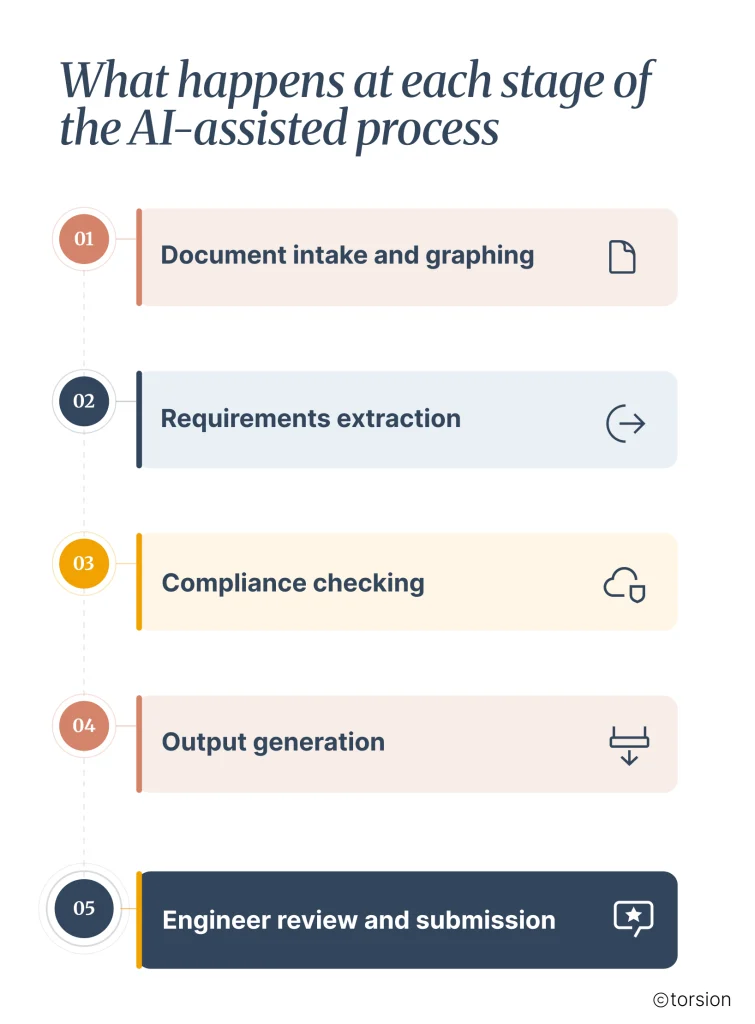
Document intake and graphing
Manually, the engineer downloads 40-60 files, opens each one, determines its relevance, and tracks cross-references in a spreadsheet over 1-2 days. AI builds a reference graph across all documents, classifies each by relevance to the project scope, and flags cross-references and gaps in minutes: producing a that shows which spec documents reference which standards and where addenda modify original requirements. The engineer reviews the reference graph for accuracy and resolves any flagged gaps where documents appear to be missing from the client package. At SPX Cooling this step alone went from consuming two full workdays to under 30 minutes of engineer review time.structured map
Requirements extraction
An engineer reads applicable spec documents line by line to identify standards, compliance clauses, and scope requirements: a process that depends entirely on the individual’s product knowledge and attention to detail across hundreds of pages. AI extracts all applicable standards and requirements, ranks them by relevance to the project scope, and produces a structured requirements register with source citations that link each requirement back to its originating document and page. The engineer validates the requirements register, confirms that the AI has correctly interpreted ambiguous language, and adds context for requirements that depend on project-specific variables. Any manufacturing proposal team AI automation implementation guide that skips this validation step is setting teams up for compliance failures.
Compliance checking
The engineer manually cross-references each product specification against all applicable requirements to build a pass/fail list, a task that requires deep product knowledge and typically takes a full day for a standard bid package. AI runs a full pass/fail/review compliance check against the requirements register and generates a compliance matrix with engineer-resolvable flags for items that fall outside clear pass/fail boundaries. The engineer resolves flagged items, confirms deviations, and makes strategic decisions about which non-compliant items to address through exceptions or alternative product selections. At SPX Cooling, the compliance catch rate improved measurably after AI was introduced, catching requirements that had historically been missed during manual review.
Output generation
The engineer builds the compliance matrix, writes questionnaire responses, and formats bid documents from scratch: a process that accounts for 8-12 hours of the total RFP cycle and produces output that varies in quality depending on who writes it. AI pre-fills the questionnaire using extracted requirements and historical response data, generates the compliance matrix output, and produces a formatted bid template for engineer customisation that matches the client’s required submission format. The engineer reviews pre-filled responses, customises language for the specific client relationship, and adds strategic content such as product rationale and competitive positioning.
Engineer review and submission
In the manual process, the senior engineer reviews the full package from scratch, and missed compliance items discovered at this stage require full rework that can add days to the timeline. AI presents the engineer with a pre-validated package where compliance issues have already been flagged and addressed in earlier stages, reducing the review to a focused check on strategic content, deviation justifications, and client-specific customisations. The engineer resolves any remaining flagged items, adds strategic content such as deviation strategy and product selection rationale, and submits the final package. The review shifts from catching errors to making judgment calls.
The manufacturing RFP process: what AI does at every stage vs manual review
| Workflow stage | Before AI | With AI |
| Document intake and graphing | Engineer downloads 40-60 files, determines relevance individually, and tracks cross-references in a spreadsheet over 1-2 days. | AI builds a reference graph across all documents, classifies by relevance, and flags cross-references and gaps in minutes. |
| Requirements extraction | Engineer reads applicable spec documents line by line to identify standards, compliance clauses, and scope requirements. | AI extracts all applicable standards and requirements, ranks by relevance to project scope, and produces a structured requirements register with source citations. |
| Compliance checking | Engineer manually cross-references product against all spec documents to build a pass/fail requirements list. | AI runs a full pass/fail/review compliance check and generates a compliance matrix with engineer-resolvable flags. |
| Output generation | Engineer builds compliance matrix, writes questionnaire responses, and formats bid documents from scratch. | AI pre-fills the questionnaire, generates compliance matrix output, and produces a formatted bid template for engineer customisation. |
| Engineer review and submission | Senior engineer reviews full package; missed compliance items discovered here require full rework. | Engineer reviews AI output, resolves flagged compliance items, adds strategic content (product rationale, deviation strategy), and submits. |
Total time from document intake to submission-ready output drops from 30-40 hours (60-80+ for large packages) to 6-8 hours of human judgment work.
Where your engineers still make the call
AI cannot make final product selection decisions or resolve ambiguous client requirements: it surfaces relevant specifications, but engineers confirm deviations and strategic choices. This is not a limitation to work around; it is a design boundary. AI handles pattern recognition across its training data, matching requirements to product specifications and identifying compliance gaps based on historical bid documents. Novel requirements outside that training set, unusual client specifications, or first-of-kind product applications still need expert judgment. AI-driven systems in manufacturing currently operate best as decision-support tools rather than autonomous decision-makers, and RFP response is no exception.
The first bid in a product category the system has not seen yet returns less, because it has no prior examples to draw on. The system improves as it processes more bids in that category, building a deeper reference base of requirements, compliance patterns, and response templates. This means the steepens over time rather than delivering peak value on day one. Ambiguous or contradictory client requirements still require a subject-matter expert to resolve: AI flags them clearly, but the decision about how to interpret conflicting specifications or whether to propose a deviation remains with the engineer. These are judgment calls that depend on client relationship context, competitive positioning, and risk tolerance: none of which AI can assess from document content alone.ROI curve
How this played out at a $500M industrial equipment manufacturer we work with (SPX Cooling)
Before AI-assisted workflows, SPX Cooling’s proposal team manually read 40-60 files per RFP, cross-referenced requirements across spec documents, built compliance matrices by hand, and produced bid output from scratch. Each package consumed 30-40 hours of skilled engineering time (60-80+ for large packages), and the team was declining roughly one in three bid opportunities due to capacity constraints. The Phase 1 build took 6 weeks. Torsion trained the system on SPX Cooling’s own historical bid documents and product specification database, established accuracy benchmarks against completed bids, and validated output quality before production cutover. The system was integrated into the existing proposal workflow rather than replacing it, so engineers could adopt it incrementally.
Document review dropped from 3 to 4 days down to under four hours, the compliance catch rate improved, and the team took on 30% more bid opportunities in the first quarter. Engineers shifted from processing documents to the work that wins bids, including product selection for edge-case applications and deviation strategy. The arc is simple to state: mixed processing and judgment work that had run 30 to 40 hours per package, and 60 to 80 or more for large ones, became six to eight hours of concentrated judgment.Gartner predicts AI-driven sales enablement will deliver 40% faster sales stage velocity
Starting your AI-assisted RFP response programme
The difference between a manufacturing proposal team that processes 10 bids per quarter and one that processes 15 is not headcount: it is how much of each engineer’s time goes to document processing versus judgment work. AI-assisted RFP response does not replace engineers; it gives them back the 70-80% of their time currently spent on tasks that do not require their expertise.
If you want to see what AI-assisted RFP response for manufacturing sales teams looks like for your team, book a 30-minute RFP automation assessment at torsion.ai. For a tailored walkthrough of how this applies to your specific bid workflow and product categories, get in touch and the Torsion team will respond with insights specific to your business.