
TL;DR:
- The decision: moving from a successful single-use-case AI pilot to a structured enterprise deployment across multiple bid categories requires a deliberate, phased approach.
- Common mistake: attempting to replicate the pilot model across all bid categories simultaneously rather than expanding category-by-category with accuracy benchmarks at each step.
- What to evaluate: category-by-category expansion plan, per-category accuracy benchmarks, and training data assessment per category.
- Red flag to avoid: any expansion plan that adds more than one new bid category per quarter without confirmed training data availability for each.
- What good looks like: category-by-category expansion with a data audit, accuracy benchmarks, and a parallel run for each new category before full production cutover.
If your manufacturing company has a working AI pilot producing real results on a single RFP bid category, you are likely asking the right next question: how to scale AI beyond the pilot to enterprise deployment across multiple bid categories. The most common mistake at this stage is not a lack of ambition but too much of it, specifically attempting to replicate the pilot model across all bid categories at once rather than expanding category-by-category with accuracy benchmarks at each step, which is exactly how most teams planning an AI deployment across multiple RFP categories in manufacturing stumble. This article provides the criteria, red flags, and a structured framework for making a better expansion decision, whether you build internally or work with a partner.
What most teams get wrong when moving from a successful single-use-case AI pilot to a structured enterprise deployment
The single most common error is treating pilot success as a green light to expand everywhere at once. A manufacturing proposal team that achieved 90% accuracy on, say, transformer equipment RFPs assumes the same model and training data will perform equally well on switchgear bids, power distribution assemblies, or aftermarket service contracts. It will not. Each bid category carries different document structures, compliance requirements, product specification formats, and pricing logic. When teams push the pilot model into unfamiliar territory without retraining, accuracy drops from production-grade to unreliable within weeks, and the proposal team, which was just starting to trust the system, loses confidence entirely. That confidence is far harder to rebuild than it was to earn in the first place.
The correct question is not “how fast can we scale?” but “what does each new category need before it is ready for production?” This distinction matters because it separates what off-the-shelf RFP software does, which is provide proposal libraries, collaboration tools, and template generation, from what a custom AI system does, which is train on a company’s own bid history, product specs, and compliance records to produce category-specific technical responses. Enterprise AI expansion from a pilot in manufacturing proposal operations requires treating each new category as its own mini-deployment, not a checkbox on a rollout timeline. The teams that get this right expand more slowly at first but end up covering more categories with higher accuracy within 12 months than teams that try to do everything at once.
The five criteria for expanding past the pilot safely
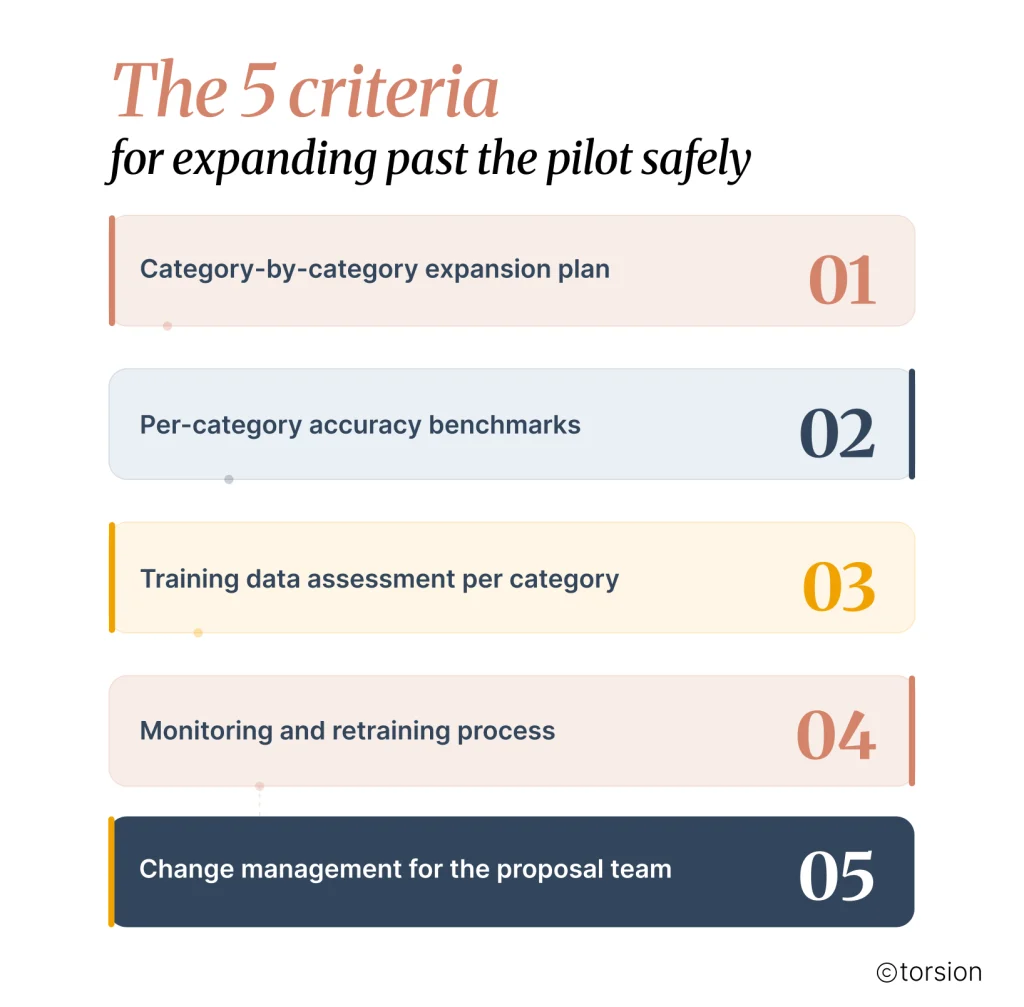
Category-by-category expansion plan
Expanding to a new bid category without confirming sufficient historical training data exists will produce a system that is less accurate than the pilot, which directly damages team confidence in the entire programme. A good expansion plan names each target category in priority order, with a data availability gate before each one. Ask your vendor or internal team: “For each category on the roadmap, what is the minimum data threshold required before we begin training, and what happens if we do not meet it?” A strong answer specifies a number (typically 20-30 historical bids per category) and describes the fallback. A vague answer like “we will work with whatever data you have” is a warning sign.
Per-category accuracy benchmarks
Each new bid category should be treated as a new deployment with its own accuracy benchmark sign-off, not assumed to perform at the same level as the pilot category. Transformer equipment RFPs and industrial valve assembly bids have fundamentally different technical vocabularies, compliance standards, and response patterns. The evaluation method here is straightforward: ask “will each new category have its own accuracy target, and who signs off before it goes live?” What good looks like is a documented threshold, typically 85-90% response accuracy measured against human-reviewed outputs, agreed upon before training begins.
Training data assessment per category
New bid categories require a minimum of 20-30 historical bids of that type to train to production accuracy. A data assessment before each expansion prevents premature deployment into categories where the AI simply does not have enough material to learn from. The question to ask: “What does your data audit process look like before expanding into a new category, and what is the minimum bid volume required?” A strong vendor or internal team will walk you through a specific audit checklist. Anyone who skips this step is guessing.
Monitoring and retraining process
The monitoring process built during the pilot should be extended to each new category, but with category-specific accuracy thresholds and retraining triggers. A single centralized dashboard that averages accuracy across all categories will mask problems in individual ones. Ask: “How will we detect accuracy degradation in a specific category, and what triggers a retraining cycle?” The answer should name specific metrics (response accuracy, compliance flag rates, human override frequency) and a defined retraining cadence, not just “we monitor continuously.”
Change management for the proposal team
The team’s trust was built on the pilot category, and that trust does not automatically transfer to new ones. Change management for each new category should mirror the parallel-run approach used in the original deployment: the AI produces outputs alongside the human team for a defined period, the team reviews and corrects, and only after the accuracy benchmark is met does the category move to full production. Ask: “What is the parallel-run plan for each new category, and how long does it last?” A responsible answer specifies a minimum duration, typically two weeks, and a clear exit criterion.
Three red flags when a vendor proposes scaling
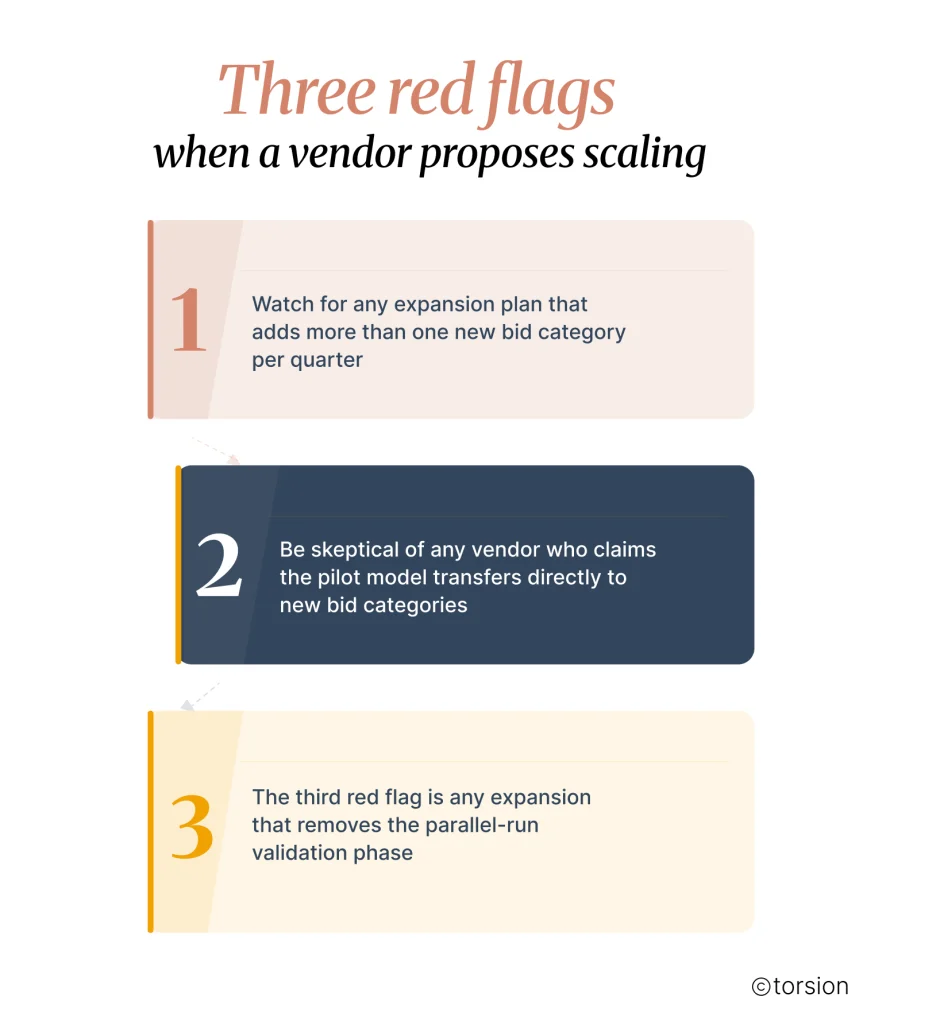
Watch for any expansion plan that adds more than one new bid category per quarter without confirmed training data availability for each. This is not a conservative preference; it is a quality control requirement. Manufacturing bid categories differ in document structure, regulatory requirements, and product complexity. When a vendor or internal team proposes launching three or four categories simultaneously, ask: “For each of these categories, can you show me the training data audit results?” If the audit has not been completed, the timeline is aspirational, not realistic. OpenAI CEO Sam Altman recently acknowledged that enterprise clients burned through their entire 2026 AI budgets in Q1 by scaling too fast without the right controls, a pattern that plays out in manufacturing AI deployments just as readily.
Be skeptical of any vendor who claims the pilot model transfers directly to new bid categories without retraining. Bid types have different document structures, compliance standards, and product mappings. A model trained on power transformer RFPs has learned specific technical language, specification formats, and regulatory references that simply do not apply to, say, industrial pump assembly bids. The test: ask “what percentage of the pilot model’s training data is reusable for the next category?” If the answer is “most of it” or “all of it,” that vendor does not understand the problem. A credible answer acknowledges that while the system architecture carries over, the training data and fine-tuning are category-specific. As one ServiceNow executive noted at their 2026 conference, enterprise AI implementation needs guardrails and control, not unchecked replication.
The third red flag is any expansion that removes the parallel-run validation phase on the grounds that the team already trusts the system from the pilot. This reasoning sounds logical but is wrong. The proposal team trusts the system for the category they have seen it handle. Asking them to trust it on a new category without a parallel run is asking them to take the vendor’s word for it, not verify it themselves. The test: ask “will each new category include a parallel-run period, and what is the exit criterion?” If the answer is “the team is already comfortable, so we can skip that step,” push back hard. Skipping parallel runs is how you lose the team’s buy-in entirely.
Scaling AI deployment across bid categories: the structured expansion framework
Ad-hoc expansion tools are the right choice for teams with straightforward collaboration needs, such as shared proposal libraries and basic template management. This comparison is for teams whose scope includes the full technical bid process: compliance checks, product specification mapping, pricing logic, and technical response generation. Scaling AI beyond the pilot to full enterprise deployment in manufacturing requires a framework that treats each category as a distinct workstream with its own data, benchmarks, and validation. The table below compares six dimensions that matter most for CTOs and VP Engineering at manufacturing companies with a working AI pilot ready to expand teams.
| Dimension | Ad-hoc expansion (common approach) | Structured category-by-category expansion |
| Expansion trigger | Pilot success treated as licence to expand immediately | Data audit per category before expansion decision |
| Accuracy assumption | Pilot accuracy assumed to transfer to new categories | New accuracy benchmarks set and signed off per category |
| Training approach | Pilot training data extended to include new categories | Separate training run per category using category-specific historical bids |
| Parallel run | Omitted for expanded categories | 2-week parallel run for each new category before full production |
| Monitoring | Centralised monitoring across all categories | Category-specific accuracy thresholds and retraining triggers |
| Timeline | All categories targeted simultaneously; quality degrades | One category per quarter; quality maintained and measurable per stage |
Google CEO Sundar Pichai recently highlighted what he called the biggest AI budget problem for companies worldwide: spending heavily on AI without structured deployment discipline. The framework above is designed to prevent exactly that pattern.
What disciplined scaling looks like in practice
A well-structured engagement starts with a data audit of the next target category, confirming that sufficient historical bids exist to train to production accuracy. It then moves through a category-specific training phase, a defined parallel-run period where the AI’s outputs are reviewed alongside human-generated responses, and a formal accuracy benchmark sign-off before the category goes live. This mirrors the original pilot process, not because the team cannot move faster, but because each category has its own technical vocabulary, compliance requirements, and response patterns that require dedicated training. Torsion’s deployment methodology, which covers the full AI lifecycle from strategy through deployment and ongoing governance, structures each category expansion as a distinct phase with its own success criteria.
A $500M industrial equipment manufacturer working with Torsion expanded from transformer equipment RFPs to two additional product line categories in months four through six, using the same phase structure as the original deployment, and each category met its accuracy benchmarks before going live. The proposal team now spends roughly 60% less time on first-draft generation for those three categories, freeing senior engineers to focus on technical differentiation rather than document assembly. The compliance review cycle, which previously added three to five days per bid, now runs in parallel with response generation. The client owns all code, models, and training data with no ongoing vendor dependency, a structure that aligns with NVIDIA’s GTC 2026 emphasis on industrializing intelligence as a core enterprise capability rather than renting it from a third party.
What a responsible AI expansion programme looks like at 6, 12, and 18 months
The difference between a successful multi-category AI deployment and a stalled one almost always comes down to discipline at the expansion stage, not the quality of the original pilot. CTOs and VP Engineering leaders evaluating this decision should focus on three things: confirmed training data per category, independent accuracy benchmarks, and a parallel-run phase that the proposal team trusts because they helped design it. Satya Nadella’s framing of AI as scaffolding for human potential rather than a substitute captures the right mindset for this work.
The safest way to plan expansion is to map it against the training data you already hold. with the Torsion team to map your category expansion roadmap based on your current training data. The team will identify your highest-impact RFP automation opportunity and tell you whether a custom system makes financial sense for your process. Book a session