
TL;DR:
- The problem: proposal professionals spend up to 65% of their working time on document-related tasks, reading, extracting, and formatting, leaving only 35% for strategic work that directly influences win rate (APMP Proposal Industry Survey 2023)
- Why it matters: the document intake and review phase alone accounts for 40-50% of total RFP response time in industrial manufacturing bids (Shipley Associates workflow benchmarks)
- Why workarounds fail: splitting the workflow into pre-review and content creation phases with different team members assigned to each stage and using bid management software to track deadlines and section ownership while still reviewing all documents manually address symptoms, not the structural cause
- What changes with AI: AI took over the document intake, graphing, and requirements extraction stages, reducing the total workflow from five stages requiring 40+ hours to three human-intensive stages requiring under 10 hours
- The root cause: the manufacturing RFP workflow has never been redesigned around the document volume that defines it today, and most proposal teams are running a 1990s sequential process against a 2020s document set
Understanding manufacturing RFP workflow steps and where time is lost starts with a hard number: proposal professionals spend up to 65% of their working time on document-related tasks like reading, extracting, and formatting, leaving only 35% for strategic work that directly influences win rate (APMP Proposal Industry Survey 2023). For manufacturing proposal managers and sales operations leaders, this imbalance translates directly into lower bid volumes, declining win rates, and revenue left on the table, which is why learning how to improve manufacturing RFP workflow efficiency has become a priority rather than a nice-to-have. By the end of this article, you will understand exactly where time disappears in the standard five-stage manufacturing RFP process, why common workarounds fail to fix the underlying problem, and what a structurally redesigned workflow looks like when AI handles the document-heavy stages.
The real scope of inefficient time allocation across RFP workflow stages
Proposal professionals spend up to 65% of their working time on document-related tasks, reading, extracting, and formatting, leaving only 35% for strategic work that directly influences win rate (APMP Proposal Industry Survey 2023). The document intake and review phase alone accounts for 40-50% of total RFP response time in industrial manufacturing bids (Shipley Associates workflow benchmarks). These two data points frame the core question behind how to improve manufacturing RFP workflow efficiency: the bottleneck is not in writing proposals or negotiating terms but in the mechanical processing of documents before any strategic thinking even begins.
A typical week for a proposal manager at a mid-to-large manufacturing firm involves receiving two to four new RFP packages, each containing anywhere from 80 to 300 pages of technical specifications, compliance requirements, commercial terms, and scope documents. Cross-referencing a single RFP against internal product catalogs, past bid libraries, and engineering datasheets can consume 10 to 15 hours before a single word of the response is drafted. The result is predictable: manufacturing organizations report declining the majority of RFPs they receive, not because they lack the capability to win, but because they lack the capacity to respond.
The cost extends well beyond hours logged. When proposal teams are buried in document processing, win rates suffer because the strategic elements of a bid, such as differentiated positioning, deviation narratives, and tailored pricing, receive whatever time is left over. Teams that consistently operate at capacity also experience higher turnover among senior proposal staff, compounding the problem by replacing experienced judgment with junior resources who need even more time per bid. Revenue impact is not theoretical here: a manufacturer bidding on $2M-$10M contracts who declines even two qualified opportunities per quarter is walking away from eight-figure annual pipeline.
Why splitting the workflow into pre-review and content creation phases is not the answer
The most common response to time pressure is splitting the workflow into pre-review and content creation phases, assigning junior staff or coordinators to handle document intake while senior proposal writers focus on drafting. In theory, this parallelizes the work. In practice, the failure mode is specific and consistent: the pre-review team lacks the technical depth to correctly identify which requirements are standard, which are unusual, and which contain hidden compliance traps. The senior writer ends up re-reading the source documents anyway, and the time spent on RFP workflow stages and time allocation in manufacturing doubles rather than halves because two people are now doing what one person used to do poorly.
Bid management software, such as platforms that track deadlines, assign section ownership, and centralize documents, solves a coordination problem but not a volume problem. The failure mode here is equally specific: every section owner still reads and interprets the original RFP documents independently, and studies show that proposal teams spend the majority of their time on repetitive content assembly rather than original thinking. The software tells you who owns what and when it is due, but it does not reduce the 40-50% of time consumed by document intake and review. Deadlines are met more consistently, but the quality of each response remains constrained by the same time pressure.
The problem is structural. Staffing changes leave it in place. A $500M industrial equipment manufacturer that Torsion works with tried both approaches over an 18-month period and found that total hours per bid remained within the same range regardless of team configuration or software tooling.
The structural cause behind inefficient time allocation across RFP workflow stages
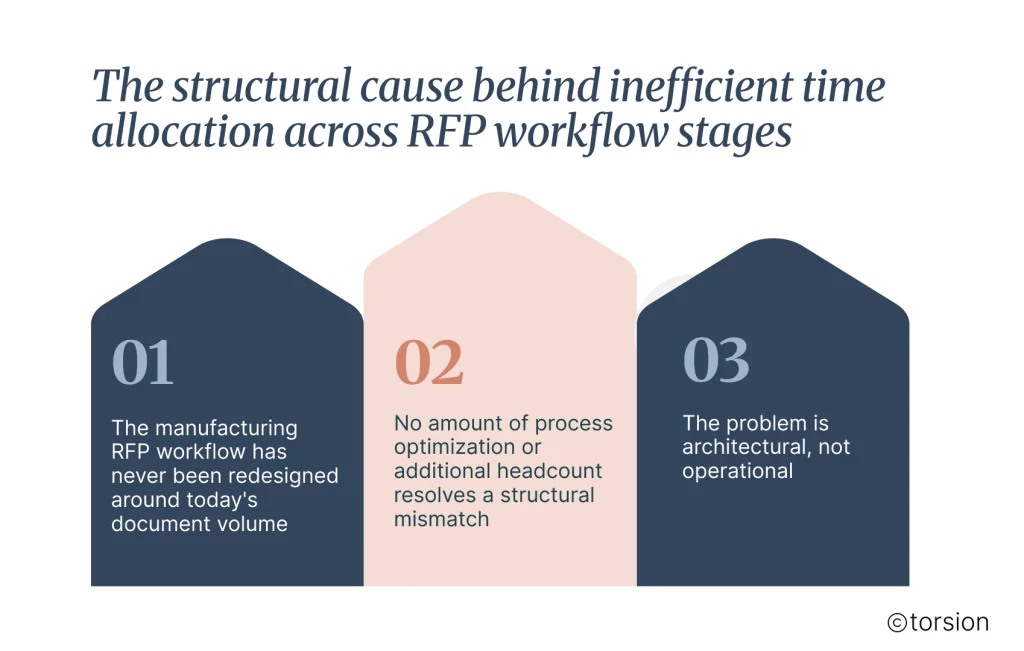
The manufacturing RFP workflow has never been redesigned around the document volume that defines it today: most proposal teams are running a 1990s sequential process against a 2020s document set. Twenty years ago, a typical manufacturing RFP might include 30 to 50 pages of requirements. Today, that number sits between 100 and 300 pages, often spread across multiple file formats, with embedded spreadsheets, referenced standards documents, and appendices that themselves reference other appendices. The five-stage sequential process of intake, review, content creation, compliance check, and submission was designed for a fundamentally different workload. No amount of process optimization or additional headcount resolves a structural mismatch between workflow design and document reality. The problem with RFP workflow stages and time allocation in manufacturing is architectural, not operational.
When this root cause goes unaddressed, the consequences compound in ways that are specific to manufacturing environments. Compliance errors surface after bid submission because reviewers under time pressure miss a single line item buried on page 187 of a technical specification. Qualified bids get declined because the team is still finishing last week’s response when the new RFP arrives. Proposal quality degrades under time pressure, with teams reusing boilerplate language that fails to address the buyer’s specific evaluation criteria. For manufacturing proposal managers and sales operations leaders, this pattern is familiar: the team is working harder every quarter but winning at the same or lower rate. Manufacturing firms adopting AI in 2026 are doing so specifically to address these structural workflow gaps rather than to chase incremental efficiency gains.
A structural cause requires a structural solution, not a faster version of the same broken process.
Which workflow stages change once AI handles document intake
When AI handles the rule-based, document-heavy portions of the manufacturing RFP workflow, the shift is not incremental. It is architectural. The specific steps that move from human to machine are document graphing (mapping the relationships between sections, appendices, and referenced standards), requirements extraction (pulling every individual requirement into a structured format with metadata), compliance checking (matching extracted requirements against internal capability databases), and first-draft output generation (assembling initial responses from approved content libraries). Torsion redesigns the workflow structure before building the AI system: the system is built around the specific stages where the client’s team loses the most time, not applied generically. This means the AI is not a bolt-on tool added to an existing process but a replacement for the stages that consume disproportionate hours. AI-driven procurement and proposal workflows are now reducing manual review cycles by targeting exactly these document-processing bottlenecks.
At the manufacturer described earlier, AI absorbed the document intake, graphing, and requirements-extraction stages and collapsed a five-stage, 40-plus-hour workflow into three human-intensive stages under 10 hours. Engineers who had spent six to eight hours per bid reading documents and filling compliance matrices now spend one to two hours reviewing AI-extracted requirements and flagging edge cases. The workflow sped up because the stages that never needed a human stopped requiring one.manufacturers deploying AI in production environments are seeing measurable reductions in processing time
Redesigning your RFP workflow around what actually takes time
The two things worth remembering: the manufacturing RFP workflow was designed for a document volume that no longer exists, and no combination of team restructuring or bid management software fixes a structural mismatch between process design and workload reality. The question is not whether your team works hard enough but whether the stages consuming 65% of their time are stages that require human intelligence at all.
If you are redrawing your RFP workflow around AI, the complete guide to AI for manufacturing RFP response covers the full picture. For teams ready to assess their own workflow structure, Torsion’s team can provide a tailored analysis of where time is going and what a redesigned process would look like for your specific bid environment: to start that conversation.reach out here