
TL;DR:
- The problem: missed bid opportunities due to capacity and document volume is costing VP Sales and Directors of Business Development at US manufacturing companies.
- Manufacturing companies that increase RFP response volume by 25-30% while maintaining quality report an 18-22% increase in annual contract value within 12 months (Aberdeen Group Sales Performance Research).
- Why it matters: The win rate for proposals that receive full team attention versus rushed or understaffed responses is 2.3x higher (Shipley Associates competitive proposal benchmarks).
- Why workarounds fail: a bid/no-bid scoring system that filters out low-probability opportunities before allocating proposal team time and submitting partial or template-heavy responses for lower-priority bids to protect capacity for priority accounts address symptoms, not the structural cause.
- What changes with AI: went from declining 3 to 4 qualified bids per month to responding to all incoming qualified opportunities while reducing per-bid team hours by 60%.
- The root cause: The core constraint is not sales strategy or market position – it is that the document-processing bottleneck imposes an artificial ceiling on how many bids a team can pursue at full quality, regardless of pipeline size.
Manufacturing companies that increase RFP response volume by 25-30% while maintaining quality report an 18-22% increase in annual contract value within 12 months (Aberdeen Group Sales Performance Research), which is exactly why the question of how manufacturing sales teams use AI to win more RFP bids has moved from theoretical to urgent. For VP Sales and Directors of Business Development at US manufacturing companies, every declined bid represents a compounding loss: not just the immediate contract value, but the long-term relationship equity and market positioning that erode when competitors fill the gap, making the push to increase RFP win rates through manufacturing sales team AI adoption a revenue-critical priority. By the end of this article, you will understand the specific structural bottleneck that forces qualified bids off the table, why common workarounds fail to address it, and what changes in bid capacity and win rate when AI handles the document-processing burden that creates the constraint in the first place.
The real scope of missed bid opportunities due to capacity and document volume
Manufacturing companies that increase RFP response volume by 25-30% while maintaining quality report an 18-22% increase in annual contract value within 12 months (Aberdeen Group Sales Performance Research). The win rate for proposals that receive full team attention versus rushed or understaffed responses is 2.3x higher (Shipley Associates competitive proposal benchmarks). These two data points frame the real cost of the problem: every bid declined or rushed due to capacity is not just a missed opportunity but a measurable drag on annual contract value. The drive to increase RFP win rate through manufacturing sales team AI is grounded in these numbers, not in speculative efficiency gains.
A typical week for a proposal manager at a mid-to-large US manufacturer involves receiving two to five new RFP packages, each ranging from 40 to 200 pages of technical specifications, compliance requirements, and commercial terms. Each bid requires cross-referencing product catalogs, historical pricing data, engineering tolerances, and regulatory documentation across multiple internal systems. When three bids land in the same week with overlapping deadlines, the proposal team is forced to triage. Two get full attention. One gets declined. The decision is rarely about the quality of the opportunity; it is about the hours available to process documents.
The true cost extends well beyond lost time. Declined bids reduce a company’s visible market presence, weaken relationships with procurement teams that track response rates, and hand competitors uncontested wins. Rushed proposals, meanwhile, carry higher error rates in compliance sections and pricing, which directly suppresses win rates. A team that responds to 60% of qualified bids at high quality is leaving a measurable share of revenue on the table, and no amount of pipeline development fixes a ceiling imposed by document throughput.
Why a bid/no-bid scoring system that filters out low-probability opportunities is not the answer
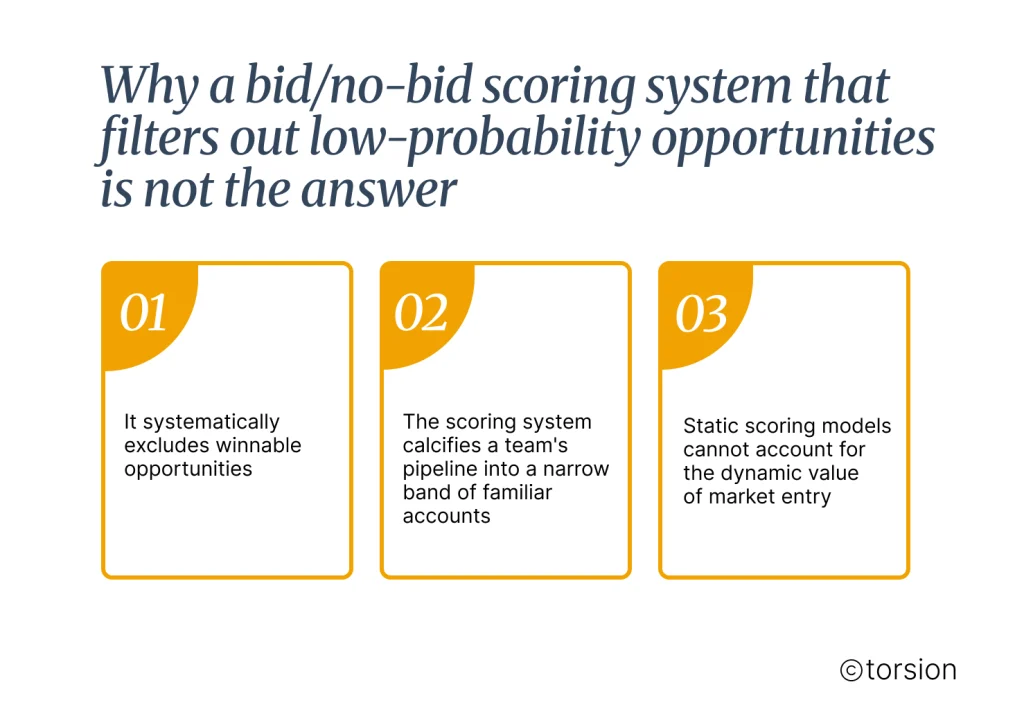
A bid/no-bid scoring system is a structured framework where proposal teams assign weighted scores to incoming RFPs based on criteria like contract value, competitive position, incumbent status, and technical fit. The idea is sound: focus limited resources on the bids most likely to convert. The specific failure mode is not that the scoring is inaccurate but that it systematically excludes winnable opportunities that score below an arbitrary threshold. A $2M contract with a new customer in an adjacent vertical might score lower than a $5M renewal, but declining it means zero chance of entering that market. Over time, the scoring system calcifies a team’s pipeline into a narrow band of familiar accounts, and manufacturing bid acceptance rate improvement through proposal automation becomes impossible because the filter itself is the constraint. The evolution of AI-driven bid workflows in 2026 reflects a growing recognition that static scoring models cannot account for the dynamic value of market entry and relationship building.
Submitting partial or template-heavy responses for lower-priority bids is the other common workaround. Teams strip out custom engineering sections, reuse boilerplate compliance language, and submit a response that checks the “we responded” box without genuinely competing. The specific failure mode here is that procurement teams recognize template responses immediately. Evaluators at major OEMs and Tier 1 buyers score these submissions lower, and repeated template responses damage a manufacturer’s reputation with that buyer’s procurement office. The response rate looks healthy on a dashboard, but the win rate on those partial submissions trends toward zero.
The ceiling is structural. More people will not raise it. A $500M industrial equipment manufacturer Torsion works with had tried both approaches for over two years before concluding that neither addressed the root constraint: the volume of document work required per bid simply exceeded what any reasonable team could process at quality.
The structural cause behind missed bid opportunities due to capacity and document volume
The core constraint is not sales strategy or market position – it is that the document-processing bottleneck imposes an artificial ceiling on how many bids a team can pursue at full quality, regardless of pipeline size. This is structural because adding headcount does not resolve it proportionally. Each new proposal coordinator requires months of onboarding to learn a manufacturer’s product portfolio, compliance history, and pricing logic. Process improvements like better templates or shared drives reduce friction at the margins but do not change the fundamental ratio of document pages to human hours. Manufacturing bid acceptance rate improvement through proposal automation is blocked not by a lack of tools but by the nature of the work itself: each RFP demands unique cross-referencing of technical specifications against a company’s specific capabilities, tolerances, and certifications. The reality is that outdated cost models and manual document processes quietly undermine manufacturing profitability in ways that are difficult to see from a quarterly revenue report.
When this root cause goes unaddressed, the consequences compound. Compliance errors surface after bid submission because a rushed engineer missed a tolerance specification on page 87 of a 150-page RFP. Qualified bids get declined not because the opportunity is poor but because the team is already at capacity with three concurrent deadlines. Proposal quality drops under time pressure, and senior engineers who should be focused on product selection and deviation strategy spend their hours on document extraction and formatting. For VP Sales and Directors of Business Development at US manufacturing companies, this creates a frustrating dynamic: the pipeline is full, the sales team is generating qualified opportunities, and the proposal team physically cannot process them all. The business is constrained not by demand but by throughput.
A structural cause requires a structural solution, one that changes the ratio of document work to human hours rather than simply redistributing the same workload.
What becomes biddable once AI clears the document bottleneck
When AI handles the rule-based, document-intensive steps of the proposal process, the capacity equation shifts fundamentally. Specific steps that move from human hours to machine processing include document graphing (mapping the structure and requirements of an incoming RFP), requirements extraction (pulling technical specifications, compliance mandates, and commercial terms into structured data), compliance checking (cross-referencing extracted requirements against the manufacturer’s certifications, product tolerances, and regulatory history), and output generation (producing draft response sections with accurate technical content). Torsion’s system is trained on the client’s own product portfolio and compliance history, so it handles each new bid at the accuracy level of the client’s best engineers, not a generic baseline. This distinction matters because manufacturing RFPs are not generic: a bid for hydraulic actuators requires different compliance documentation than one for precision machined components, and the AI must reflect that specificity. The growing role of AI in enterprise B2B sales documents shows this shift is already well underway across industries, but manufacturing’s technical complexity makes the accuracy requirement especially high.
The same industrial manufacturer went from declining three to four qualified bids a month to answering every qualified opportunity, while cutting per-bid team hours by 60%. Headcount held steady. What changed is that the document work per bid stopped setting the ceiling on how many bids the team could pursue at full quality.
From capacity ceiling to competitive advantage
The pattern is consistent across every manufacturing proposal team that has addressed this problem: the bottleneck was never a lack of qualified opportunities or weak sales strategy. It was the volume of document work per bid imposing a hard ceiling on how many opportunities the team could pursue at full quality. Removing that ceiling through AI-driven document processing does not replace the proposal team; it gives them the capacity to compete on every qualified bid while spending their time on the strategic and technical work that actually wins contracts.
If you are looking at which bids AI could make winnable, that create the bid volume bottleneck covers the full picture. For a conversation specific to your team’s bid volume, document complexity, and compliance requirements, Torsion’s team can provide a tailored assessment of where AI would have the highest impact on your proposal throughput and win rate – to start that discussion.how AI handles the document review and compliance stepsreach out here