TL;DR:
- The decision: understanding the implementation and ramp-up timeline for AI in a manufacturing proposal process, from data audit through full production handoff.
- Common mistake: expecting the AI system to perform at full accuracy from week one. Custom AI improves with usage, and the first 30 days involve calibration, not peak performance.
- What to evaluate: Days 1-14 for data audit and scoping, Days 15-42 for Phase 1 build, Days 43-56 for accuracy benchmarking, Days 57-70 for parallel production run, Days 71-90 for full production handoff.
- Red flag to avoid: any AI vendor who cannot provide a signed accuracy benchmark document before the system processes its first live bid.
- What good looks like: a fixed 6-week Phase 1 build on the client’s own historical data, followed by accuracy sign-off and a 2-week parallel run. The client owns all code and models at day 90.
If your manufacturing proposal team is actively evaluating what to expect in the first 90 days of AI-assisted proposal writing, you are likely past the “should we use AI?” stage and deep into the “how do we deploy it without wrecking our bid process?” stage. The most common mistake teams make during this evaluation is expecting the AI system to perform at full accuracy from week one; any realistic AI deployment timeline for manufacturing proposals in the first 90 days involves calibration, training on your specific data, and iterative improvement rather than instant results. This article provides the criteria for evaluating vendors, the red flags that signal a bad engagement, and a concrete framework for what each phase of the first 90 days should look like so your team can make a better decision.
What most teams get wrong when evaluating the implementation and ramp-up timeline for AI in a manufacturing proposal process
The most common error manufacturing proposal teams make is treating the AI deployment as a software installation rather than a training process. Teams evaluate vendors by asking for a demo, seeing impressive output on generic examples, and then expecting that same performance on their own 200-page technical bids with custom compliance requirements, product configuration tables, and region-specific pricing. When the system goes live and produces mediocre first drafts, the team concludes “AI doesn’t work for our bids” and shelves the project. The real problem was never the technology; it was the assumption that a system trained on generic data would understand the difference between ASME pressure vessel certifications and ISO 9001 quality management clauses without being taught.
The correct question is not “can AI write proposals?” but “what happens after an AI system goes live on our manufacturing proposal workflow, and how long before it reflects our institutional knowledge?” This distinction separates RFP software, which handles proposal libraries, collaboration, and template generation, from custom AI systems trained on a client’s bid history, product specifications, and compliance records. RFP software is a productivity tool. Custom AI is a knowledge system. Confusing the two leads to the wrong vendor, the wrong expectations, and a failed deployment. Manufacturing proposal teams that invest in AI for proposal writing in 2026 need to understand this difference before signing anything.
The five checkpoints that tell you the deployment is on track
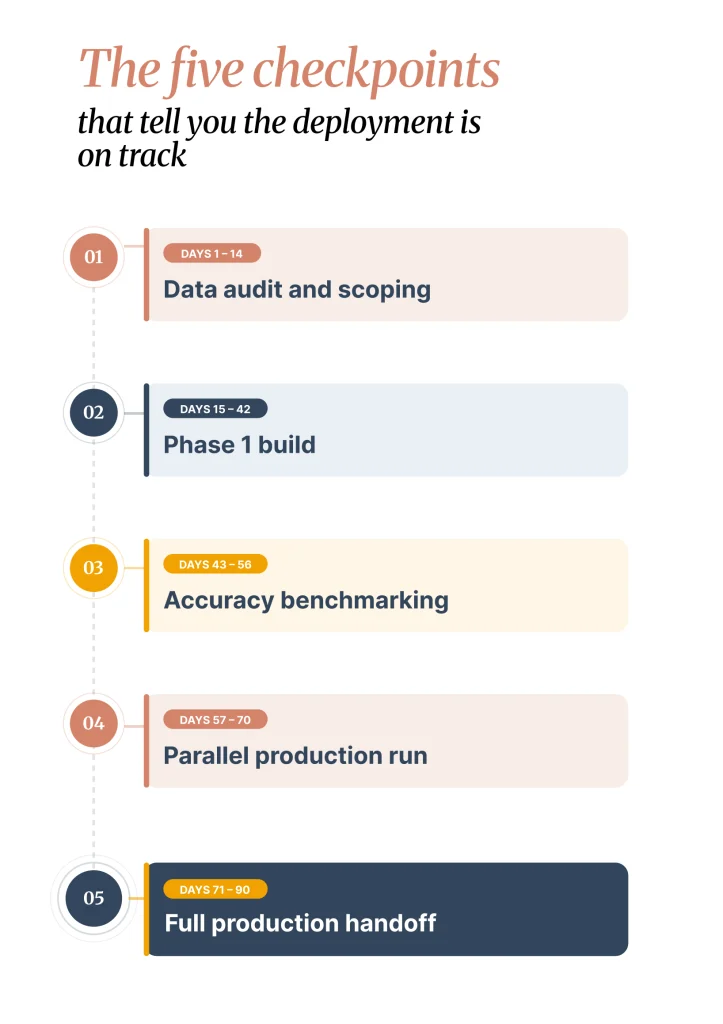
Days 1-14: Data audit and scoping
The first two weeks are spent auditing the historical bid archive and agreeing on accuracy benchmarks. The quality of this scoping phase determines everything that follows, because an AI system trained on poorly organized or incomplete data will produce unreliable output regardless of how sophisticated the model is. Ask your vendor: “What specific data formats and document types do you need from us, and what happens if our archive has gaps?” A good answer includes a structured checklist and a process for handling missing data. A vague answer like “just send us everything you have” signals a vendor who will figure it out later at your expense.
Days 15-42: Phase 1 build
The 4-week build trains the AI on the client’s actual bid documents, product spec database, and compliance records, not generic industry data. This is where the system learns the difference between your company’s standard response to a corrosion resistance requirement and a competitor’s boilerplate. The evaluation question here: “Will the model be trained exclusively on our data, or will it include generic pre-training data from other clients?” A vendor building on your data will ask detailed questions about your document taxonomy. A vendor using generic fine-tuning will ask for a data dump and go quiet for three weeks. Research shows that AI tools built on company-specific data produce measurably better proposal outcomes than generic alternatives.
Days 43-56: Accuracy benchmarking
Before the system processes any real bid, accuracy is benchmarked against historical bids the client holds back from training. The client signs off on performance thresholds. This is the most important checkpoint in the entire 90-day process, and skipping it is the single biggest predictor of a failed deployment. Ask: “Will you provide a signed accuracy benchmark document before the system touches a live bid?” The answer should be an unqualified yes with a specific format for the benchmark report. Any hedging here, such as “we measure accuracy continuously after launch,” means the vendor is shifting risk to your live submissions.
Days 57-70: Parallel production run
For two weeks, the AI runs in parallel with the manual process. Its output is compared against manual review on the same live bids before the team transitions fully. This phase catches edge cases the historical benchmarking missed: unusual RFP formats, new compliance requirements, or product configurations that were not well-represented in the training data. The question for vendors: “Is the parallel run mandatory in your engagement model, or optional?” A mandatory parallel run means the vendor stands behind their accuracy benchmarks. An optional one means they are comfortable letting you find errors in production.
Days 71-90: Full production handoff
From day 71, the team uses AI output as the primary input to bid preparation. The monitoring and retraining process takes over, with dashboards tracking accuracy metrics and triggers for model retraining when performance drifts. What good looks like at this stage: the client owns all code, models, and documentation. The proposal team has runbooks for common scenarios. There is a defined process for flagging edge cases and feeding them back into the model. The AI system is not a black box operated by the vendor; it is an in-house capability with clear ownership. Industry data shows that organizations with structured AI deployment processes achieve 40% faster compliance-related workflows compared to ad-hoc implementations.
Three red flags in a vendor’s deployment plan
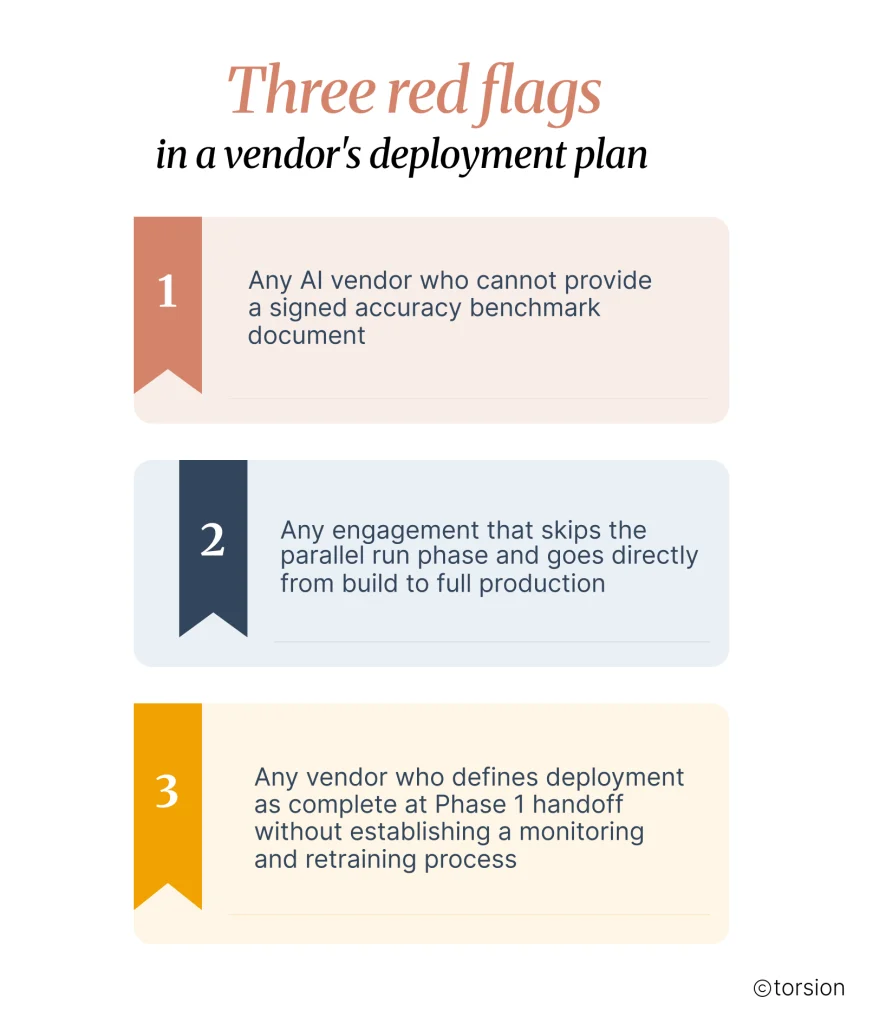
Any AI vendor who cannot provide a signed accuracy benchmark document before the system processes its first live bid is asking you to accept unknown risk on real revenue. For manufacturing proposal teams, this is not an abstract concern: a single inaccurate compliance statement in a bid for a $10M contract can disqualify the submission or create legal liability. Test this directly by asking: “At what point in the engagement do we receive a written accuracy benchmark, and who signs it?” If the answer involves phrases like “ongoing measurement” or “we track accuracy after go-live,” the vendor is planning to benchmark on your live bids, which means your real submissions become their test environment.
Any engagement that skips the parallel run phase and goes directly from build to full production is cutting the safety net that catches errors before they reach a customer. In manufacturing proposals, errors are not cosmetic: a wrong material specification, an incorrect lead time, or a misapplied regulatory citation can cost the bid or, worse, create contractual obligations the company cannot fulfill. Ask: “How many of your current clients ran a parallel phase, and what was the average number of issues caught during that phase?” A vendor with real parallel run experience will have specific numbers. A vendor who treats it as optional will not.
Any vendor who defines deployment as complete at Phase 1 handoff without establishing a monitoring and retraining process is delivering a system that will degrade over time. Manufacturing product lines change, compliance requirements evolve, and new RFP formats emerge. Without a maintenance process, the AI’s accuracy will drift downward within months. Ask: “What does your post-deployment monitoring look like, and who owns the retraining process after handoff?” The answer should include specific metrics, alert thresholds, and a clear handoff of monitoring responsibility to the client’s team. Evidence from three years of enterprise AI deployments confirms that accuracy without ongoing maintenance declines significantly within the first year.
The first 90 days of AI-assisted proposal writing: what happens and when
Generic AI deployment tools are the right choice for teams with straightforward collaboration needs, simple template-based proposals, and low bid volumes. This comparison is for teams whose scope includes the full technical bid process: compliance mapping, product configuration, pricing logic, and multi-stakeholder review cycles. Understanding what to expect in the first 90 days of AI-assisted proposal writing for manufacturing requires comparing the generic approach against a structured, data-specific deployment. The table below compares six dimensions that matter most for manufacturing VP Sales, Proposal Directors, and CTOs overseeing a new AI deployment.
| Dimension | Generic AI deployment (common approach) | Torsion Phase 1 deployment |
| Data preparation | Client provides data; vendor decides what to use | Structured data audit in weeks 1-2; client and Torsion agree on training set |
| Training approach | Generic model fine-tuned on client data | Model built on client’s historical bids, product specs, and compliance records |
| Accuracy sign-off | System goes live; accuracy measured post-deployment | Accuracy benchmarks agreed before go-live; client signs off on thresholds |
| Parallel run | Optional or absent | 2-week mandatory parallel run with AI output validated against manual review on live bids |
| Monitoring | Periodic review at vendor discretion | Monitoring dashboards and retraining triggers established at handoff; client owns the process |
| Day-90 deliverable | Access to a running SaaS system | Deployed production system plus documentation, runbooks, and training for in-house operation |
The future of proposal management increasingly depends on AI systems that are purpose-built rather than generic, and this table illustrates why the distinction matters for manufacturing teams with complex bid requirements.
What a well-run first 90 days looks like in practice
A well-structured engagement starts with a fixed 6-week Phase 1 build on the client’s own historical data, followed by an accuracy sign-off where the client reviews benchmark results and approves the system for parallel testing. The parallel run lasts two weeks, during which every AI-generated section is compared against the manual process on the same live bids. At day 90, the client owns all code, models, and training data. There is no ongoing vendor dependency unless the client chooses to retain support for model retraining. This structure ensures that no live bid is processed by an unvalidated system, and that the client retains full control of the technology.
A $500M industrial equipment manufacturer working with Torsion was processing live bids in production at day 56, two weeks ahead of the 90-day plan, after the parallel run confirmed accuracy benchmarks were met. The proposal team now uses AI-generated first drafts as the starting point for every technical bid, spending their time on strategic differentiation and pricing rather than rewriting boilerplate compliance sections. The system handles product configuration lookups, regulatory citation mapping, and historical win/loss pattern analysis. The client owns all code, models, and training data with no ongoing vendor lock-in, and the state of AI in enterprise workflows in 2026 reflects this shift toward ownership-first deployment models.
What you should have at day 90 and how to know the deployment worked
At day 90, a manufacturing proposal team should have a production AI system trained on their own data, validated through accuracy benchmarks and a parallel run, with monitoring dashboards and retraining processes fully documented and owned by the client’s team. The signal that the deployment worked is not that the AI writes perfect proposals; it is that the proposal team spends measurably less time on repetitive technical content and compliance mapping, and more time on strategy, pricing, and customer-specific differentiation.
The clearest way to see whether the 90-day plan fits your process is a short scoping call. to walk through the 90-day deployment plan before committing. The Torsion team maps your highest-impact RFP automation opportunity and tells you whether a custom system makes financial sense for your process.