
TL;DR:
- The process: AI processing of large multi-document RFP packages in manufacturing currently takes 3-5 days of senior engineering time manually
- What AI changes: under 4 hours for the same output. AI processed a 40-60 file RFP package, built a reference graph, extracted applicable standards, generated a compliance matrix in under 4 hours.
- The same work previously took an engineering team 3 days
- The steps: File intake and document graphing, Relevance classification, Requirements and standards extraction, Compliance matrix generation, Output packaging
- What AI cannot do: AI cannot prioritise which compliance gaps to resolve first based on client relationship or strategic bid importance. That triage decision requires the proposal manager’s judgment
- The result: engineers act on a processed package instead of reading 400 pages
An engineer manually reads a 400-page RFP package consisting of 40-60 individual files, determines document relevance, extracts requirements into a tracker, and cross-references compliance clauses across multiple specs – and the question of how to process a 400-page RFP package in hours, not weeks, becomes urgent when that manual cycle costs 3-5 days of senior engineering time per bid. This article walks through exactly what happens at each stage of AI processing of large multi-document RFP packages in manufacturing, from file intake through compliance matrix generation. If you are a manufacturing proposal manager or engineer dealing with high-volume RFP packages, you will finish this piece knowing the specific outputs AI produces at each step, where human judgment remains essential, and what realistic time savings look like on a real engagement.
The AI processing of large multi-document RFP packages in manufacturing process before AI
The manual process starts the moment a bid lands. An engineer downloads all files, opens each individually, and decides relevance based on file name and an initial read – a half-day task for a 40-file package. That engineer then reads each relevant document and manually tags sections as technical spec, compliance clause, scope definition, or background. This classification step alone takes 1-2 days for a large package, and the most common error is misclassifying a compliance clause buried inside a scope narrative, which means it gets skipped entirely. For teams trying to figure out how to process a large RFP package quickly in manufacturing, the bottleneck is almost always here.
Once tagging is done, the engineer reads tagged sections and extracts applicable ISO, ASTM, and client-specific standards and scope requirements into a tracking spreadsheet. Missing a single referenced standard at this stage can cascade into a non-compliant bid. The engineer then cross-references each extracted requirement against the product specification database and manually builds a compliance matrix, a process that takes another full day for a complex package. Finally, the engineer compiles the requirements register, compliance matrix, and initial response framework into a usable bid preparation package – often reformatting data across three or four different tools.
The cumulative toll is real: 3-5 days of senior engineering time per package, and that is time pulled from product engineering, customer support, or other active bids. A $500M industrial equipment manufacturer Torsion works with reported that roughly 30% of RFP invitations went unanswered simply because the team could not process packages fast enough to meet submission deadlines. A single compliance error caught after submission can disqualify a bid outright, and at that revenue scale, each missed bid represents significant lost pipeline.
What happens at each stage of processing the package
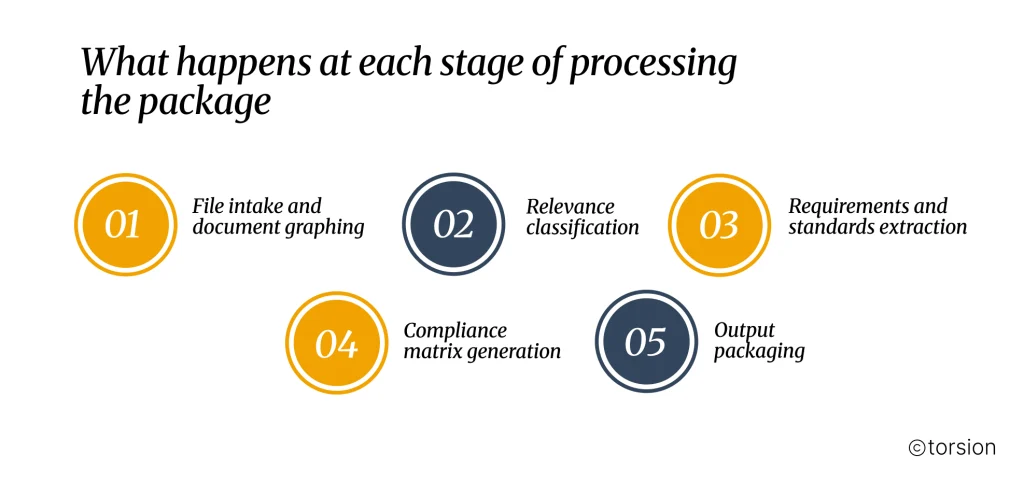
File intake and document graphing
Manually, an engineer downloads all files, opens each individually, and decides relevance based on file name and initial read – a half-day task for a 40-file package. AI ingests all uploaded files simultaneously, parses document structure, builds a cross-reference graph showing document relationships, and flags missing referenced documents in minutes. At the same manufacturer, this step alone eliminated a recurring problem: engineers would start extracting requirements only to discover midway that a referenced appendix was missing from the original package. The engineer still reviews flagged gaps and confirms the reference graph before the next stage begins.
Relevance classification
An engineer reads each relevant document and manually tags sections as technical spec, compliance clause, scope definition, or background – taking 1-2 days for a large package. AI classifies each document section by type and relevance to the defined project scope, producing a prioritised document map. This is where large RFP document processing through AI delivers measurable manufacturing time reduction: classification that previously consumed the bulk of the cycle now completes in minutes. The engineer reviews the prioritised map and overrides any misclassifications, which typically account for fewer than 5% of sections.
Requirements and standards extraction
Manually, an engineer reads tagged sections and extracts applicable ISO, ASTM, and client-specific standards and scope requirements into a tracking spreadsheet. AI extracts all applicable standards, compliance clauses, and scope requirements from across all documents and produces a structured requirements register with source references. Each extracted requirement links back to its source page and paragraph, so the engineer can verify context without re-reading entire documents. The engineer handles edge cases: requirements that reference superseded standards or client-specific terms that do not map cleanly to the product database.
Compliance matrix generation
An engineer cross-references each extracted requirement against the product specification database and manually builds a compliance matrix. AI runs a full pass/fail/review compliance check against the product spec database and generates a compliance matrix with engineer-resolvable flag categories. At the same manufacturer, this step previously generated the most rework because manual cross-referencing across hundreds of line items inevitably produced errors. The engineer resolves items flagged as “review” – typically 10-15% of the total – and confirms pass/fail designations.
Output packaging
An engineer compiles requirements register, compliance matrix, and initial response framework into a usable bid preparation package. AI packages the requirements register, compliance matrix, and pre-filled response template into a structured bid preparation package ready for engineer review. The output is formatted for the proposal team’s existing tools, not a proprietary interface that requires additional training. The engineer reviews the assembled package, adjusts response language, and routes it to the proposal manager for strategic review.
Processing a 400-page RFP package: what takes 3 days manually vs under 4 hours with AI
| Workflow stage | Before AI | With AI |
| File intake and document graphing | Engineer downloads all files, opens each individually, and decides relevance based on file name and initial read – a half-day task for a 40-file package. | AI ingests all uploaded files simultaneously, parses document structure, builds a cross-reference graph showing document relationships, and flags missing referenced documents in minutes. |
| Relevance classification | Engineer reads each relevant document and manually tags sections as technical spec, compliance clause, scope definition, or background – taking 1-2 days for a large package. | AI classifies each document section by type and relevance to the defined project scope, producing a prioritised document map. |
| Requirements and standards extraction | Engineer reads tagged sections and extracts applicable ISO, ASTM, and client-specific standards and scope requirements into a tracking spreadsheet. | AI extracts all applicable standards, compliance clauses, and scope requirements from across all documents and produces a structured requirements register with source references. |
| Compliance matrix generation | Engineer cross-references each extracted requirement against the product specification database and manually builds a compliance matrix. | AI runs a full pass/fail/review compliance check against the product spec database and generates a compliance matrix with engineer-resolvable flag categories. |
| Output packaging | Engineer compiles requirements register, compliance matrix, and initial response framework into a usable bid preparation package. | AI packages the requirements register, compliance matrix, and pre-filled response template into a structured bid preparation package ready for engineer review. |
Total time from document intake to submission-ready output drops from 3-5 days of senior engineering time to under 4 hours.
What still needs an engineer after the package is processed
AI cannot prioritise which compliance gaps to resolve first based on client relationship or strategic bid importance – that triage decision requires the proposal manager’s judgment. The system identifies gaps and flags them. It does not know that a particular client has historically accepted deviations on material testing standards, or that winning a specific contract opens a new market segment worth pursuing at a lower margin. AI handles patterns from its training data; novel requirements outside that training set still need expert judgment. This is a design boundary, not a limitation to apologize for.
Two additional constraints matter in practice. First, on the first package in an unfamiliar category the system has little precedent, so early output is limited. The system improves as it processes more bids in that category, because the product spec database and classification models become more accurate with each cycle. Procurement teams that only after sustained use across multiple bid cycles. Second, where requirements conflict the system marks them for an engineer rather than resolving them. AI flags them sometimes with specific page references showing the contradiction, but engineers decide how to interpret and respond. The system is a processing engine, not a decision-maker.
How one manufacturer cleared a 400-page package
The before state was familiar to anyone running a proposal operation at scale. An engineer manually read a 400-page RFP package consisting of 40-60 individual files, determined document relevance, extracted requirements into a tracker, and cross-referenced compliance clauses across multiple specs. Each package consumed 3-5 days of senior engineering time. The Phase 1 build with Torsion took 6 weeks. The system was trained on the client’s own historical bid documents and product spec database, with accuracy benchmarks established before production cutover. This is consistent with how proposal management is evolving in 2026: teams are training AI on their own data, not relying on generic models.
AI processed a 40-60 file RFP package – built a reference graph, extracted applicable standards, generated a compliance matrix – in under 4 hours; the same work previously took an engineering team 3 days. The proposal team now operates differently. Engineers focus on product selection, deviation strategy, and client relationships instead of document processing. The bid decline rate dropped because the team could respond to more invitations within deadline windows. The time comparison held consistently across subsequent packages: from 3-5 days of senior engineering time to under 4 hours, with engineer review built into that window.
What you get back from AI after processing a 400-page RFP
The shift is straightforward: your engineering team stops spending days on document processing and starts spending hours on the decisions that actually win bids. Every minute recovered from manual extraction is a minute available for product strategy, deviation negotiation, and client engagement – the work that differentiates a winning proposal from a compliant one.
If you want to see what AI processing of large multi-document RFP packages in manufacturing looks like for your team, book a walkthrough and Torsion’s team will follow up with insights specific to your bid operation.