
Key Takeaways
- Legacy healthcare systems block AI adoption through data silos, integration complexity, and security gaps while consuming 75% of IT budgets on maintenance rather than innovation.
- The 2025 HIPAA Security Rule update mandates encryption, MFA, and vulnerability scanning that legacy systems cannot support without significant architectural changes.
- Incremental refactoring with parallel-run methodology delivers zero-downtime modernization in 8-12 weeks with 95% processing time improvements and $500K-$720K annual savings.
- HIPAA compliance for AI requires architecture-level design using API gateways, tokenization, automated audit logging, and data lineage tracking rather than bolt-on solutions.
- Healthcare organizations that bridge legacy systems and AI compliance will lead the next decade while those that delay face $9.77M breach costs and watch competitors deploy AI at scale.
The data engineering team at a mid-sized healthcare platform had a problem that kept getting worse. Their patient record processing ran on 15-year-old Perl scripts with zero documentation because the original engineer left three years ago. Every time they needed to add a data source, they held their breath because processing took 7-8 hours every single night, and any change risked breaking downstream systems that nobody fully understood anymore.
Leadership had approved a GenAI initiative for clinical decision support, and the AI models were ready with a compelling business case behind them. Then the VP of Engineering looked at the integration points and realized they were processing 500K records daily through legacy infrastructure while needing to meet HIPAA compliance requirements.
And keep existing reporting pipelines serving physicians running without interruption. The gap between approved and deployed became painfully clear.
This scenario plays out across healthcare where 70% of healthcare providers depend on outdated platforms despite modernization being a priority for 95% of executives. Meanwhile 83% of healthcare IT teams say legacy systems in healthcare actively disrupt operations.
With the first major update to HIPAA Security Rule in 20 years coming in 2025, 67% of healthcare organizations are not prepared for stricter AI security requirements.
Healthcare legacy systems were not built for decentralized AI model training, generative outputs, or real-time inference, just as HIPAA was not designed for synthetic data or LLM hallucinations. But the industry cannot wait for a perfect moment to modernize because competitors are already deploying AI at scale.
This guide provides a technical roadmap for healthcare CTOs, VPs of Engineering, and Directors of Data Science navigating the intersection of legacy system modernization, AI integration, and HIPAA compliance with architecture patterns, security frameworks, and measurable outcomes from organizations that have successfully closed the gap.
Why Legacy Healthcare Systems Create a Perfect Storm for AI Adoption
The Infrastructure Time Bomb Nobody Talks About
Healthcare legacy systems are typically 10-15+ year-old infrastructures built before modern tools like Airflow, dbt, and FHIR APIs even existed as standard options. These monolithic architectures have tightly interconnected components where changing one piece risks breaking six others in ways that are difficult to predict.
| System Type | Common Examples | Typical Age | Primary Challenge |
| EMR/EHR Platforms | Epic, Cerner, custom builds | 10-20 years | Proprietary data formats |
| Claims & Payment Processing | Custom billing, clearinghouse integrations | 15+ years | Fragile integration points |
| Data Warehouses | On-premise Oracle, Teradata, Informatica | 10-15 years | High maintenance costs |
| ETL Pipelines | Perl scripts, Shell scripts, proprietary tools | 10-20 years | Undocumented transformation logic |
The financial burden is staggering because maintaining legacy platforms consumes up to 75% of IT budgets, which means money that should fund innovation instead keeps the lights on.
What Are the Risks and Hidden Costs of Maintaining Legacy Healthcare Systems?
The risks and hidden costs of maintaining legacy healthcare systems extend far beyond infrastructure expenses in ways that directly impact both operations and patient care.
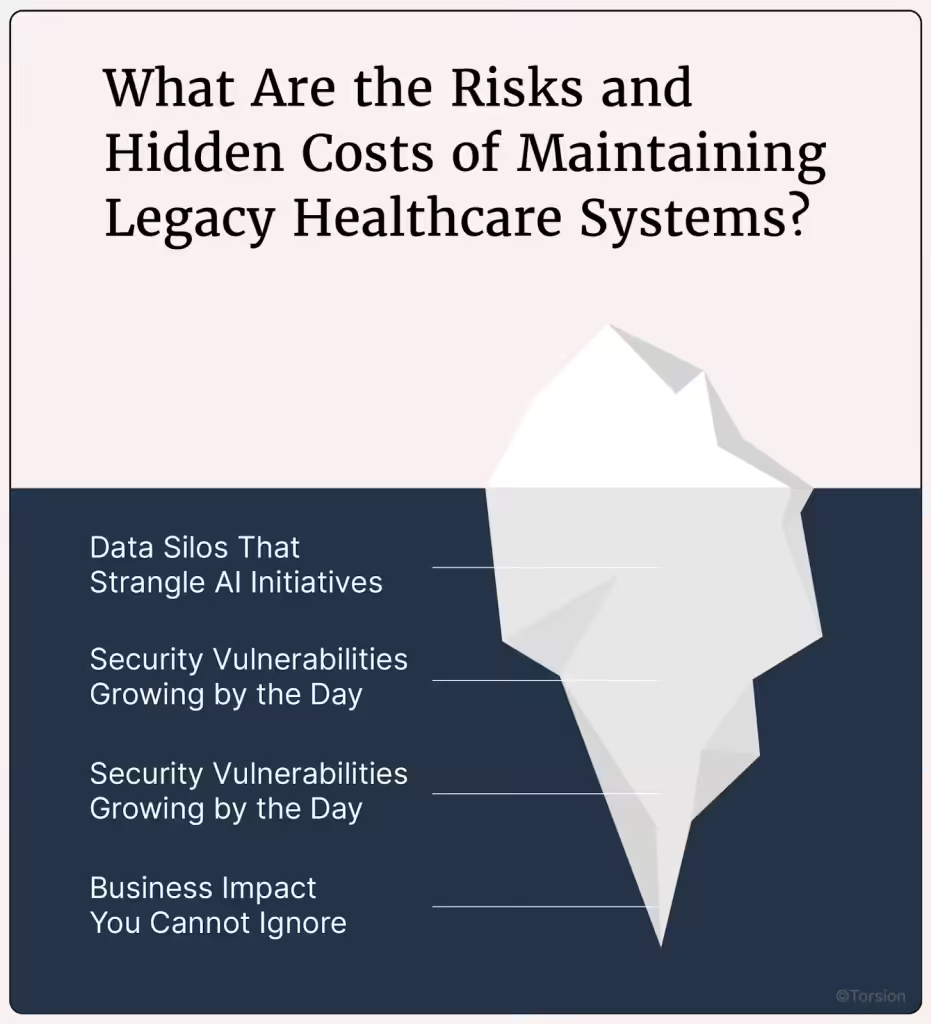
Data Silos That Strangle AI Initiatives
Patient data scatters across 6+ disconnected systems where 72% of providers cannot get a complete view of patient information due to poor interoperability, while 80% of healthcare data remains unstructured and inaccessible to AI models.
“The best engineers spend 50% of their time maintaining legacy pipelines instead of building AI features because nobody wants to work on 15-year-old Perl scripts, which means you cannot hire and your existing team is burning out.”
Security Vulnerabilities Growing by the Day
About 74% of hospitals on legacy systems experienced a cybersecurity incident in the past year, and healthcare breaches now cost an average of $9.77 million per incident, which is nearly double the global average. Legacy healthcare system security often lacks modern encryption protocols like TLS 1.3 and AES-256 along with the zero-trust architectures that current threats require.
The Integration Complexity That Kills AI Projects
Data preparation consumes 60-70% of AI project timelines while data quality issues cause 80% of AI POC failures in the first week, and integration challenges derail 29% of healthcare AI projects before they reach production.
Business Impact You Cannot Ignore
Hospital IT downtime costs $7,900 per minute while lab test results are delayed 62% longer during EHR outages, yet only 25% of companies see real impact from AI investments despite 75% of executives ranking GenAI as a top-3 priority.
Why AI Integration Is Not Plug-and-Play with Healthcare Legacy Systems
The Data Readiness Gap
LLMs are only as good as the data they train on, which means AI systems require clean, normalized, accessible data while legacy healthcare systems provide the exact opposite. The reality of legacy systems healthcare shows that data is siloed, messy, and unstructured while AI struggles to process legacy enterprise data formats, and only 40% of healthcare organizations have a mature interoperability strategy.
Integration solutions for legacy healthcare systems face significant technical barriers because legacy platforms use outdated protocols like HL7 v2 that are incompatible with modern REST APIs. Many older EHRs do not support FHIR standards, which limits cloud and AI integration, while processing 500K+ records daily through legacy infrastructure creates latency that real-time AI inference cannot tolerate.
The HIPAA Compliance Minefield
Add HIPAA into the equation and the complexity multiplies exponentially because the 2025 HIPAA Security Rule update represents the first major revision in 20 years and introduces requirements legacy systems were never designed to meet.
| New Requirement | Legacy System Challenge |
| Mandatory encryption (AES 128/192/256-bit) for all ePHI | Retrofitting encryption into decades-old databases |
| Multi-factor authentication for all system access | Legacy authentication systems lack modern protocols |
| Technology asset inventory of all AI systems handling ePHI | No centralized tracking infrastructure exists |
| Bi-annual vulnerability scanning | Legacy systems often cannot support modern scanning tools |
| 72-hour restoration requirement for ePHI after incidents | Backup/recovery systems designed for different timelines |
What OCR is actively targeting in 2024-2025 includes PHI leakage from poorly governed AI models, AI hallucinations that fabricate or distort health data, synthetic PHI that mimics real patients, and organizations performing only superficial Security Risk Analyses.
“Black-box models are a red flag because OCR guidance requires that all predictive systems used in healthcare can produce decision rationale for each output and maintain traceability logs that satisfy HIPAA’s auditability clause.”
The Five Compliance Challenges Where Legacy Systems and AI Collide
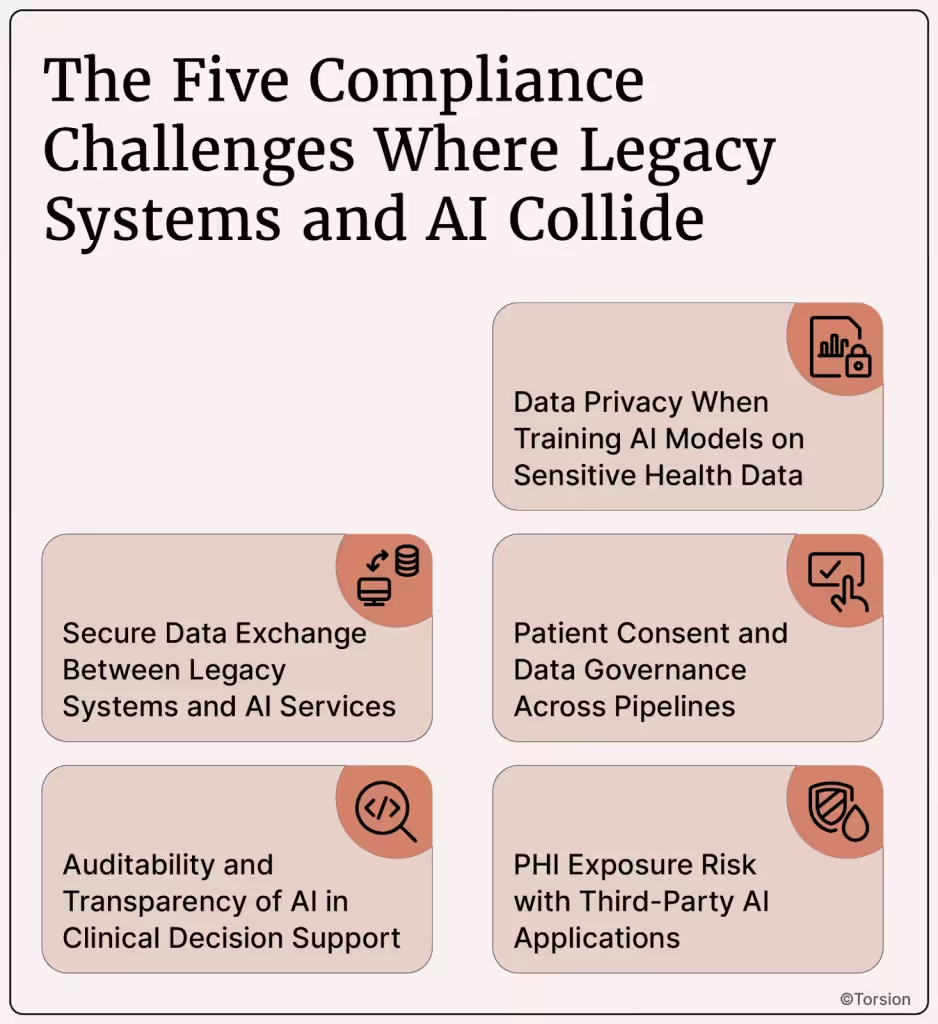
1. Data Privacy When Training AI Models on Sensitive Health Data
The reconstruction risk is real because AI models trained on de-identified data can regenerate patterns resembling original patients, which means even synthetic PHI must be governed, logged, and justified if it approximates real identities.
The de-identification challenge becomes clearer when you understand that HIPAA’s Safe Harbor method requires removing 18 specific identifiers while open-source PHI de-identification tools achieve 95%+ recall but precision varies significantly with some achieving as low as 78%. Healthcare organizations need validation pipelines to ensure de-identification completeness before model training.
2. Secure Data Exchange Between Legacy Systems and AI Services
Protocol incompatibility creates integration nightmares because many older EHRs do not support FHIR standards while legacy systems use HL7 v2 messaging, which lacks the flexibility modern APIs require. Challenges of legacy payment systems in healthcare include fragile clearinghouse integrations that break under modern data volume demands.
3. Patient Consent and Data Governance Across Pipelines
OCR now treats data lineage as non-negotiable, which means AI systems must track data from source through every transformation to final inference.
“If an organization cannot demonstrate how PHI entered, moved, and influenced a model, that is a compliance failure.”
The consent management complexity grows with each integration point because patient consent for AI processing may differ from consent for treatment, and legacy systems often lack mechanisms to track granular consent preferences while cross-system lineage tracking requires infrastructure legacy platforms do not have.
4. Auditability and Transparency of AI in Clinical Decision Support
Over 60% of healthcare professionals express hesitation adopting AI due to lack of transparency while only 29% of AI healthcare studies report clinician involvement in development.
Documentation requirements for HIPAA compliance include model cards documenting purpose, limitations, and training data along with input-output recording at inference with decision justification and version histories that maintain immutable logs for model changes.
5. PHI Exposure Risk with Third-Party AI Applications
About 75% of insurance and healthcare professionals cite data privacy as their primary AI concern, which makes Business Associate Agreement requirements particularly difficult to enforce with legacy systems.
Written BAA is required before any PHI is shared with AI vendors and the agreement must define AI use cases while prohibiting unauthorized secondary use for model training. It must also require transparency clauses for AI decision-making because cloud service providers storing encrypted data are considered business associates under HIPAA.
Integration Solutions for Legacy Healthcare Systems: Technical Approaches That Work
Building Secure, Modular Data Pipelines
The API-first middleware architecture provides the isolation layer legacy systems need through a three-layer design pattern that separates concerns and protects production systems.
| Layer | Function | Technology Options |
| System Layer | Connect to source systems (EHRs, claims, labs) | Mirth Connect, HL7/FHIR adapters |
| Process Layer | Transform, validate, apply business rules | Apache Camel, Mule ESB |
| Experience Layer | Expose clean APIs to AI services | Kong, AWS API Gateway, Apigee |
Key implementation principles include using an API Gateway as single secure entry point that manages authentication, throttling, and request/response handling. Event-driven architecture enables real-time data sync without polling legacy systems while circuit breakers and failover mechanisms protect production stability.
Torsion’s approach focuses on Systems Integration and API Development where we integrate AI solutions via APIs, middleware, and real-time data sync with existing systems.Torsion-Brand-Narrative.pdf
Tokenization and De-Identification: The Compliance Safety Net
How can healthcare organizations securely modernize legacy payment systems? The answer starts with tokenization because this approach replaces sensitive data elements like patient names, SSNs, and MRNs with tokens while preserving data utility for AI training.
This enables offshore development and testing with masked realistic data while achieving compliance with HIPAA Safe Harbor standards and maintaining referential integrity across systems. De-identification pipeline design combines rule-based pattern matching using regex and dictionaries for dates, phone numbers, and addresses with machine learning NER models that identify names and contextual PHI, and hybrid approaches combining patterns plus ML achieve best results.
Real-world proof point: AWS and Philips automated de-identification reduced manual effort by 67%.
Continuous Monitoring and Audit Automation
AI-driven compliance tooling reduces manual audit lift by 40-50% through real-time monitoring that flags model drift which could impact PHI exposure or bias while tracking hallucination frequency and unexplainable outputs and catching unusual access patterns like after-hours queries and bulk exports.
Audit automation automates generation of time-stamped audit trails for every data access while creating tamper-proof, searchable logs organized by regulation and aligning policy syncing to OCR guidance updates and state-specific privacy laws.
Healthcare Legacy System Modernization: The Parallel-Run Methodology
Why Incremental Refactoring Beats Rip and Replace
Which integration solutions are most effective for connecting legacy healthcare systems to cloud-based EHR? The ones that do not require shutting down production during the transition process.
| Strategy | Best For | Timeline | Risk Level |
| Incremental Refactoring | Systems with technical debt, tightly coupled components | 8-12 weeks | Low |
| Rehosting (Lift-and-Shift) | Stable systems needing cloud benefits | 6-10 weeks | Medium |
| Rearchitecting | Systems needing scalability, flexibility | 12+ weeks | Medium-High |
| Full Replacement | Severely outdated, unsupportable systems | 16+ weeks | High |
Incremental refactoring works because it minimizes disruption to ongoing operations while allowing phased validation at each stage and preserving institutional knowledge during modernization, which reduces big bang risk that causes 65% of healthcare AI projects to fail.
Torsion’s Zero-Downtime Approach
Remember that healthcare platform with 15-year-old Perl scripts? Here is how we modernized the system without breaking production.
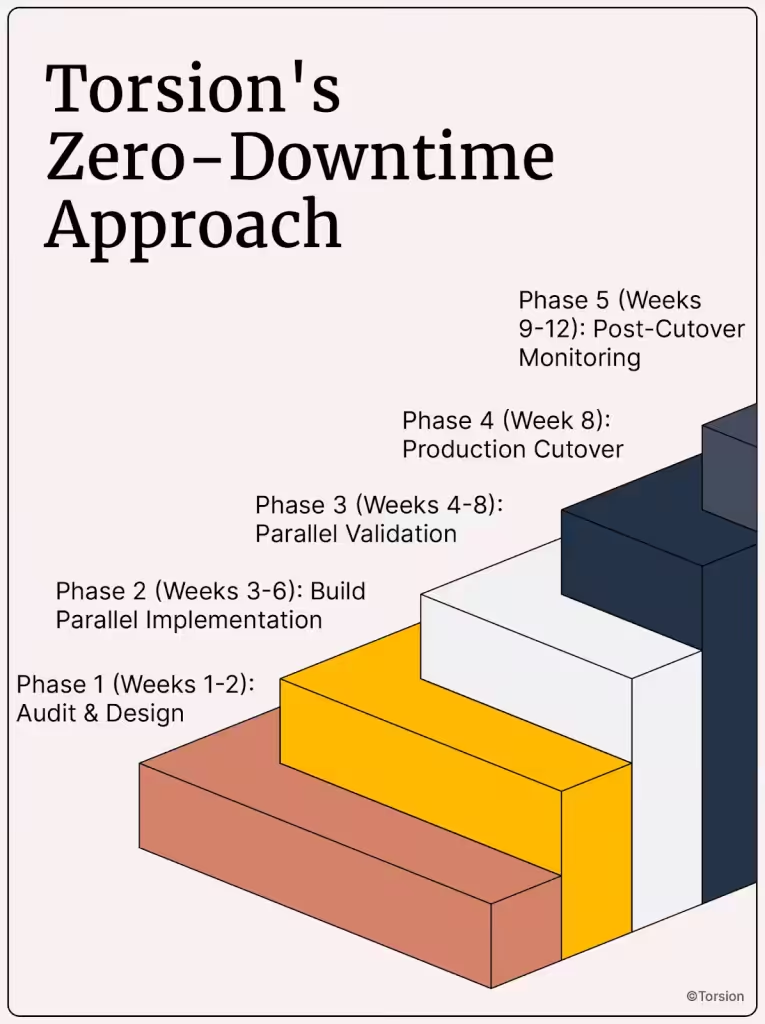
Phase 1 (Weeks 1-2): Audit & Design
We reverse-engineer legacy transformations even with zero documentation while documenting data flows, business rules, and dependencies before designing modern replacement architecture.
Phase 2 (Weeks 3-6): Build Parallel Implementation
We construct modern stack using Python, Airflow, and dbt alongside legacy systems so the legacy system continues serving production without interruption and no production risk exists during development.
Phase 3 (Weeks 4-8): Parallel Validation
Both systems run simultaneously processing duplicate data streams while automated comparison validates outputs match exactly, and we identify and fix edge cases before cutover.
Phase 4 (Week 8): Production Cutover
We execute during low-traffic windows with defined 1-hour rollback capability if needed while legacy system remains available as fallback.
Phase 5 (Weeks 9-12): Post-Cutover Monitoring
We provide 30-60 days of intensive support while knowledge transfer happens to internal team and full documentation with runbooks are delivered.
Results achieved:
Processing time dropped from 7-8 hours to 20 minutes for a 95% reduction while annual savings reached $720K from data center decommissioning, and the team shifted from firefighting legacy code to building AI features with zero downtime during entire migration.
Integration Patterns for Healthcare Payment and Claims Systems
Challenges of legacy payment systems in healthcare require specialized approaches where we use modular billing integration that supports existing clearinghouse connections. Webhook automation provides real-time settlement confirmation while immutable audit trails prove superior to traditional wire documentation.
For claims processing, automated document intelligence reduces manual data entry by 80% while smart contract validation cuts exception rates from 20% to under 5%.
What Modernization Strategies Are Recommended for Security Vulnerabilities?
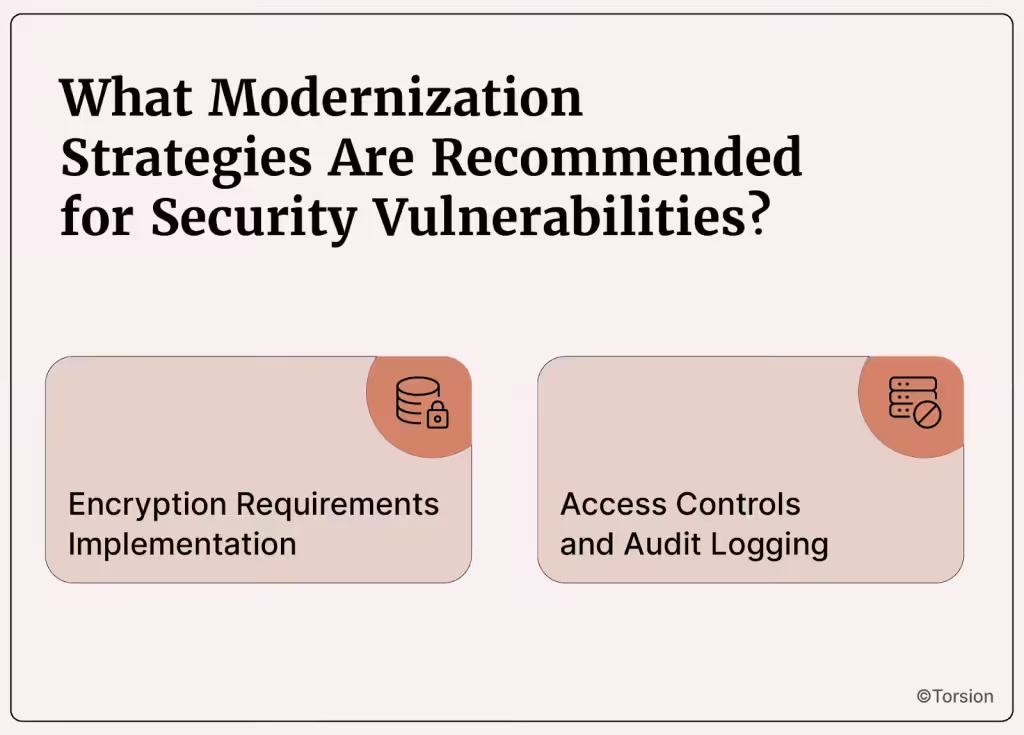
Encryption Requirements Implementation
The 2025 HIPAA Security Rule mandates encryption standards legacy systems were not designed to support, which means organizations need AES 128-bit minimum with AES-256 recommended for highly sensitive data while encrypting data at rest including databases, file systems, and backups.
Encrypt data in transit using HTTPS/TLS for all communications while using NIST/FIPS 140-2 validated cryptographic modules and implementing VPNs or secure tunneling for remote access, and store encryption keys separately from encrypted data.
Key management for legacy systems requires Hardware Security Modules that store keys securely with automated key rotation schedules that maintain security while access controls limit who can decrypt PHI.
Access Controls and Audit Logging
Zero-trust architecture principles apply to legacy environments through role-based access controls that follow the principle of least privilege while multi-factor authentication retrofits via API gateway layer. Session management and automatic timeout enforcement add security while comprehensive audit logging tracks every PHI access.
Measuring Success: Compliance and Business Impact
Compliance KPIs That Matter
| Metric | Target | Measurement Method |
| Regulatory compliance rate | >95% | Automated policy checks against HIPAA requirements |
| Audit preparation time | <2 weeks | Documentation automation and real-time logging |
| Breach detection time | <24 hours | Real-time monitoring and anomaly detection |
| Security control coverage | 100% | Control mapping tools validating all ePHI touchpoints |
Business KPIs Connected to Compliance
How do the benefits and drawbacks of legacy healthcare systems impact operational efficiency? Phased healthcare legacy system modernization cuts IT operating expenses by 25-40% within three years while security AI and automation reduce breach costs by $2.2 million on average, and automated compliance reduces manual audit lift by 40-50%.
Healthcare breach cost avoidance reaches $9.77-$10.93 million per incident while downtime prevention saves $7,900 per minute of hospital operations. POC documentation reduces enterprise AI deployment time by 40-50% while compliance-ready infrastructure enables faster regulatory approval for new AI models and team productivity improves as engineers shift from maintenance to innovation.
“Governance is not red tape but rather a competitive advantage because mature compliance accelerates Enterprise AI deployment, trust, and innovation.”
The HIPAA-Compliant Data Lake: How One Payer Bridged the Gap
The Challenge
A regional healthcare payer faced the classic dilemma where patient data scattered across 6 different systems and no safe way existed to test LLMs on real member data while HIPAA compliance requirements remained unclear for AI workloads. The data science team was blocked from experimentation while the compliance team felt nervous about any cloud deployment.
The Torsion Approach
We completed a 10-week implementation where weeks 1-3 focused on building AWS data lake foundation using S3, Glue, and Athena. We created a de-identification pipeline using tokenization and ML-based NER and designing IAM policies with encryption strategy for compliance.
Weeks 4-7 covered implementation and testing where we set up audit logging for all data access while implementing KMS-based encryption at rest and in transit. We also validated de-identification accuracy against HIPAA Safe Harbor requirements.
Weeks 8-10 involved validation with the compliance team where parallel validation happened while the documentation package went to HIPAA auditors and knowledge transfer occurred to the internal data engineering team.
Results Achieved
We passed the HIPAA audit on the first attempt with a complete audit trail for all PHI access and automated compliance reporting that reduces manual work by 40%. The centralized platform supports 3 LLM use cases in production while data prep time is reduced from weeks to hours, and the data science team became unblocked and can now experiment safely with the foundation for future AI initiatives established.
Technology stack deployed included AWS S3, Glue, Athena, KMS, Python, and Terraform.
The Path Forward: Turning Legacy Constraints into AI Advantages
Key Takeaways for Healthcare Technology Leaders
Legacy healthcare systems create a dual challenge where technical debt blocks AI adoption and compliance gaps create regulatory exposure, but they do not require full replacement. HIPAA compliance for AI requires architecture-level thinking because bolt-on solutions do not work for generative models and predictive systems processing PHI.
Incremental modernization with parallel validation is the proven approach that delivers zero downtime, fixed timelines, and measurable outcomes, and the healthcare platform case study proves this works. Compliance becomes a force multiplier when built in from day one because when governance integrates into the AI lifecycle from the start, it accelerates deployment and builds trust with clinical stakeholders.
What to Do Monday Morning
Assess current infrastructure for AI readiness and compliance gaps by mapping data flows from legacy systems to potential AI integration points while identifying which systems handle PHI and current encryption/access control status, and document the knowledge concentration risk where only 1-2 people understand the system.
Involve compliance, clinical, and engineering teams early by scheduling a joint workshop between technical, compliance, and clinical leadership while defining HIPAA requirements for your specific AI use cases and establishing governance framework before POC phase.
Consider focused modernization engagements that deliver working infrastructure by evaluating partners who offer fixed scope, timeline, and price while prioritizing vendors with healthcare-specific HIPAA compliance expertise and looking for proven parallel-run migration methodology with zero-downtime commitment.
The Competitive Reality
“The divide between top performers and those falling behind is growing fast where some payers are stuck testing without moving forward while others are putting large-scale effective solutions into action.”
The organizations leading healthcare AI transformation do not necessarily have the newest infrastructure but rather figured out how to bridge legacy systems, AI ambitions, and HIPAA compliance while turning constraints into controlled advantages.
Ready to Bridge the Gap Between AI Approved and AI Deployed?
The gap between approved and deployed does not come from the AI models but rather from the infrastructure underneath them. Healthcare organizations that solve this challenge will lead the next decade of care transformation while those that do not will spend that decade explaining audit failures and watching competitors deploy AI at scale.
Torsion specializes in turning legacy healthcare systems into AI-ready infrastructure with HIPAA compliance built in from the start because our end-to-end approach covers Discovery & Strategy, POC Development, Enterprise Deployment, and Optimization & Governance. We deliver working infrastructure with fixed scope, timeline, and price while your team learns as we build, which ensures independence within 6 months rather than perpetual vendor dependency.
Learn how other healthcare organizations have modernized legacy systems while maintaining HIPAA compliance by contacting Torsion at torsion.ai to discuss your specific integration challenges and explore a technical roadmap tailored to your environment.