Key Takeaways
- Consumer wallets have cost $2.17 billion in losses in 2025 alone, single points of failure where one person controls funds with no recovery if keys are lost
- Enterprise infrastructure uses multi-signature security requiring 2-of-3 or 3-of-5 approvals, so no single employee can move funds unilaterally
- The GENIUS Act (July 2025) established federal oversight for stablecoins with 1:1 reserve backing and monthly audits, removing regulatory ambiguity
- Enterprise stablecoin payments cut costs by 50%+ (from $20-50 per wire to under $5) with settlement in minutes instead of 3-5 days
- SOC 2 Type II certification, institutional custody, and insurance up to $1 billion+ protect enterprise implementations with 2-4 week implementation timelines
- Torsion handles technical integration, compliance, and accounting so treasury teams never touch crypto infrastructure directly, full audit-ready reporting included
In February 2025, Bybit, one of the world’s largest cryptocurrency exchanges, lost $1.46 billion when hackers gained remote access to an internal cold wallet system. The breach happened despite “robust security measures.” Users panicked. Ethereum’s price dropped 4%. The CEO promised the company would cover losses from its treasury.
Three months earlier, in July 2024, WazirX lost $230 million from a wallet that required four signatures to authorize transactions. Somehow, the attackers bypassed them all.
Here’s what both incidents have in common: Neither involved enterprise-grade stablecoin infrastructure.
Over $2.17 billion was stolen from crypto services in 2025 year-to-date. Consumer wallets now represent 23.35% of all stolen funds. Yet stablecoins processed $14 trillion in 2024, surpassing Visa, and 15% of CFOs plan to accept stablecoin payments within two years.
The gap between these two facts reveals the central challenge facing finance leaders today: Stablecoins offer undeniable business value, but most infrastructure solutions weren’t built for enterprise treasury requirements.
This isn’t about whether your organization should use stablecoins. That question is already being answered by the market. This is about understanding the fundamental architectural difference between consumer crypto wallets and enterprise payment infrastructure, and why that difference determines whether you’re optimizing treasury operations or creating catastrophic security exposure.
What Most CFOs Get Wrong About “Crypto Wallets”
When finance leaders hear “stablecoin payments,” many picture the same wallets retail investors use for Bitcoin speculation. That’s the wrong mental model, and it’s dangerous.
Consumer crypto wallets were designed for individual users who want full control of their assets. In practice, this means:
- One person holds the private key. Lose that key, lose the funds forever, no recovery, no insurance, no backup.
- No approval workflows. A single employee can authorize unlimited transactions with no oversight.
- No compliance infrastructure. AML/KYC compliance is the user’s responsibility, with no automated reporting.
- No audit trail. Transaction history exists on-chain but isn’t formatted for enterprise accounting systems.
If your treasury operations use a consumer wallet architecture, a single compromised laptop, phishing email, or disgruntled employee can drain your entire corporate treasury with zero recovery path.
The Architecture That Finance Teams Actually Need
Enterprise stablecoin infrastructure operates on fundamentally different security principles. Here’s what changes:
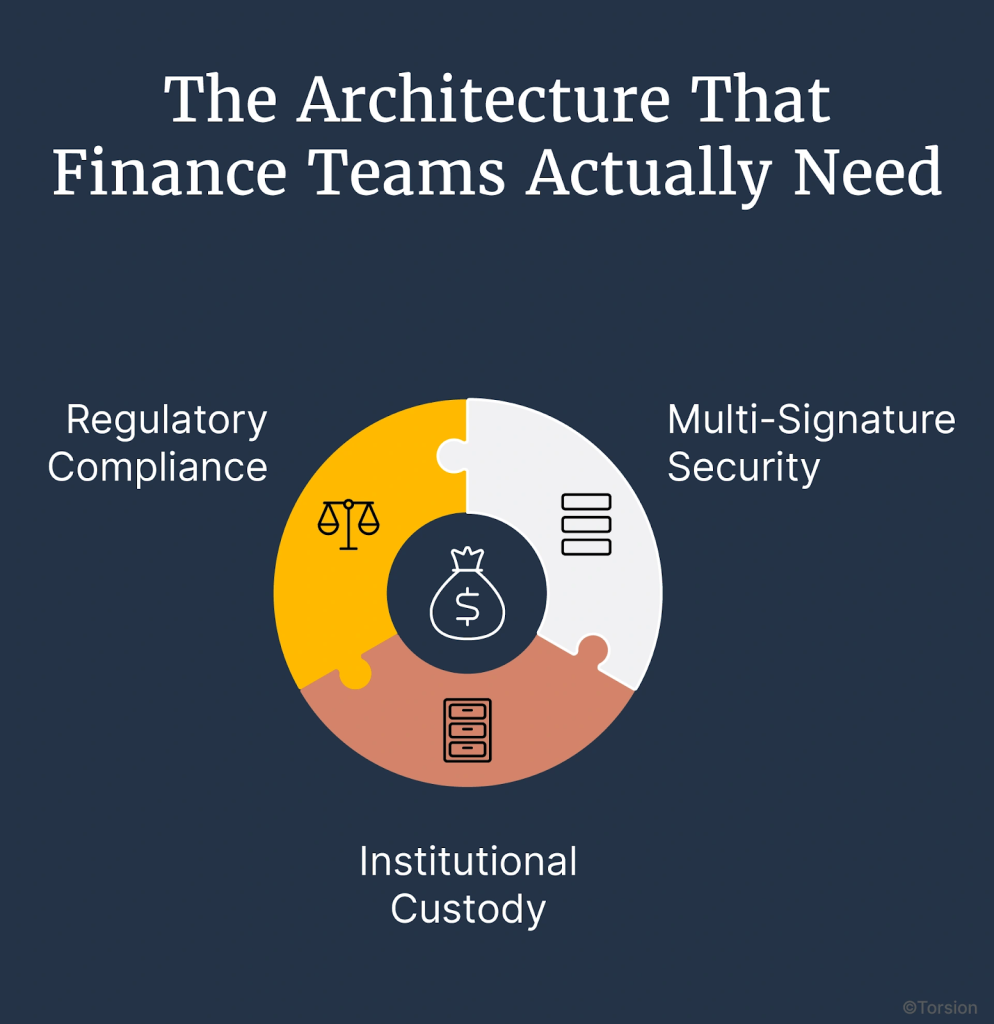
Multi-Signature Security: Eliminating Single Points of Failure
Instead of one person controlling funds, enterprise infrastructure requires multiple authorized parties to approve transactions.
How it works in practice:
- A treasury manager initiates a $100,000 supplier payment
- The system automatically routes it to the CFO and Controller for approval
- Only when 2-of-3 signatures are collected does the transaction execute
- No single person can move funds unilaterally
Companies like Torsion implement these multi-layer approval workflows based on your organization’s existing authority structure, ensuring no employee, regardless of access level, can bypass treasury controls.
Institutional Custody: Your Assets Never Touch Consumer Infrastructure
Rather than employees managing private keys on personal devices, enterprise infrastructure uses regulated custody partners like Fireblocks and Anchorage.
What this provides:
- Multi-Party Computation (MPC) technology distributes key fragments across secure environments, no single server holds complete keys
- Hardware Security Modules (HSMs) protect cryptographic operations in tamper-resistant hardware
- SOC 2 Type II certification validates security controls through independent audits
- Insurance coverage up to $1 billion+ protects against custodial failures
Critical difference: Torsion handles the technical integration, regulatory compliance, and accounting treatment so your treasury team never touches crypto infrastructure directly. You’re not managing wallets, you’re using an audited payment rail.
Regulatory Compliance: Built Into the Infrastructure
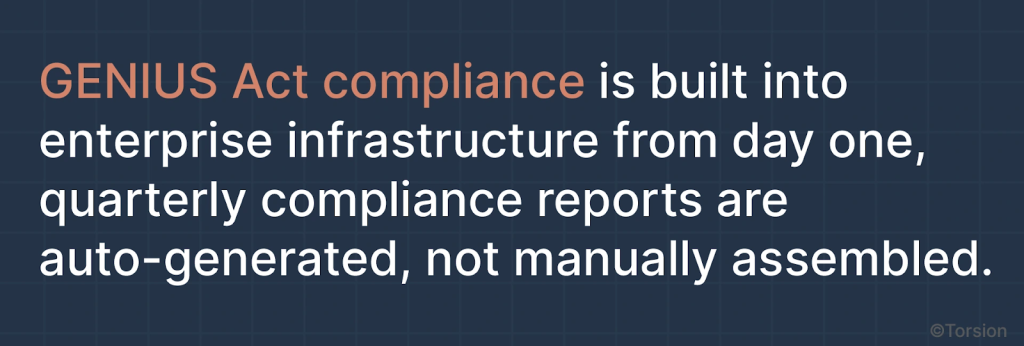
The GENIUS Act, passed in July 2025, established a federal framework for stablecoin regulation. Enterprise infrastructure implements these requirements at the protocol level:
- AML/KYC verification through Chainalysis and TRM Labs for all counterparties
- Travel Rule compliance for transactions over $3,000
- Automated Suspicious Activity Reports (SARs) when patterns trigger thresholds
- Transaction monitoring with quarterly compliance reports auto-generated for audit teams
Consumer wallets offer none of this. Compliance is entirely manual, or entirely absent.
The Reserve Question: What Actually Backs These Payments?
Finance leaders ask this immediately, and they should. Here’s what you’re working with:
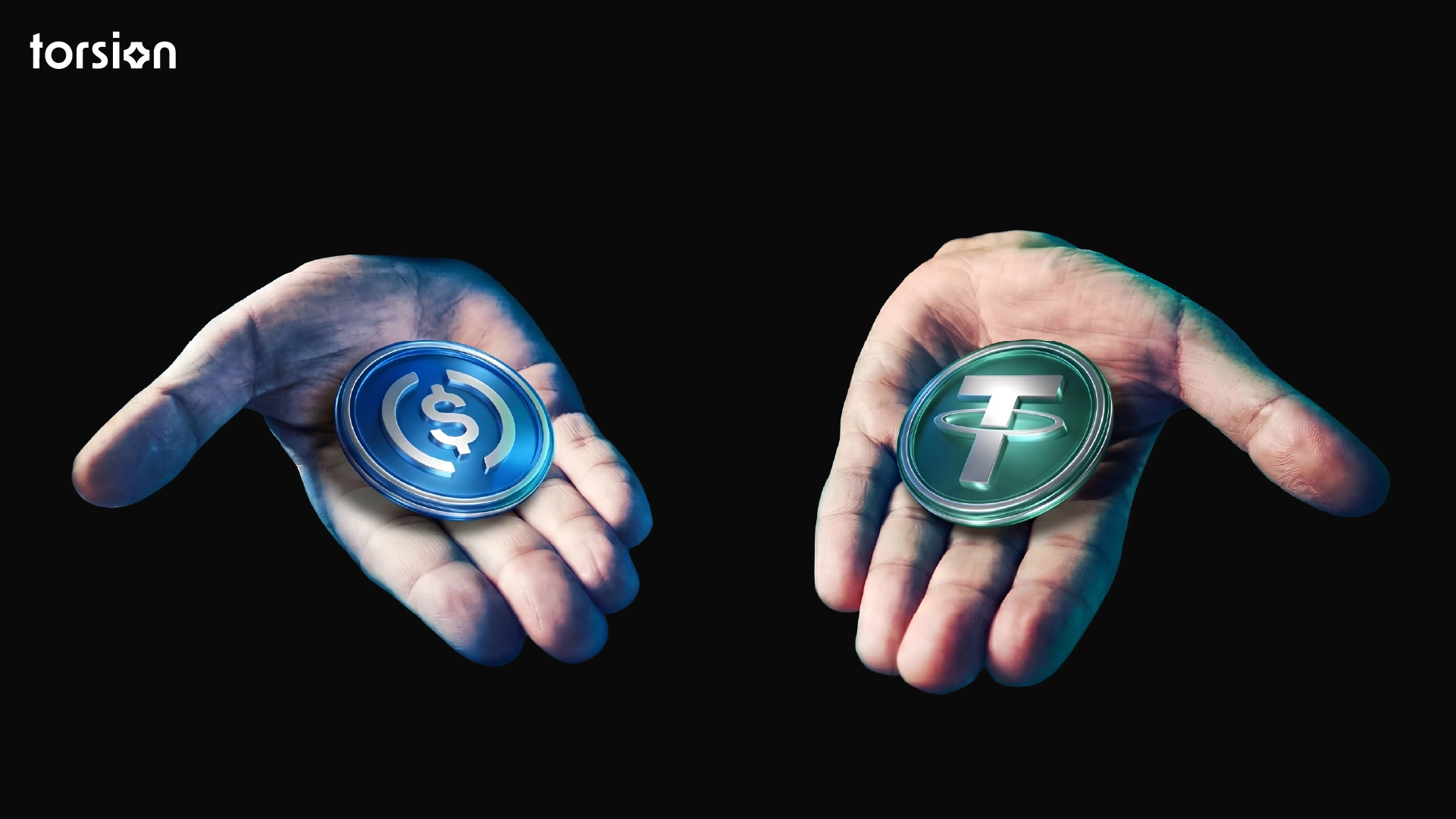
USDC (Circle):
- Backed 1:1 by cash and US Treasury bills
- Monthly third-party attestations by Big Four accounting firms
- As of October 2025: $64.7 billion in reserves backing $64.6 billion USDC outstanding
- Weekly reserve composition disclosures published publicly
USDT (Tether):
- $98.5 billion in reserves, including US Treasury bills
- Monthly transparency reports
- Operates under GENIUS Act regulatory framework
Track record: Major stablecoins haven’t de-pegged in over three years of operation. Reserve audits happen monthly, more frequently than most commercial banks.
Why this matters: When you send a stablecoin payment, you’re transmitting a claim on dollar reserves held by regulated institutions, not speculating on Bitcoin’s price. These are fundamentally different instruments.
What This Actually Looks Like in Treasury Operations
Enterprise infrastructure delivers concrete operational benefits that consumer wallets structurally cannot provide:
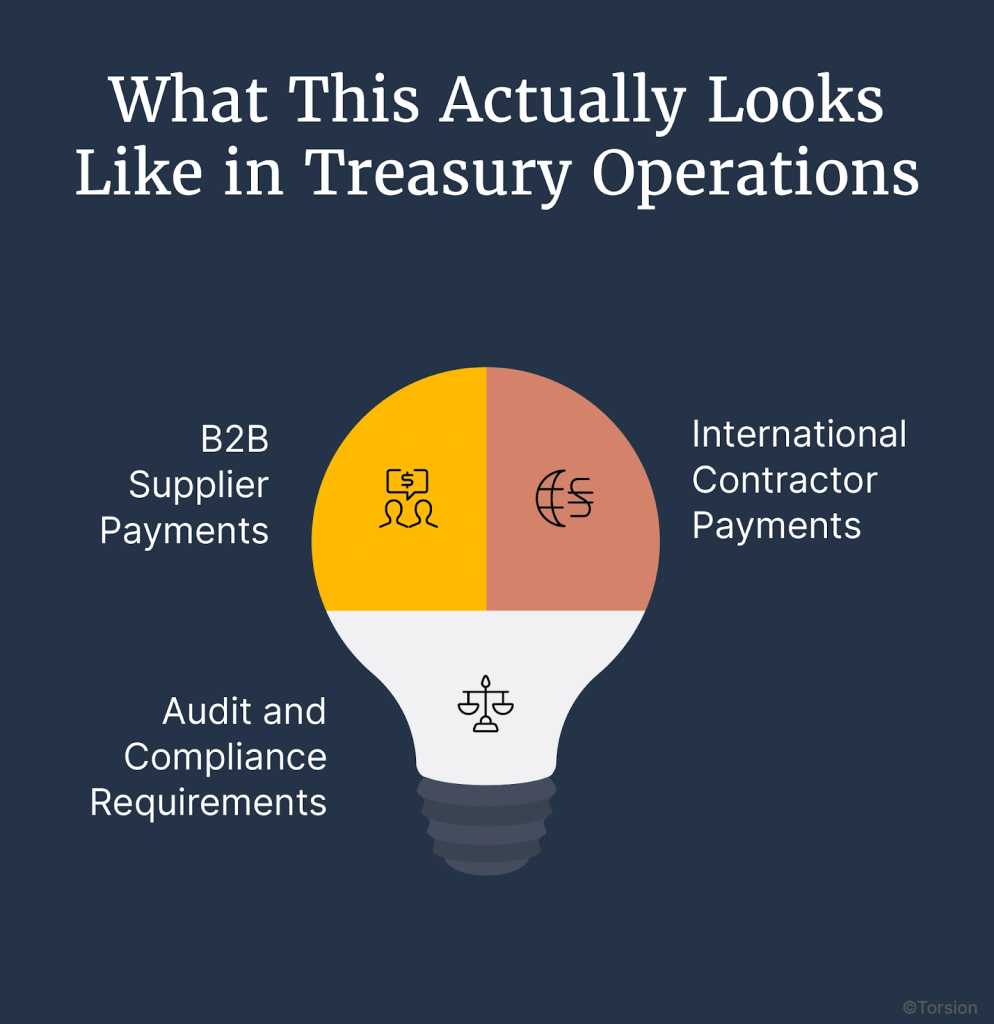
For B2B Supplier Payments
Current state: Wire transfers cost $20-50 per transaction, take 3-5 days to settle, and create cash flow gaps in production schedules.
With enterprise stablecoin infrastructure:
- Payment costs drop to under $5
- Settlement happens in minutes, not days
- Manufacturers with $1M+ annual payment volume see immediate impact on working capital
Implementation detail: Torsion’s REST API connects to existing ERP systems (NetSuite, SAP, QuickBooks, Xero), so treasury teams continue using familiar workflows. The infrastructure handles blockchain operations invisibly.
For International Contractor Payments
Current state: Remote-first companies paying contractors across 10+ countries face wire fees, exchange rate spreads, and manual tax documentation.
With enterprise infrastructure:
- Automated tax reporting and 1099 generation
- Instant settlement across borders
- 50%+ cost reduction on international payments
Critical security component: Multi-signature approval workflows prevent unauthorized payments. A finance coordinator can’t send $500,000 to a compromised contractor account without CFO authorization.
For Audit and Compliance Requirements
What auditors need from you:
- Transaction IDs (blockchain proof of payment)
- Reserve audit reports (monthly attestations from Circle/Tether)
- Custody confirmation from regulated custodians
- KYC documentation for all counterparties
What Torsion provides automatically: All of the above, formatted for enterprise accounting systems, with full audit trails and immutable blockchain records. Stablecoin payments are treated as cash equivalents on your balance sheet, with tax treatment identical to foreign currency transactions.
Consumer wallet capability: None of this exists. You’d manually reconstruct transaction histories from blockchain explorers and hope your auditor accepts it.
Side-by-Side: Why Infrastructure Type Matters
| Security Feature | Consumer Wallet | Enterprise Infrastructure (Torsion) |
| Access Control | Single signature | Multi-signature (2-of-3, 3-of-5) |
| Key Management | User holds private key | MPC + HSM + institutional custody |
| Recovery Mechanism | None, loss is permanent | Institutional backup + insurance up to $1B |
| Compliance | Manual/user responsibility | Built-in AML/KYC/Travel Rule |
| Audit Trail | Limited on-chain data | Immutable blockchain + formatted reports |
| Approval Workflow | None | Role-based, multi-layer |
| SOC 2 Certification | No | Required |
| ERP Integration | Manual processes | REST API, webhooks |
| Accounting Treatment | Manual reconciliation | Auto-reconciliation with existing systems |
| Implementation Time | Immediate but uncontrolled | 2-4 weeks with full compliance |
The pattern: Consumer wallets optimize for individual speed and autonomy. Enterprise infrastructure optimizes for security, compliance, and auditability at scale.
You cannot retrofit the latter onto the former. The architectural differences are fundamental.
The Regulatory Framework That Changed Everything
The GENIUS Act, signed into law in July 2025, established federal oversight for stablecoin issuers. This matters because it eliminates the regulatory ambiguity that previously made CFOs hesitant.
What the law requires:
- Federal licensing for stablecoin issuers
- 1:1 reserve backing requirement
- Monthly third-party audits mandatory
- Bank Secrecy Act compliance
- Federal Reserve oversight
Translation for CFOs: Stablecoins are now federally regulated payment instruments, not “crypto experiments.” They carry clear accounting treatment, audit standards, and regulatory status equivalent to other payment rails.
Why this matters now: The “wait and see” excuse expired in July 2025. Companies implementing stablecoin payments today are operating under a clear federal framework, not pioneering regulatory gray areas.
What Happens When Organizations Get This Wrong
The Bybit breach ($1.46 billion) and WazirX hack ($230 million) represent worst-case outcomes. But the more common failure mode is subtler:
Scenario: Mid-sized manufacturing company implements consumer wallet for treasury operations
- Finance team downloads MetaMask to “test” stablecoin payments for international suppliers
- Treasury manager holds private key on laptop for $5M operational account
- Phishing email compromises laptop credentials
- Attacker drains account, $5M transferred to unrecoverable wallet addresses
- No insurance, no custody backup, no recovery mechanism
- Company files police report that goes nowhere
- CFO explains to board how $5M disappeared with no recovery path
- Career-ending outcome
This isn’t hypothetical. 23.35% of crypto ecosystem theft in 2025 came from consumer wallet compromises. These architectures were never designed for corporate treasury operations.
The cost of avoiding this risk: 2-4 weeks to implement enterprise infrastructure properly.
The cost of not avoiding it: Everything.
How Torsion Bridges Strategy and Execution
Most CFOs understand the business case for stablecoin payments: 50%+ cost reduction, instant settlement, market access expansion. What they don’t have is execution capability.
Internal teams lack crypto infrastructure expertise. Consumer solutions create catastrophic security exposure. Building in-house takes 12-18 months and $5M+.
Torsion’s approach eliminates this gap:
Technical Integration → REST API connects to existing payment systems, ERP platforms (NetSuite, SAP, QuickBooks, Xero), and treasury infrastructure. Implementation takes 2-4 weeks.
Regulatory Compliance → AML/KYC through Chainalysis and TRM Labs, SOC 2 Type II certified infrastructure, transaction monitoring, and GENIUS Act compliance built in.
Accounting Treatment → Stablecoin payments treated as cash equivalents, with auto-reconciliation, full audit trails, and monthly reports for accounting teams. Tax treatment handled identically to foreign currency transactions.
What auditors need → Transaction IDs, reserve audit reports, custody confirmation, and KYC documentation, all automatically generated.
The core value proposition: Your treasury team never touches crypto infrastructure directly. You’re not managing wallets, you’re using an enterprise payment rail with blockchain settlement.
This mirrors Torsion’s broader approach to technology adoption: bridging the gap between strategic vision and operational reality. Just as Torsion helps organizations move from AI strategy to AI execution, the same methodology applies to payment infrastructure modernization, implementing proven technology without organizational disruption or security compromise.
The Implementation Reality Check
Finance leaders ask three questions:
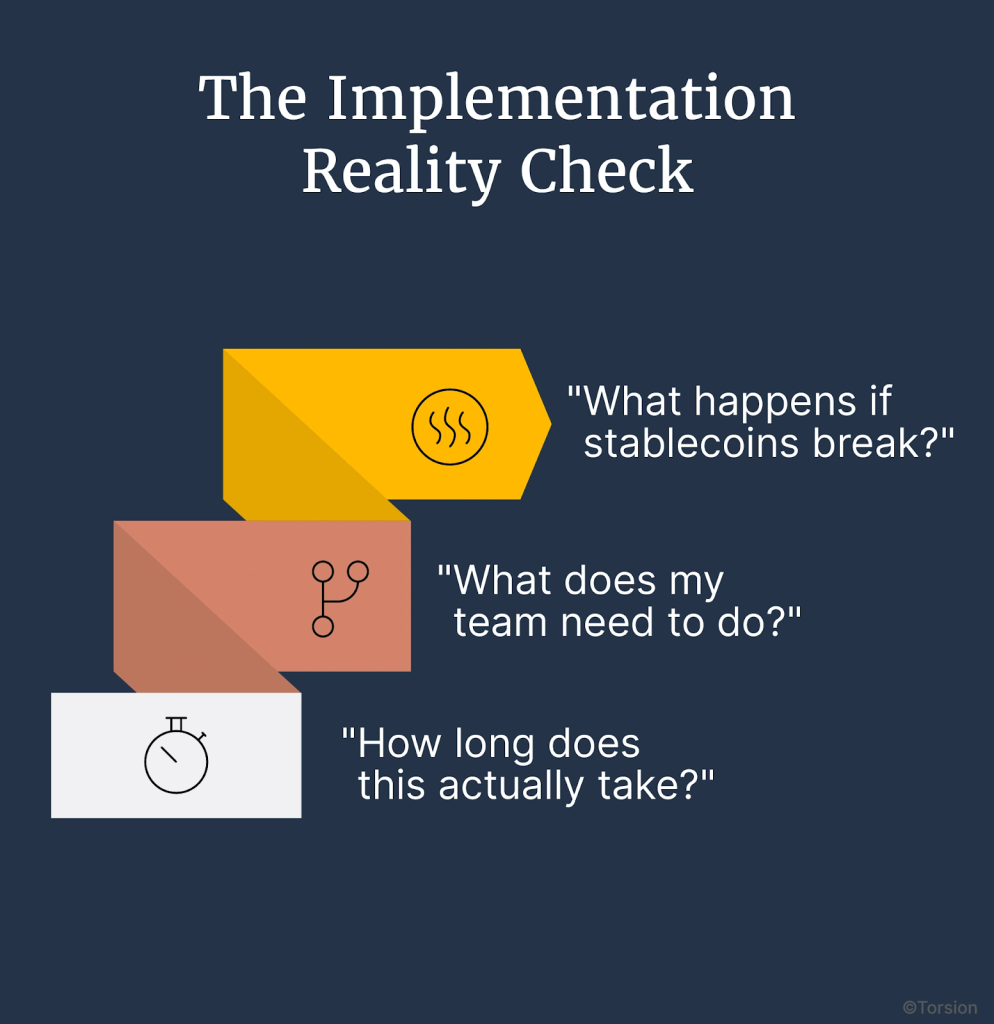
1. “How long does this actually take?”
Most integrations: 2-4 weeks. This includes:
- Technical integration with existing ERP systems
- Multi-signature approval workflow configuration
- Compliance infrastructure setup
- Accounting team training on reporting formats
2. “What does my team need to do?”
For CTOs: Provide API access to existing payment systems. Torsion handles the blockchain infrastructure.
For CFOs: Review approval workflows and accounting treatment documentation. The infrastructure handles reconciliation automatically.
For Compliance: Standard business KYC (identical to opening a bank account). Transaction monitoring and quarterly reports are auto-generated.
3. “What happens if stablecoins break?”
Major stablecoins (USDC/USDT) haven’t de-pegged in three years. Reserve audits happen monthly. Your funds settle same-day, no long-term exposure to reserve risk.
If a stablecoin issuer failed (unprecedented for major issuers), your exposure is limited to same-day payment volume, not treasury reserves. Consumer wallets offer no such protection.
The Decision Point
The question isn’t whether stablecoins belong in corporate treasury operations. Stablecoins already processed $14 trillion in 2024, surpassing Visa.
The question is whether your security infrastructure matches your fiduciary responsibility.
Consumer-grade wallets optimize for individual autonomy at the expense of enterprise controls. They structurally cannot provide multi-signature workflows, institutional custody, automated compliance, or audit-ready reporting.
Enterprise infrastructure like Torsion provides these capabilities by design, not as add-ons, but as architectural foundations.
The gap between these approaches is the difference between:
- 50%+ cost reduction with audit-ready compliance, or
- Career-ending security breaches with no recovery path
39% of CFOs at $10 billion+ companies are implementing stablecoin capabilities within two years. The GENIUS Act passed in July 2025, establishing clear regulatory frameworks. The “wait and see” window has closed.
What remains is execution: choosing infrastructure built for enterprise requirements, not retrofitting consumer tools for treasury operations.
Next Steps for Finance Leaders
If your organization is evaluating stablecoin infrastructure:
Start with use case clarity: Where are wire transfer costs, settlement delays, or payment processor limitations creating measurable business impact?
Evaluate infrastructure requirements: Multi-signature workflows, institutional custody, SOC 2 certification, ERP integration, and audit-ready reporting should be table stakes, not aspirational features.
Understand implementation timelines: Enterprise infrastructure takes 2-4 weeks to implement properly. Consumer wallets can be set up in minutes, but create exposure that can destroy your career in seconds.
Torsion handles the technical integration, regulatory compliance, and accounting treatment so your treasury team never touches crypto infrastructure directly. The goal isn’t to make your organization a blockchain expert, it’s to give you access to more efficient payment rails without organizational disruption or security compromise.
The payments infrastructure of 2025 looks fundamentally different than 2020. The question is whether your treasury operations reflect that reality.
Ready to explore enterprise stablecoin infrastructure? Torsion provides audit-ready implementation with the security, compliance, and integration CFOs require.